








 By Marc C. Johnson
I came of age in a different political time.
Hell, it was a different political universe.
As a press secretary to a Democratic governor in a very conservative state – years ago now – a significant part of my time was devoted to getting the boss on a local radio station, arranging a visit with a rural community newspaper and fielding, as fast as I could, daily questions from the Associated Press and daily newspapers and television stations from reporters who were assigned to cover state government. There was the occasional call from a national paper or network. Those calls got less attention.
The point of my task was to be as aggressive and consistent as possible in communicating and facilitating access to a wide array of journalists, editors, editorial writers, TV reporters and radio talk show hosts.
The mantra was “no call goes unanswered.”
We tried really hard to show up and engage even when the questions were hostile or uninformed or just silly. It went with the job.
Today it seems many statewide elected officials across the country make it policy to avoid such coverage or concentrate what effort they give to communication on outlets they know will be favorable. Or the politican takes to Facebook or X or Instagram to post a pithy, partisan, usually self servicing and often misleading messages.
Real issues count for little. It’s the “image” and “engagement” that matter.
But a rare thing still happens in Oregon. Many of the state’s politicians continue to show up for public meetings with constituents where they answer real questions from real people.
What a concept.
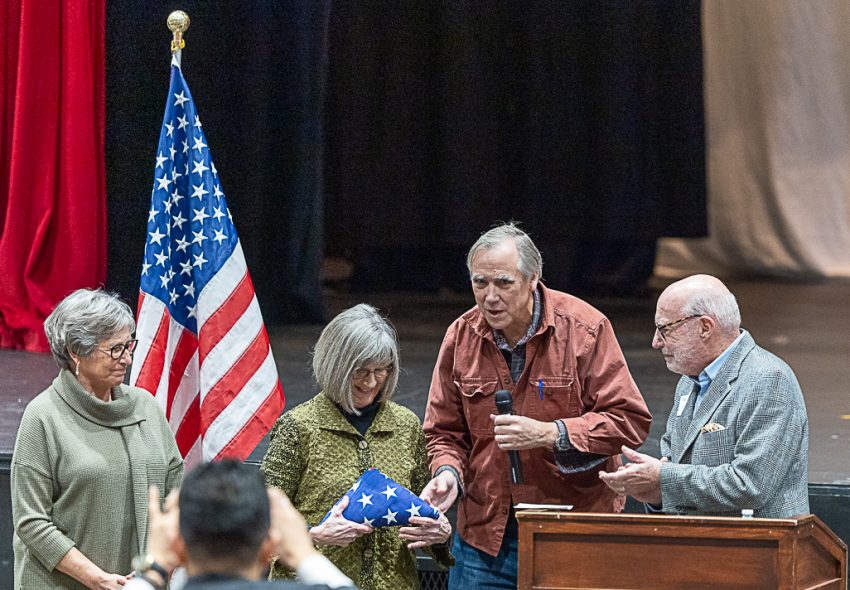
This is Oregon Democratic Senator Jeff Merkley on Saturday in a chilly high school auditorium in Tillamook, a town known for its cheese and a county known for supporting Donald Trump. The high school sports teams are The Cheesemakers. Top that …
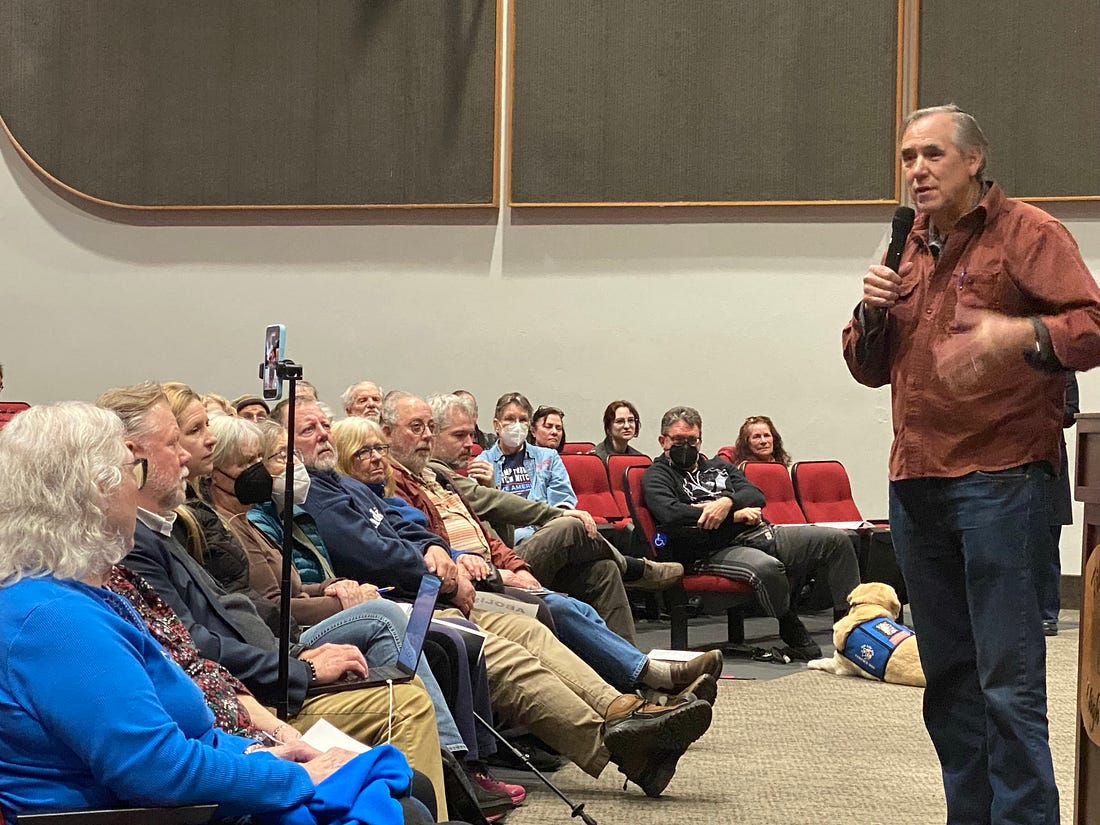 Oregon Senator Jeff Merkley
The Tillamook event, attended, I would estimate by a couple of hundred folks, was Merkley’s second town hall last Saturday. He started the day at 10:00 am 70 miles south in Newport and then held his third town hall of the day at 6:00 pm in Warrenton, an hour north in Clatsop County. It was a day long tour of the Oregon coast.
Merkley had three more public town hall events scheduled Sunday.
Merkley and Oregon’s other U.S. senator Ron Wyden do this town hall thing every year – each holds a public, everyone welcome town hall in every one of Oregon’s 36 counties every year. Almost no other U.S. senator – maybe Iowa’s Chuck Grassley – does this.
The event I attended Saturday was Merkley’s tenth town hall since the first of the year. Wyden has held more than 1,100 such events during his time in the Senate, and he’ll be in Tillamook County this week.
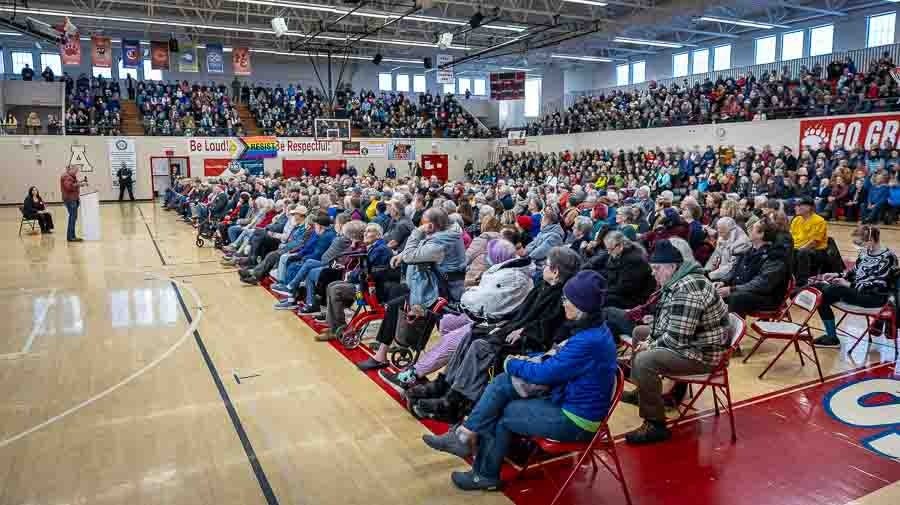 |
Senator Jeff Merkley’s recent town hall in Ashland, Oregon. The place was packed. (Photo by Bob Palermini/AshlandNews)
The format for these hour long events is straight forward. A brief introduction of the senator and questions from the audience. Everyone who hopes to ask a question gets a numbered ticket and tickets are drawn at random from a basket. The person with the drawn number gets to ask a question. Nothing pre-screened or scripted.
Saturday’s questions to Merkley ranged from Venezuela to the Epstein files, from the local World War II blimp hanger – a landmark recently damaged in windstorm – to Citizen’s United, the Supreme Court and the affordability of higher education. The mood was, I would say, one of anxiety, concern and anger about, among other things, our political division and a lawless administration in Washington.
The questions were respectful, but often pointed. There was little hint of partisanship, and at least once Merkley suggested he tries to keep the events on issues not ideology. He opened with a brief comment about respecting everyone’s opinion, even those you disagree with.
Merkley was pointed in his critique of our Trumpian world, as he was in southern Oregon earlier in the month, but his comments were based on facts and not just opinions.
He responded at some length to questions about the Epstein files and he knew the details of what is going on. He sponsored the bill in the Senate to force release of the Epstein material held by the Justice Department, and Wyden has led the charge to reveal what the Treasury Department knows about Epstein’s financial web.
Merkley’s comments were no rant, but a calm discussion of the fact that Congress, with overwhelming bipartisan support, passed legislation to require by a date certain release of the Justice Department files. That deadline was December 19 and the Trump Administration has yet to comply.
I think we know why. The crowd did, too.
Tillamook County narrowly voted for Donald Trump in 2024 – Trump winning just over 49% of the vote to Kamala Harris’ nearly 48%. The county might be the very definition of “purple” and “rural.”
Timber production, agriculture and fishing are big industries, as is tourism. The place puts the “blue collar” in blue collar.
Merkley is on the ballot this year, and in 2020 he won Tillamook County – barely – against a little known Republican. He carried Oregon with 57% of the vote in 2020 and is widely expected to win again in November.
But these town halls – and this may be the political idealist in me – are less about the next election than they are about simply showing up, even in places where Oregon Democrats regularly lose. (Merkley began his yearly town hall visits in early January in southern Oregon’s Douglas County, a place where he got trounced six years ago.)
Democrats in the main have lost the plot in rural America. Much of that is cultural and the image that the party has given itself over to coastal “elites.” If there is a path out of this swamp it’s not clear to me, but there is no path at all unless they show up, like these two senators from Oregon.
About Marc Johnson: I am a Nebraska native, grew up in South Dakota and migrated in Idaho after college to work in broadcast journalism. In 1986, I joined the “comeback” campaign of a legendary Idaho political figure – Cecil D. Andrus – who eventually served four terms as governor and four years as Secretary of the Interior, not bad for a Democrat in a very conservative state. I had a small role in helping Cece Andrus win his last two gubernatorial terms. I did communication and crisis consulting work, and since “retiring” have written three books on U.S. Senate history. I’m working on a new book on another legend – this one a legend in journalism.
I write this Substack to scratch my itch to connect history with current politics. I hope, in some small way, to contribute to understanding of this perilous moment for our democracy, for free speech and facts.
