Tillamook County Pioneer

News & People of Tillamook County. Every Day.

Menu
  • Home
  • Feature
    • Breaking News
    • Arts
    • Astrology
    • Business
    • Community
    • Employment
    • Event Stories
    • From the Pioneer
    • Government
    • Letters to the Editor
    • Non Profit News
    • Obituary
    • Public Safety
    • Podcast Interview Articles
    • Pioneer Pulse Podcast: Politics, Palette, and Planet – the Playlist
  • Guest Column
    • Perspectives
    • Don Backman Photos
    • Ardent Gourmet
    • Kitchen Maven
    • I’ve been thinking
    • Jim Heffernan
    • The Littoral Life
    • Neal Lemery
    • View From Here
    • Virginia Carrell Prowell
    • Words of Wisdom
    • Chuck McLaughlin – 1928 to 2025
  • Weather
  • Post Submission
  • Things to do
    • Calendar
    • Tillamook County Parks
    • Tillamook County Hikes
    • Whale Watching
    • Tillamook County Library
    • SOS Community Calendar
  • About
    • Contribute
    • Advertise
    • Subscribe
    • Opt-out preferences
  • Search...
Menu

NEWS UPDATE FROM STATE REPRESENTATIVE DAVID GOMBERG: Whither Go Our Roads??

Posted on January 27, 2026 by Editor

By Representative David Gomberg, House District 10

1/26/2026
Dear Friends and Neighbors,

Have you heard the joke that if you ask two lawyers a question, you will likely get three answers?

Here’s how that joke played out in Oregon this week.

As regular readers know, gas tax revenue is declining as people drive more fuel-efficient vehicles. And so, through much of 2025, your legislature struggled with how to pay the increasing cost of keeping our roads and highways safe. Eventually, a super-majority passed a greatly reduced plan to increase gas taxes by six cents, rather than 20, adjust some fees, simplify trucking regulations, charge electric vehicles that don’t use gas, and add a number of important accountability measures to our Department of Transportation (ODOT).

I pointed out that most drivers were looking at an increase of about $6 to $7 a month, which I felt was a fair price to pay for decent roads. But almost immediately, some Oregonians circulated petitions to refer the gas tax to the November 2026 election. Governor Kotek responded with a suggestion that rather than wait a year, the legislature repeal the whole thing when we return in February for the 2026 session.

But – it seems there is an obscure 1935 Oregon Attorney General opinion that the legislature cannot act on referrals until after an election. Our current 2026 Attorney General responded that the Constitution has changed in the last 90 years, and new court cases indicate that the legislaturem can probably act. The lawyer who works for the Legislature agreed last week. But on further review, Legislative Counsel told us that the legislature cannot intervene until an election has been held.

Two lawyers; three opinions.

So last week, legislative leadership – our House Speaker and Senate President – announced that instead of risking a messy court fight, they will instead propose that the election be moved from November to May.

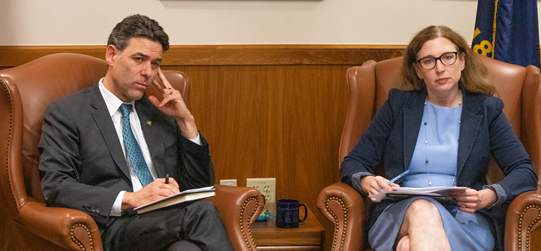
Senate President Rob Wagner of Lake Oswego and House Speaker Julie Fahey of Eugene speak with reporters.

Since this whole mess erupted, I’ve been saying that May is a good compromise. If voters want a say, then we should let them vote. But let’s not wait until November to settle this. Let’s vote in the regular May election and then get back to the business of how we find money to fill potholes, paint fog lines, respond to accidents, and fix landslides.

It is important to understand the difference between a repeal and a referral vote.

A repeal by the legislature would remove all of HB 3991 – known as the Special Session Transportation Package. That includes increases to the state’s gas tax, the state’s payroll tax, and most DMV fees, along with accountability measures for ODOT, reform of many trucking fees and regulations, and new charges for electric vehicles and vehicles that get more than 40 miles per gallon.

The referendum on the ballot only addresses the gas tax, the payroll tax, and the DMV fees. So with the election option, we will keep accountability, EV fees, and trucking reforms.

And with a May election, we will have a better understanding sooner of just how much money ODOT will have as we prepare to write their budget again in January 2027. This means more time to plan and more time to negotiate a long-term solution to our transportation funding woes.

The May “primary” election usually has lower participation than the November “general” election. That is a valid criticism. But getting this question resolved sooner rather than later matters. And interest in gas taxes may actually get more people to send ballots in!

For a good overview of this entire story, see this article in the Oregonian.

The final thing I want to say about this election is very important. My job is to help inform voters, but I do not, and should not, use my legislative office to try to influence voters. Nothing I’ve shared here is intended to endorse a yes or no vote.

Wither Go Our Roads?? My column title this week is a bit sardonic. Am I asking if our roads are going to decline? Or am I asking what direction will drive our way out of all this?

Those questions have been top of mind this week as I have been part of a small group of legislators asked to propose a number of large cuts to the ODOT budget that will offset the reduction in income. Whether we vote in May or November, the current 25-27 budget needs to be cut, and we may also need to buy a few months into the next two-year biennium.

Said another way, we need to find $242 million in reductions right now and another $55 million to stretch to the end of 2027.

Without more funding soon, the agency has warned it will have to cut back on road maintenance, emergency response, and DMV services.

Remember that already in 2025, my committee cut $46 million and around 120 jobs. Now we are being faced with choices I call really bad, worse, and really worse.

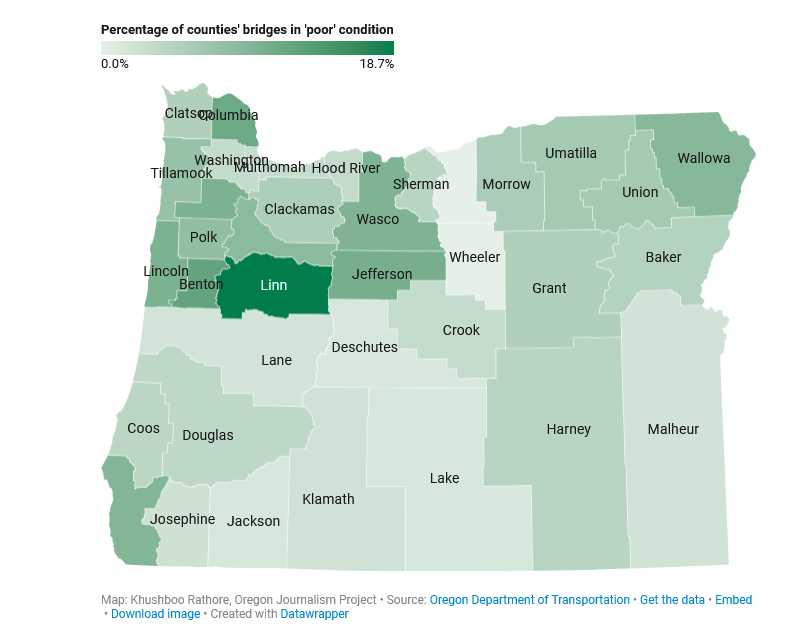
Do we delay work on big bridges on I-5 or along the coast? Deterioration will continue, and costs will only go up. Ten percent of Lincoln County bridges are ranked in “poor” condition. But delaying all this work gets us maybe a third of the money needed.

This interactive map shows the number of “fair” bridges in each county.

Alongside redirecting money from our bridges and capital projects, other larger pots of money in ODOT programs will need to be considered to successfully rebalance the budget.

Since the 2025 legislative session, I’ve received hundreds of suggestions in my inbox that cuts to programs at ODOT are preferable to any increases in taxes or fees. Now that a rebalance plan is inevitable, it’s important to understand the gravity of what is at stake.

Safe Routes to Schools and Connect Oregon are good examples. These programs are popular, and they give a good illustration of the hard choices ahead.

Safe Routes provides grants for sidewalks, bike lanes and crosswalks near schools. About $42 million in anticipated revenues through 2029 have not yet been allocated.

Connect Oregon provides grants for our ports, rail lines, and bridges that support economic development. About $96 million has not yet been allocated.

Take unallocated funds from both, and we find about $138 million. That’s a large sum of money that would help us rebalance the budget, but these are important programs with many supporters, and we would need to weigh the impacts of temporarily defunding these programs that many communities expect and count on.

An area I have advocated for cuts is contained in the Transportation Operating Fund, which will mean less funding for Community Charging grants, Innovative Mobility Grants (transit micro-grants), and Amtrak Cascades Passenger Rail Services. That total is about $40 million.

Taken together, these programs are examples that get us to $178 million, which means we’ll still need to look at deeper cuts at the agency or redirecting funds for large projects currently underway. Reducing administrative positions, ending out-of-state travel, and leaving hundreds of currently vacant positions open may get us there. But Oregonians will notice the difference in service at the DMV, during our icy winters, and in rural areas where long stretches of highway may lack needed maintenance. And of course, redirecting funds from existing projects will mean very costly delays in their completion.

It’s important to consider that, as we work our way to a rebalance plan that gets us to the $297 million target, this simply isn’t a sustainable long-term fix – but it is a necessary next step.

This rebalance would get us through the next two years, but with shrinking gas tax revenues and increasing costs for materials and labor, we will need to cut further and further each biennium to meet our constitutional obligation to balance the budget. Without a discussion on new revenues on the table in 2027, our transportation networks will be in very big trouble.

Transportation leaders estimate they would cut more than 1,000 jobs, including 570 vacant roles and 470 current employees, without further funding. Rebalancing the ODOT budget this February is an unavoidable reality and will mean hard choices to stave off even worse outcomes for Oregonians by doing nothing.

While these programs and cut scenarios I’ve presented are just examples, they reflect the kind of work I’m doing right now ahead of the 2026 legislative session. Nothing has been decided yet, and I’ll be sure to keep readers in the loop on decisions that are made as I prepare to reconvene with my colleagues in Salem next week.

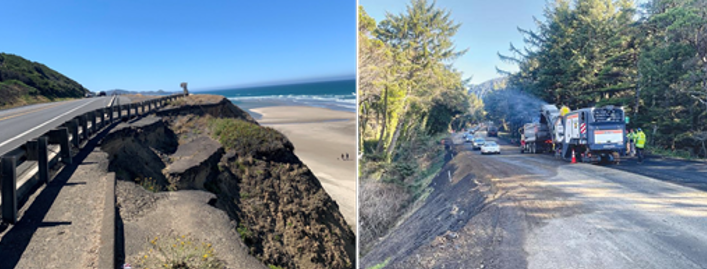
For years, the Oregon Department of Transportation has been battling ongoing road issues along Highway 101 in the Beverly Beach area north of Newport.

Let’s look a little deeper.

Right now, ODOT says about 87% of its 18,000 miles of pavement meet the standard of “fair or better” condition.

However, agency engineers told legislators Wednesday that pavement conditions have been steadily declining since 2018, as paving costs rise and available funding drops. This decline continues as the costs increase and available funds decline. Deferring routine maintenance, such as paving, crack sealing, and striping, accelerates deterioration, turning manageable repairs into costly reconstruction projects. Starting next year, ODOT will only be able to afford to pave our interstates.

ODOT told us that declining pavement conditions mean that there are more potholes and ruts on our roads, and fading striping and other pavement markings. This makes the roads less safe for all travelers.

While less than 1% of interstate bridges statewide are in poor condition, conditions vary by roadway. Along U.S. Highway 101, ODOT estimates about 16% of bridges are already rated poor and require ongoing maintenance to avoid closures or restrictions. And as I said earlier, ten percent of Lincoln County bridges are ranked as “poor”.

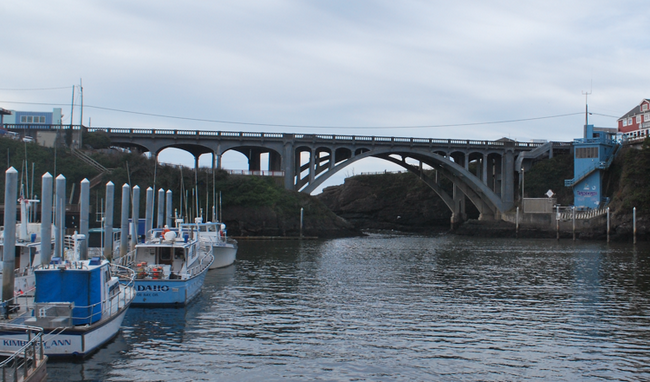
A $10,978,943​ preservation and improvement project is underway at the Depoe Bay Bridge along Highway 101.

ODOT completed the $30 million Yaquina Bay Bridge restoration project in 2023 — $2 million under budget and about six months ahead of schedule. The extensive restoration effort to sustain the bridge’s structural integrity and extend its lifespan was launched in the spring of 2020. A $10,978,943​ preservation and improvement project is underway at the Depoe Bay Bridge along Highway 101.

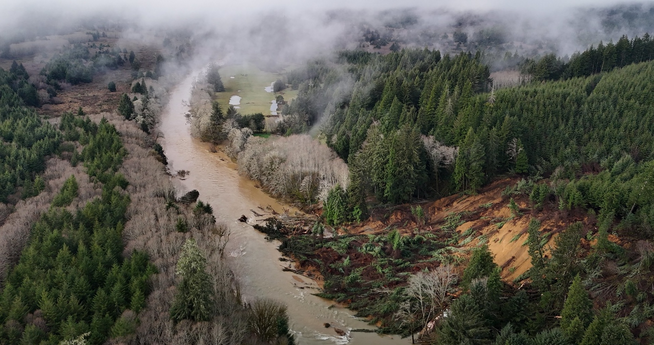
Meanwhile, Highway 229 is closed indefinitely by a massive slide, 101 at Cascade Head is restricted to one lane, Beverly Beach is scary at speeds over 40, Highway 18 gets treacherously bumpy at milepost 13, and seemingly every crosswalk is required to be updated as a result of an accessibility lawsuit.

A massive landslide has closed Highway 229 and cut Siletz off from Lincoln City. It may take years to clear.

ODOT officials told lawmakers they will wait until after the session concludes to finalize service reductions, project delays or layoffs, but warned that without action, Oregon’s roads and bridges will continue to decline, becoming more expensive and disruptive to fix over time.
Any discussion of new revenue is on hold until after the referendum is voted on. Meanwhile I’m continuing to work on the least impactful of difficult cuts to current programs. I’m talking frequently with colleagues in the other party. And Thursday evening I had dinner with members of the Transportation Commission.

I want to conclude this report with excerpts from a guest opinion in the Bend Bulletin written by one of those Commissioners.

As December wind and rain storms pummeled Oregon, ODOT maintenance crews worked tirelessly to tackle landslides, flooding, and hundreds of downed trees to keep us safe and moving on our state highways.

But as we enter the middle of winter, when prompt snow and ice removal can be the difference between life and death, the funding we need to maintain our state highways is in jeopardy. The No Tax Oregon referendum has frozen new taxes and fees needed for personnel and equipment to maintain our roads and, ultimately, seeks to repeal the legislation providing this new revenue during the 2026 elections.

Why is state highway maintenance so underfunded right now? When the Oregon Legislature passed our last major state transportation package in 2017, our state senators and representatives didn’t plan for basic maintenance funding to keep up with COVID-era inflation. So ODOT hasn’t had sufficient maintenance funding for 3 years and has had to seek emergency allocations from the Legislature and hold many maintenance positions vacant to stay within budget.

How can ODOT maintenance be so underfunded while ODOT spends hundreds of millions of dollars per year on new capital construction projects? The same 2017 transportation package that didn’t plan for long term inflation for maintenance costs also directed ODOT to construct many major intersection and bridge upgrades and highway lane additions. Much of the revenue coming from new 2017 gas taxes and title and registration fees were allocated to those new capital projects. House Bill 2017 restricts ODOT from reallocating funds for these new capital projects to basic maintenance.

In September House Bill 3991 passed with a 3/5 majority. It included a 6 cent per gallon gas tax increase, title and registration fee increases, and a new Road Use Charge for electric and hybrid vehicles. This new revenue was to be dedicated to basic road operations and maintenance.

But Oregonians were frustrated with ODOT and don’t like new taxes when they feel the government isn’t using their money well. No Tax Oregon gathered over 200,000 signatures for a referendum to repeal House Bill 3991. Collection of the new taxes and fees was frozen just as ODOT started to fill vacant maintenance positions. Without that new revenue, ODOT now needs to plan to cut these and more positions needed to keep Oregonians safe and moving.

Oregonians should be concerned about cost overruns for major new HB 2017 capital construction projects, but that is another story. Frustration about new capital construction projects is not a reason to punish ODOT maintenance crews. Complaints about the efficiency and effectiveness of ODOT are rarely directed at ODOT maintenance crews. Instead, I mostly hear appreciation for the ODOT employees who clear crashes and downed trees, keep highways clear of snow, maintain bridges and culverts to fix flooding and patch cracks to prevent more costly fixes later.

If Oregonians want ODOT maintenance crews to keep our state highways safe and open, we need to identify additional funding for basic maintenance to prevent mass layoffs.

And that, my friends, is probably more than you wanted to know about our roads. I’m sure I lost some of you along the way. And I’m sure others read with furrowed brows.

Session begins in a week. I’m hopeful that working together – Senators and Representatives, Democrats and Republicans – with focus, high intent, and a sense of common purpose, we can address these challenges.

email: Rep.DavidGomberg@oregonlegislature.gov

phone: 503-986-1410

address: 900 Court St NE, H-480, Salem, OR, 97301

website: http://www.oregonlegislature.gov/gomberg

Slide Slide Slide Slide Slide Slide Slide Slide Subscribe Contribute

Ads

Featured Video

Tillamook Weather

Tides

Tillamook Church Search

Cloverdale Baptist Church
Nestucca Valley Presbyterian
Tillamook Ecumenical Service

Tillamook County Pioneer Podcast Series

Archives

  • Home
  • EULA Privacy Policy
  • Contact
  • Opt-out preferences
  • Search...
Share on facebook
Facebook
Share on pinterest
Pinterest
Share on twitter
Twitter
Share on linkedin
Linkedin
Catherine

Recent Posts

  • Help Feed Kids This Summer: Schools and Community Organizations Needed to Offer Meals Through Summer Food Service Program

    January 27, 2026
  • WEST COAST HEALTH ALLIANCE: ‘Broad consensus’ on safety, benefits of American Academy of Pediatricians-recommended immunizations 

    January 27, 2026
  • NEWS UPDATE FROM STATE REPRESENTATIVE DAVID GOMBERG: Whither Go Our Roads??

    January 27, 2026
©2026 Tillamook County Pioneer | Theme by SuperbThemes

Manage Cookie Consent
To provide the best experiences, we use technologies like cookies to store and/or access device information. Consenting to these technologies will allow us to process data such as browsing behavior or unique IDs on this site. Not consenting or withdrawing consent, may adversely affect certain features and functions.
Functional Always active
The technical storage or access is strictly necessary for the legitimate purpose of enabling the use of a specific service explicitly requested by the subscriber or user, or for the sole purpose of carrying out the transmission of a communication over an electronic communications network.
Preferences
The technical storage or access is necessary for the legitimate purpose of storing preferences that are not requested by the subscriber or user.
Statistics
The technical storage or access that is used exclusively for statistical purposes. The technical storage or access that is used exclusively for anonymous statistical purposes. Without a subpoena, voluntary compliance on the part of your Internet Service Provider, or additional records from a third party, information stored or retrieved for this purpose alone cannot usually be used to identify you.
Marketing
The technical storage or access is required to create user profiles to send advertising, or to track the user on a website or across several websites for similar marketing purposes.
  • Manage options
  • Manage services
  • Manage {vendor_count} vendors
  • Read more about these purposes
View preferences
  • {title}
  • {title}
  • {title}