











 By Neal Lemery
Recent political commentary mentions the use of the 25th Amendment to the US Constitution, raising the specter of removing the president from power for reasons of incapacity or disability. What is the 25th Amendment?
The Twenty-fifth Amendment (Amendment XXV) to the Constitution addresses issues related to presidential succession and disability. It clarifies that the vice president becomes president if the president dies, resigns, or is removed from office by impeachment. It also establishes the procedure for filling a vacancy in the office of the vice president.
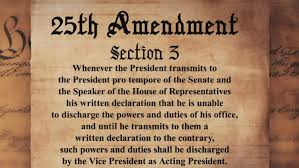
The amendment provides for the temporary transfer of the president’s powers and duties to the vice president, either on the president’s initiative alone or on the initiative of the vice president, together with a majority of the president’s cabinet. In either case, the vice president becomes the acting president until the president’s powers and duties are restored.
In the original Constitution, adopted in 1789, Article II, Section 1, Clause 6 reads: “In Case of the Removal of the President from Office, or of his Death, Resignation, or Inability to discharge the Powers and Duties of the said Office, the Same shall devolve on the Vice President…”.
This provision is ambiguous as to whether, under the enumerated circumstances, the vice president becomes president (that is, the “Office… shall devolve on” the vice president) or merely assumes the “powers and duties” of the presidency (that is, the “Powers and Duties… shall devolve upon” the vice president.) It also fails to define inability or to say how questions about inability are to be resolved. The 25th Amendment addresses these deficiencies. The ambiguities in this original clause of the Constitution regarding death, resignation, removal, or disability of the president created difficulties several times.
The 25th Amendment was approved by Congress in 1965 and the states in 1967, after the assassination of President Kennedy. It has been invoked six times in total, primarily under Section 3 for temporary transfers of power during presidential surgeries (Reagan in 1985, G.W. Bush in 2002 and 2007) and under Section 2 to fill Vice Presidential vacancies (Agnew/Ford in 1973, Ford/Rockefeller in 1974).
Section 4, removing a president against their will, has never been used.
The Vice President and a majority of the Cabinet (or another body Congress designates) can invoke the 25th Amendment, Section 4, by sending a written declaration to Congress that the President is unable to perform their duties, making the Vice President the acting President immediately, though Congress can ultimately decide if the President contests the removal.
If the president subsequently issues a declaration claiming to be able, then a four-day period begins during which the vice president remains acting president. If, by the end of this period, the vice president and a majority of the “principal officers” have not issued a second declaration of the president’s inability, the president resumes his powers and duties; but if they do issue a second declaration within the four days, then the vice president remains acting president while Congress considers the matter. Then, if within 21 days the Senate and the House determine, each by a two-thirds vote, that the president is unable, the vice president continues as acting president; otherwise the president resumes his powers and duties.
The framers of the original Constitution and the drafters of the 25th Amendment deliberately did not precisely define “inability” or “unable to discharge the duties of his office”, wanting to build in generality and vagueness to encompass a broad range of fact patterns and conditions. This allows Congress to be the ultimate decision-maker in a particular situation.
2/2/2026
