











“I think ultimately, us being mortal, the faith will win out in the end. But I certainly hope when I get to heaven, Jesus has a sense of humor.” – Stephen Colbert
By Marc C. Johnson
By now you must have heard or read about the latest squabble between CBS – once known, because of its class and quality, as “the Tiffany Network” – and it’s soon to be out of work late night host Stephen Colbert.
Quick recap: On Monday Colbert booked on his show Texas state representative James Talarico, one of the Democrats running in this year’s U.S. Senate race in Texas.
CBS lawyers, apparently, warned Colbert that by interviewing Talarico he was risking running afoul of the current chairman of the Federal Communications Commission, Brendan Carr, who has been dropping hints about enforcing the mostly dormant “equal time” rule against network talk shows. ¹
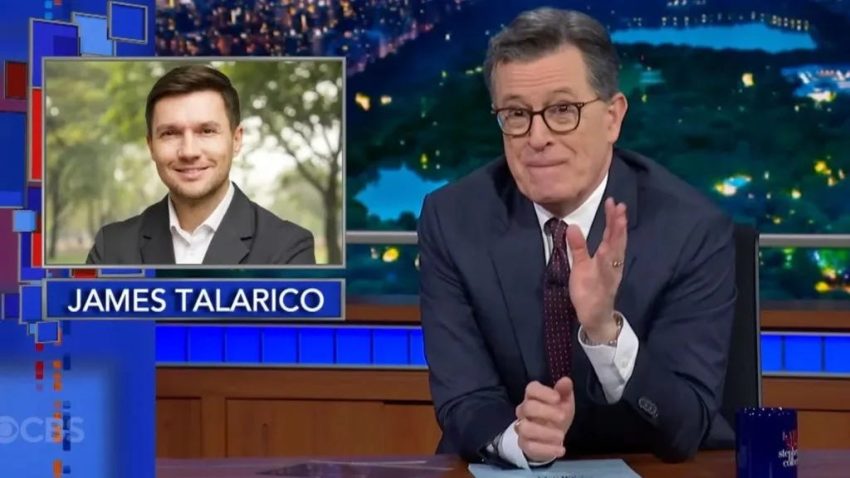
Stephen Colbert jokingly put up a picture of someone who is not James Talarico in order to not run afoul of CBS lawyers who must have been sweating out his show in a walnut paneled conference room somewhere
Colbert then interviewed Talarico and featured the interview on The Late Show’s YouTube page, but not before blasting CBS brass for giving in to the threatening hints from Carr. The YouTube appearance subsequently garnered more than six million views and helped Talarico raise a bundle of cash for his campaign.
[Both Colbert and Talarico described what happened as an assault on free speech, and in Colbert’s case another example of CBS obeying in advance the vastly improper and vastly political actions of the head of the FCC.]The dispute accelerated Tuesday when CBS took issue with Colbert’s account. And remember that the talk show host was essentially fired last year while CBS was in the process of being acquired by the Donald Trump-aligned owner of Paramount, David Ellison, whose father is the uber-billionaire Larry Ellison, also a Trump buddy. CBS called cancellation of Colbert’s show a purely business decision, but that simply hasn’t passed a smell test.
After Paramount purchased CBS, Ellison also started remaking the news division to, one assumes, humor Trump. Conservative commentator Bari Weiss was hired, with no experience in broadcasting, to oversee CBS News.
The whole Colbert/Talarico/CBS business, of course, birthed a thousand conspiracy theories. Conservative media, at least most of it, dismissed Colbert’s version of the story, as did the FCC chairman who criticized Colbert, and the world returned to news that Trump is on the verge of attacking Iran.
Now that my “quick recap” runs to six paragraphs I really want to focus on another aspect of the Colbert story that has received little, if any, attention.
Stephen Colbert and James Talarico spent most of their interview talking about religion and what it means to be a Christian.
It’s difficult to be an optimist in today’s world and I’m not all that optimistic, but I do focus on realism and try to populate my writing with solid sourcing and not merely opinion. I write these pieces to offer a perspective based on history and particularly American political history since 1900.
Something very different in Texas
I have no idea if James Talarico will win the March 3 Democratic primary in Texas or if he does whether he can win in a state that is so reliably Republican it hasn’t elected a Democratic U.S. Senator since 1988.
What I do know is that Talarico is a genuinely interesting young guy, with two Masters degrees – one in theology, another in education. He’s not accepting corporate political action committee money for his campaign, favors term limits, enforceable ethics rules for the Supreme Court and has pointed – very pointed – views about the dangers of Christian nationalism.
Adam Wren, a writer for Politico, profiled Talarico in 2023 around the time he gave a speech in the Texas House of Representatives opposing legislation mandating the display of the Ten Commandments in every Texas classroom.
He looked squarely at the bill’s sponsor, state Rep. Candy Noble, whom he acknowledged as a fellow “devout Christian,” before letting loose a two-minute and nine-second exchange that would go viral on TikTok and Twitter, racking up more than 1 million views on Twitter alone.
“This bill to me is not only unconstitutional, it’s not only un-American, I think it is also deeply un-Christian,” he told her, as she stood motionless. “And I say that because I believe this bill is idolatrous. I believe it is exclusionary. And I believe that it is arrogant, and those three things, in my reading of the Gospel, are diametrically opposed to the teachings of Jesus.” He cited Matthew 6:5, in which Jesus urges his disciples to not pray publicly like the hypocrites.
A profile in The Guardian last year noted the ease with which Talarico speaks of his own faith and the skill with which he skewers the Christian right’s lust for political power:
Talarico defines the effort to wed government with biblical ideology as Christian nationalism, “the worship of power – social power, economic power, political power, in the name of Christ”, as he put it in a 2023 guest sermon. Accusing adherents of turning Jesus “into a gun-toting, gay-bashing, science-denying, money-loving, fear-mongering fascist,” he declared it “incumbent on all Christians to confront it and denounce it”. Posted to YouTube, the sermon has since garnered 1m views.
A serious talk about religion on television
Obviously I don’t know for sure, but I suspect Colbert, at least in part, wanted to talk to Talarico because Colbert has never been bashful about discussing his own Catholic faith.
In fact after a preliminary discussion of the guest booking “guidance” of CBS lawyers and a bit of hyperbole by Talarico about Donald Trump wanting to silence him, Colbert said:
“The right attempts to co-opt Christianity saying, you know, you can’t believe in God … Donald Trump might have said something like that at the National Prayer Breakfast, like you can’t actually be a Christian and be a Democrat, but the religious right is largely a political movement that references spirituality, but it’s a political movement. What is your heartfelt hand out to the people who want to use religion as a tool of political power?
Talarico’s answer was unlike most anything you’ll see from most Democrats (with apologies to Georgia Senator and preacher Raphael Warnock) who can be uncomfortable talking about their own faith or who religion impacts politics.
In part Talarico said:
“I’ve said before don’t tell me what you believe show me how you treat other people and I’ll tell you what you believe. (applause) And I think in our faith we need to get back to those fundamentals.”
If you haven’t seen the interview join a few million fellow Americans who have.
My own struggle with religion and my Catholic faith continues, and surely always will.
In our extremely difficult times I keep coming back to the belief that we would all wise to adopt, or readopt, an essential element of America’s political foundation – the Founder’s belief in a separation of church and state, a real separation.
“Render unto Caesar the things that are Caesar’s, and unto God the things that are God’s,” as Jesus reminds us.
At the same time, at least in my view, Christians are called, as a test of fundamental character for us as individuals as well as for our leaders, to not merely say what we believe but show what we believe.
And how we treat other people, particularly the most fragile, most vulnerable and most oppressed among us, is for each of us the ultimate test of Christian character.
Thanks for reading. All the best.
1
The old equal time rule was intended to make sure that over the air broadcasters treated political candidates more or less the same when it comes to air time. TV talk shows and talk radio have long been exempt from the rule, but Carr, who is also “investigating” ABC’s show The View seems intent on changing that except he’s not interested in applying the rule to talk radio, which is, of course, the native home of many right leaning talkers. And that is, of course, the real concern about Carr’s approach here – that the “rule” will be applied unevenly and unfairly. The equal time rule explicitly does not apply to cable TV or streaming services that the FCC has no control over.
