Tillamook County Pioneer

News & People of Tillamook County. Every Day.

Menu
  • Home
  • Feature
    • Breaking News
    • Arts
    • Astrology
    • Business
    • Community
    • Employment
    • Event Stories
    • From the Pioneer
    • Government
    • Letters to the Editor
    • Non Profit News
    • Obituary
    • Public Safety
    • Podcast Interview Articles
    • Pioneer Pulse Podcast: Politics, Palette, and Planet – the Playlist
  • Guest Column
    • Perspectives
    • Don Backman Photos
    • Ardent Gourmet
    • Kitchen Maven
    • I’ve been thinking
    • Jim Heffernan
    • The Littoral Life
    • Neal Lemery
    • View From Here
    • Virginia Carrell Prowell
    • Words of Wisdom
    • Chuck McLaughlin – 1928 to 2025
  • Weather
  • Post Submission
  • Things to do
    • Calendar
    • Tillamook County Parks
    • Tillamook County Hikes
    • Whale Watching
    • Tillamook County Library
    • SOS Community Calendar
  • About
    • Contribute
    • Advertise
    • Subscribe
    • Opt-out preferences
  • Search...
Menu

NEWS UPDATE FROM STATE REPRESENTATIVE DAVID GOMBERG: Slushing Through the Third Week

Posted on February 24, 2026 by Editor

By Representative David Gomberg, House District 10

2/23/2026

Dear Friends and Neighbors,

Since he took office in January 2025, Attorney General Dan Rayfield has signed Oregon on to dozens of lawsuits against President Donald J. Trump’s administration. This week, the U.S. Supreme Court ruled in Oregon’s favor in one of the most closely watched and consequential of those cases.

On February 20, the court ruled against the president in Oregon v. Trump that alleged he’d exceeded his authority when he unilaterally imposed a wide-ranging series of tariffs — taxes on imported goods — on U.S. trading partners. The president acted alone, even though the U.S. Constitution specifically gives the power to tax and impose tariffs to Congress. The average U.S. tariff has gone from 2.5% when Trump returned to the White House in January to nearly 17% a year later, the highest since 1934, according to calculations by Yale University’s Budget Lab.

“Today’s ruling is a big win for Oregonians,” Rayfield said Friday at a virtual press conference. “The cost of these tariffs have impacted absolutely everyone in our communities. From the food that we buy to the clothes that we wear, to the lights that we turn on in our homes, everyone has been impacted.”

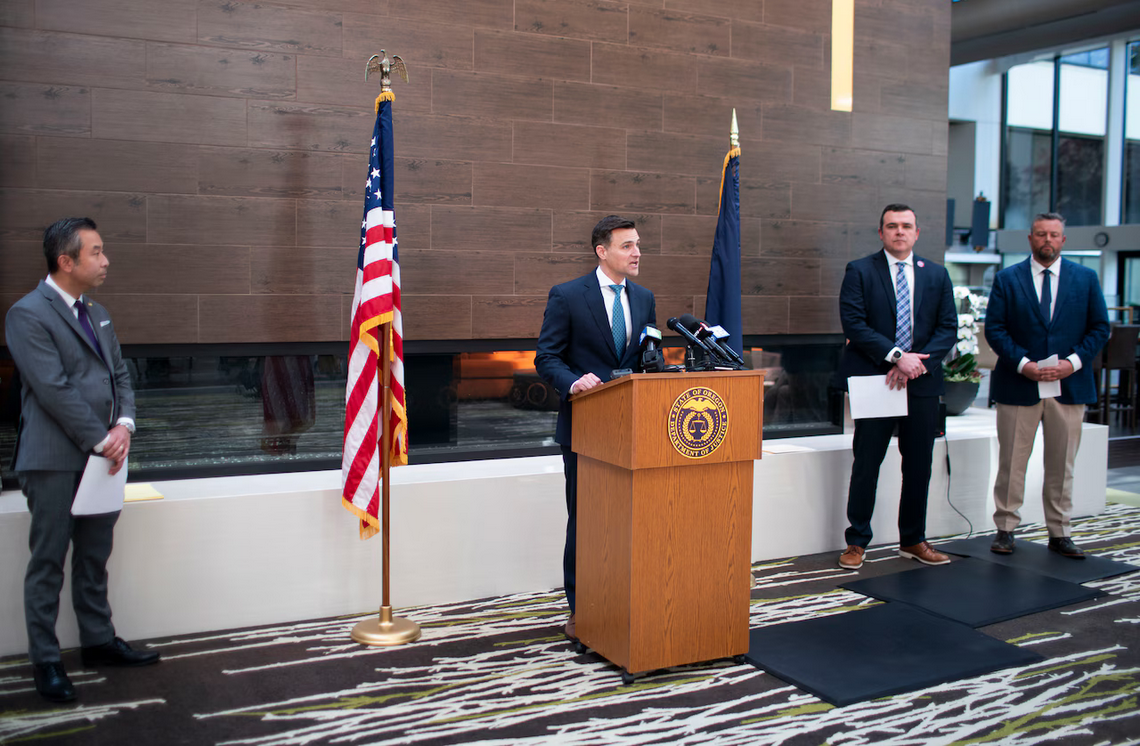
Oregon Attorney General Dan Rayfield, pictured, filed a federal lawsuit last April that sought to overturn President Donald Trump’s tariffs. Eleven other states joined in the lawsuit. The Supreme Court on Friday sided with Rayfield’s arguments. Oregonian photo.

President Trump has made tariffs a key part of his economic and foreign policy. He has said — erroneously, in the opinions of many leading economists — that by taxing imports, he would encourage the rebirth of American manufacturing and punish trading partners for undercutting U.S. goods. Trump also claimed that U.S. trading partners, such as China, would bear the cost of the tariffs.

Importers who bring in foreign products pay the Trump-imposed tariffs to the U.S. government, but exactly who absorbs the cost of those import taxes has been feverishly debated. The President claims exporters bear the cost, with the revenue flooding into the U.S. Treasury as almost free money. Many economists disagree with that explanation, saying the importers pass along the costs to Americans who are the end users of the imported goods. A research paper by the Federal Reserve Bank of New York released earlier this month found that U.S. consumers, rather than foreign trading partners, bore almost the entire brunt: “In sum, U.S. firms and consumers continue to bear the bulk of the economic burden of the high tariffs imposed in 2025,” the report said.

The Oregonian reported: “Efforts to claw back the estimated $133 billion to $175 billion of previously collected tariffs now deemed illegal are bound to be complicated and will likely favor larger companies with more resources. Consumers hoping for a refund are unlikely to be compensated.”

As a coastal state with large manufacturing and agricultural sectors, Oregon is “heavily dependent” on foreign trade, according to Business Oregon, the state’s economic development agency. That means the top court’s decision should benefit Oregon companies, along with Oregon consumers.

The results of the Court decision may be short-lived. President Donald Trump said Saturday that he wants a global tariff of 15%, up from 10% he had announced a day earlier after the U.S. Supreme Court struck down many of the far-reaching taxes on imports that he had imposed over the last year.

Read more here:

  • 7 key things to know about Trump’s tariffs after the Supreme Court decision. (OPB)
  • U.S. Supreme Court Sides With Oregon AG Dan Rayfield in Trump Tariff Case. (Willamette Week)
  • Oregon DOJ notches win in Trump tariff case; it may be short-lived. (Oregonian)
  • President tells the press the administration has ‘great alternatives’. (OPB)
  • Trump says he’ll raise tariffs to 15% after Supreme Court ruling. (OPB)
As we pass the halfway mark of this 35-day session, legislators are carefully determining which proposals have the necessary support to advance through both chambers. Numerous bills have already been debated, amended, advanced, or died in committee. Those that are moving were heard on the House and Senate floors this week.

I’ll spare you for now the drama and procedural machinations surrounding the more controversial measures dealing with the gas tax referral, firearms, or abortion. Instead, I wanted to highlight a dozen bills that help Oregonians with housing, personal finances, and education improvements.

Putting Oregon Homebuyers First – HB 4128 helps level the playing field for Oregon homebuyers. The bill creates a 90-day waiting period before large institutional investors can purchase single-family homes, giving working families and first-time buyers a fair opportunity to compete. As housing costs continue to rise, this measure is an important step toward strengthening housing stability and keeping homeownership within reach for Oregonians.

Protecting Students and School Communities – HB 4079 ensures schools remain safe and stable learning environments amid rising concerns about immigration enforcement activity. The bill requires school districts and public colleges to adopt clear protocols if federal immigration authorities arrive on campus, including verifying warrants, designating trained staff, and notifying families while protecting student privacy.

Increasing Transparency in Student Attendance Data – HB 4154 improves transparency and public access to student attendance data. The bill requires the Oregon Department of Education to publish clear, consistent attendance metrics, including rates of chronic absenteeism, four times per year in an easy-to-understand format. By strengthening accountability and providing better data, this measure will help schools and communities more effectively address absenteeism and support student success.

Protecting State Authority & Emergency Readiness – (HB 4091) After President Trump’s deployment of National Guard troops into Portland last fall, our state has faced heightened concerns about the use of federal military forces in our communities. The bill establishes clear limits on when the Oregon National Guard may be mobilized under federal authority without the consent of the Governor and prohibits state participation in deployments for law enforcement or immigration enforcement purposes. It also ensures that Guard units cannot be mobilized in ways that leave Oregon unable to respond to natural disasters, wildfires, earthquakes or other statewide emergencies.

The RECOURSE Act – (HB 4143) is designed to protect Oregon communities from the federal government illegally withholding funds owed to the state. Since the start of 2025, the federal government has tried to withhold over $4.6 billion from Oregon communities. In the majority of cases, federal courts have ruled that the federal government acted illegally and have ordered them to release the funds to the State. To date, the federal administration has complied with such court orders. Should that stop being the case in the future and the federal administration does not follow a court order to release funds to the state, this bill empowers state leaders to hold back certain payments to the federal government.

Strengthening Patient and Provider Privacy Act – (HB 4088) protects our ability and privacy to make informed decisions about our own bodies, health, and futures. This bill allows providers to safely provide legal health care without fear of retaliation or punishment. The bill builds on data privacy protections enacted during the 2025 legislative session, closing gaps that could allow sensitive health information to be weaponized or shared across state lines. Together, these policies ensure that Oregonians and those seeking lawful care in Oregon from out of state can make deeply personal health decisions without fear of surveillance, retaliation, or interference from out-of-state actors.

Increasing the Earned Income Tax Credit & Closing Loopholes for the Wealthy & Big Corporations – (SB 1507) cuts taxes for low to moderate income families and encourages job creation by Oregon businesses in Oregon through the largest increase to the Earned Income Tax Credit in Oregon history, spur job growth in Oregon businesses with a jobs-based tax credit, and protect $311 million in needed funding for essential state services. Specific provisions in the legislation include:

  • A new $25 million Jobs Tax Credit for Oregon businesses that have a net increase in good-paying jobs in Oregon
  • Expanding the Earned Income Tax Credit, a tax cut for more than 500,000 Oregonians, half of whom are children
  • Preservation of $311 million for health care, education, and public safety


The proposal also reaffirms that neither tips nor overtime pay will be taxed.

Shielding Tenants’ Sensitive Information – (HB 4123) establishes new safeguards around the disclosure of tenants’ confidential information and creates clear standards for how and when that information can be shared. The bill limits the circumstances under which landlords may disclose sensitive personal information belonging to tenants, former tenants, applicants, or members of their households. The bill also provides statutory damages for individuals affected by knowing violations, helping ensure accountability and reinforcing the importance of privacy in the rental process.

Streamlining Buildable Housing Land – (HB 4035) modifies eligibility criteria, acreage limits, and procedural requirements for cities seeking to add land to their urban growth boundaries (UGBs) under the one-time process in Senate Bill 1537 (2024). The measure broadens the eligibility criteria for demonstrating housing need by removing the requirement that households be severely cost-or rent-burdened to being cost- or rent-burdened.

Protections for Oregonians Facing Financial Hardship – (HB 4116) is a consumer protection measure designed to close a loophole that allows out-of-state or online lenders to evade Oregon’s interest rate limits and consumer protections, helping to ensure that all lenders operating in Oregon play by the same rules. For nearly 20 years, Oregon’s law has said the most a lender can charge a consumer on a small personal loan is 36% interest. Of all the state-regulated finance lenders who operate in Oregon, 98% of them comply with this law. Yet, there are 5 lenders who do not—they are lending to Oregonians at rates of 73% to over 200% interest. The bill reinforces Oregon’s long-standing commitment to strong consumer protections and ensures that financial companies cannot sidestep state safeguards through federal loopholes or jurisdictional ambiguity.

Improving Car Seat Safety & Protecting Children – (HB 4092) is aimed at strengthening consumer protections by creating a legal pathway for families who purchase car seats that do not meet national safety standards and holds online retailers and marketplaces accountable. Car seats are designed to protect children and are life-saving when they meet rigorous federal safety standards. However, products that have not been tested or certified to U.S. standards remain available in Oregon’s marketplace. Families who inadvertently purchase non-compliant car seats often learn too late that the product cannot legally or safely be used and must purchase a second, compliant seat – doubling their financial burden. For working families already managing tight budgets, this creates unnecessary hardship as an average car seat can cost $250 and can be as high as $1,000. HB 4092 seeks to close this loophole and creates a pathway for families to seek justice when they have been harmed.

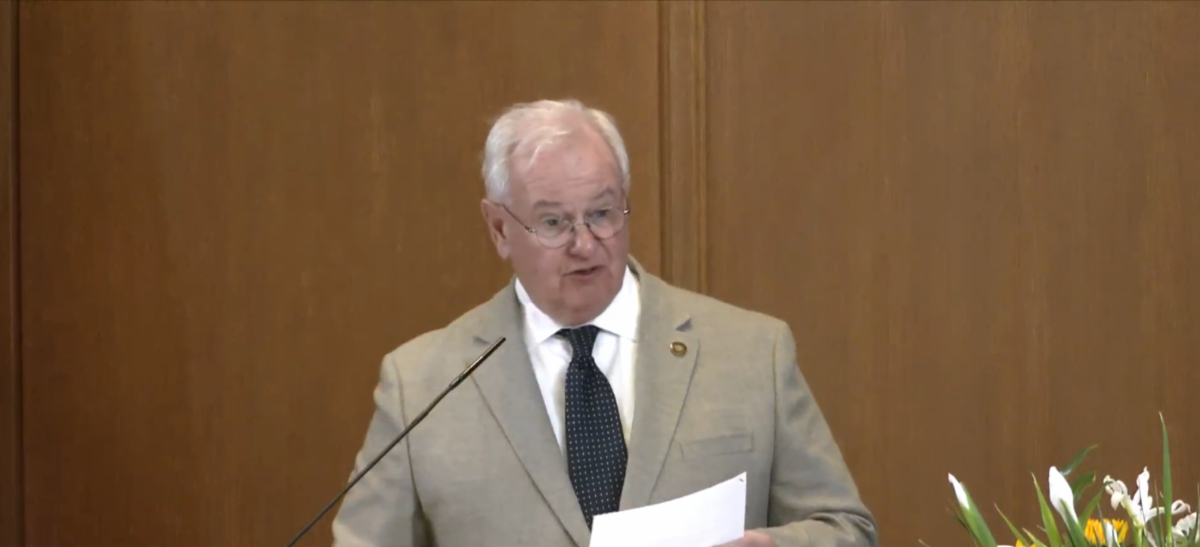
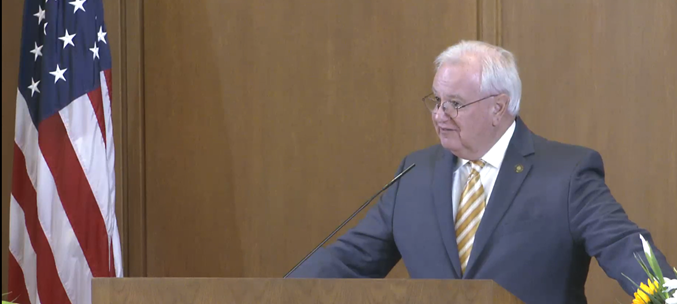
Most days this past week, the House met in morning, afternoon, and evening session. Usually, I was asked to preside.

Each day I receive dozens of emails, often regarding legislation we are considering. But the legislative session is not the only concern on your minds. Several wrote this week to urge me to take immediate action to establish clear, statewide standards for measles outbreak response in our state. State health officials declared a measles outbreak Thursday following five confirmed cases in Oregon.

I asked my staff to reach out to the Oregon Health Authority to learn more about their statewide strategy. Here was the response, sent February 20:

“Measles is an immediately reportable disease to public health and triggers an investigation by the local public health authority (LPHA). The public health response is standardized and outlined in the measles investigative guidelines. Briefly, when measles is reported, the LPHA conducts an investigation to identify contacts of the person with measles during the period of communicability, identify public places the person with measles may have been when infectious, and provide education on how to keep their loved ones protected from developing measles. Contacts of the person with measles who are susceptible to measles are offered post-exposure prophylaxis and asked to stay home to prevent further disease spread.

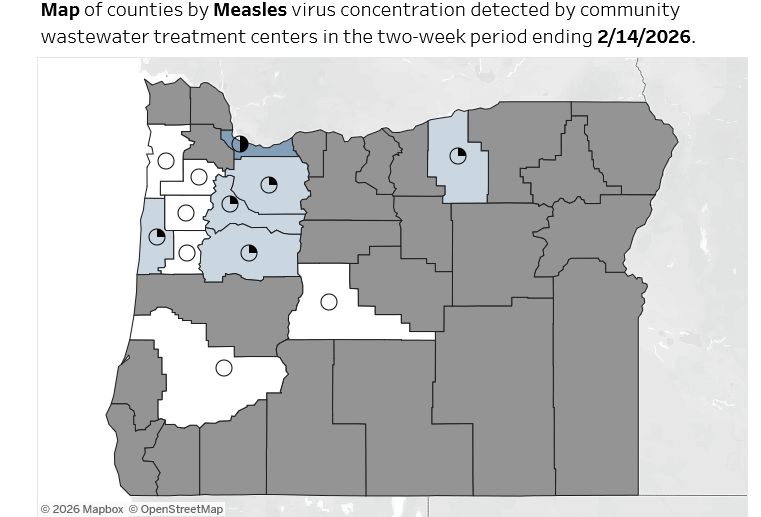
Public health is also monitoring wastewater for measles. Wastewater monitoring began Oct. 1, 2025, and complements traditional case reporting. Today, we are launching an Oregon dashboard that will show measles concentrations and categorize them as very low/low/moderate/high by county by 2-week period. This dashboard will provide important information for members of the public and health care providers on the measles situation in Oregon.”

Doctors typically recommend the two-dose measles-mumps-rubella (MMR) vaccine starting at 12 months old, with the second dose between 4 and 6 years old. Approximately 97% of individuals who receive the two doses develop immunity to measles, according to the American Academy of Family Physicians.

A new data dashboard the Oregon Health Authority published Thursday shows how the measles virus has spread through Oregon counties, based on wastewater surveillance. Health officials take samples from community sewage to check for the measles virus, as they do for other diseases. This new data tracking tool shows the five confirmed measles cases identified in the state since January 1 likely represent only a portion of infections occurring statewide, public health officials say. To strengthen early detection, OHA today published a new measles wastewater surveillance dashboard showing viral concentrations by county and categorizing activity as very low, low, moderate, or high over two-week periods.

They’ve detected traces of the measles virus in multiple parts of the state, though the confirmed cases were in Clackamas and Linn counties. During the past two weeks, according to state data, wastewater surveillance has found low levels of the measles virus in Lincoln, Linn, Marion, Clackamas, Multnomah and Morrow Counties.

Access this interactive OHA map here.

Measles symptoms can begin up to three weeks after exposure and can include fever, flu-like symptoms, and a telltale rash on the face that spreads to the rest of the body. Nearly one-third of people infected with measles develop complications, such as ear infections, pneumonia, and encephalitis, or brain swelling. The disease also makes it harder for patients’ immune systems to fight back against other diseases for months or years after infection.

Health officials have a goal of a 95% vaccination rate to limit the spread of the disease and protect infants and people who can’t be vaccinated through herd immunity. Last year, the health authority reported that 93.5% of kindergarteners had received their first dose of the MMR vaccine and 90.5% had received both doses. The state’s nonmedical vaccine exemption rate was the highest it had ever been, with nearly 10% of kindergarteners receiving an exemption for nonmedical reasons for one or more required vaccines.

Read more in the Oregon Capital Chronicle here. You can track activity for four respiratory viral pathogens in Oregon here.

Driving back and forth to Salem proved challenging this week as the roads turned slushy and icy. Passing cars that had slid off the road gave me pause, and I often considered how our legislative debates about funding road safety and winter maintenance affect real people in difficult ways.

With floor sessions stretching into the evenings, I missed several big community events this year. That included the Philomath Samaritan Awards on Friday and the opening of the Newport Seafood and Wine Festival on Thursday. I couldn’t be there, but I was thinking of you all.

email: Rep.DavidGomberg@oregonlegislature.gov

phone: 503-986-1410

address: 900 Court St NE, H-480, Salem, OR, 97301

website: http://www.oregonlegislature.gov/gomberg

Slide Slide Slide Slide Slide Slide Slide Slide Subscribe Contribute

Ads

Featured Video

Tillamook Weather

Tides

Tillamook Church Search

Cloverdale Baptist Church
Nestucca Valley Presbyterian
Tillamook Ecumenical Service

Tillamook County Pioneer Podcast Series

Archives

  • Home
  • EULA Privacy Policy
  • Contact
  • Opt-out preferences
  • Search...
Share on facebook
Facebook
Share on pinterest
Pinterest
Share on twitter
Twitter
Share on linkedin
Linkedin
Catherine

Recent Posts

  • BUTCH'S BLOG: Two TV Shows

    February 24, 2026
  • Tillamook PUD Electric Lineworker Program Scholarship

    February 24, 2026
  • NEWS UPDATE FROM STATE REPRESENTATIVE DAVID GOMBERG: Slushing Through the Third Week

    February 24, 2026
©2026 Tillamook County Pioneer | Theme by SuperbThemes

Manage Cookie Consent
To provide the best experiences, we use technologies like cookies to store and/or access device information. Consenting to these technologies will allow us to process data such as browsing behavior or unique IDs on this site. Not consenting or withdrawing consent, may adversely affect certain features and functions.
Functional Always active
The technical storage or access is strictly necessary for the legitimate purpose of enabling the use of a specific service explicitly requested by the subscriber or user, or for the sole purpose of carrying out the transmission of a communication over an electronic communications network.
Preferences
The technical storage or access is necessary for the legitimate purpose of storing preferences that are not requested by the subscriber or user.
Statistics
The technical storage or access that is used exclusively for statistical purposes. The technical storage or access that is used exclusively for anonymous statistical purposes. Without a subpoena, voluntary compliance on the part of your Internet Service Provider, or additional records from a third party, information stored or retrieved for this purpose alone cannot usually be used to identify you.
Marketing
The technical storage or access is required to create user profiles to send advertising, or to track the user on a website or across several websites for similar marketing purposes.
  • Manage options
  • Manage services
  • Manage {vendor_count} vendors
  • Read more about these purposes
View preferences
  • {title}
  • {title}
  • {title}