







Manzanita adopted a “Dark Sky” ordinance in 2024 to regulate residential lighting. The community of Oceanside has also pushed for lighting standards to protect the Three Arch Rocks Wildlife Refuge.
- Manzanita: The city council enacted an ordinance requiring outdoor lighting to be shielded and directed downward.
- Oceanside: The Oceanside Neighborhood Association (ONA) developed a proposal for a lighting ordinance, focusing on reducing light pollution to protect seabirds.
- Tillamook County Planning: There have been recommendations for the Board of County Commissioners to establish a countywide dark sky ordinance.
- Cannon Beach in Clatsop County adopted strict exterior lighting standards in 2014.
The Impact of Light Pollution on Wildlife and Human Health
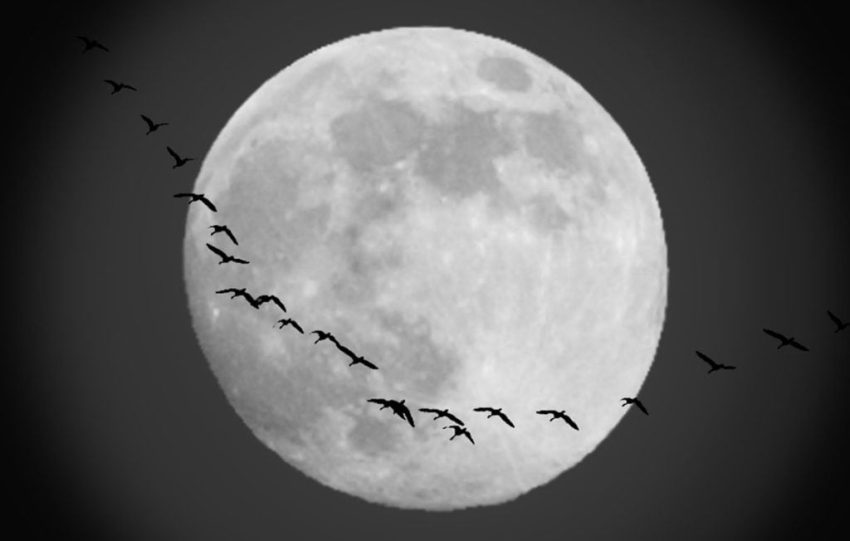
From hummingbirds and warblers to sparrows and geese, millions of birds migrate across North America every year, covering hundreds to thousands of miles. Most of these birds, some that weigh as little as half an ounce, make this remarkable and perilous journey at night, visualizing the magnetic pull of the earth and using the moon and stars to set their course. By reducing skyglow over our cities, we can help them make it to their destinations safely.
PEAK Spring Migration: April 15-May 19
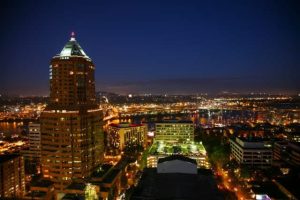
As migrating birds pass over brightly lit cities, skyglow drowns out the stars, confusing them and luring them into urban areas. Once trapped in the windowed maze of the city, birds either hit buildings directly or circle them until they collapse from exhaustion. Lights Out programs help to prevent birds from being attracted to urban areas. In Chicago, one Lights Out building showed an 80 percent decrease in strike rates after joining the Lights Out movement. Turning off unnecessary overnight lighting also helps us save energy (and money!), reduce our carbon footprint, and protect our view of the stars!
Take the pledge to go Lights Out for birds, other wildlife and human health
Pledge to reduce your unnecessary lighting! The sign shows your neighbors that you have taken the pledge to save energy, save birds and see stars!
The Night is Habitat
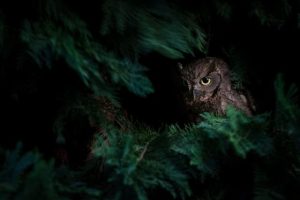
In addition to hosting migratory birds on their way north or south, the night is actual habitat. Biological systems evolved on this planet in cycles of light and dark. When we light the night, we are in fact fragmenting habitat occupied by nocturnal species. We are also tampering with highly complex ecosystems that rely on carefully timed circadian rhythms (light/dark cycles) that govern sleep, mating, migration, flowering, hunting, hibernation, plant budding and flowering, leaf drop, and the list goes on.
It is easy to minimize light trespass with well-designed lighting, and still provide all the light that we need. Bird Alliance of Oregon is working throughout the region to ensure that we are designing our built landscape for ecological resilience into the future.
Human Health
Humans need the dark too! The American Medical Association recommends steering clear of blue-rich white LED streetlights to “minimize potential harmful human health and environmental effects.” The 2014 AMA Study suggests that exposure to artificial light at night may increase the risk of cardiovascular disease, depression, sleep disorders, obesity and breast cancer. Research out of the Stanford Sleep Epidemiology Lab shows that street lighting can delay sleep cycles and reduce the quality of our sleep. Research out of the University of South Florida shows that birds exposed to artificial light incubate West Nile Virus for twice as long, potentially increasing the occurrence of West Nile Virus in our cities. Increased risk factors for diabetes, cardiovascular disease, impaired sleep, and higher risk of transmissible disease exposure may be most impactful to communities that are already at elevated risk of exposure to harmful pollutants, including the elderly, low-income communities and communities of color.
Conversion to LED
There is a gold rush conversion to LED lighting around the globe. While LEDs are great for saving energy and money, not all LEDs are safe for birds, wildlife, and human health and vision.
Research on blue-rich white light LEDs shows them to be a serious risk, both to our environment and to human health. Luckily there are warm light LED alternatives and emerging best practices in lighting design that include: fully-shielded light fixtures, aiming light down, and carefully considering lighting levels and spectral output. Read more here.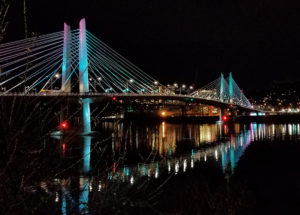
Lights Out Oregon
Building owners and residents can help by voluntarily turning off unnecessary overnight lighting during migration seasons!
How Can Building Owners and Managers Help?
Buildings can extinguish unnecessary overnight lighting from late August through mid-November (fall) and mid-March through early June (spring). Top priority is turning off exterior, ornamental and rooftop architectural lighting. Buildings can also extinguish interior lighting on upper floors, move maintenance and cleaning activities to daytime hours, turn off upward-directed sign lighting and make sure that outdoor lights are properly shielded. Take the Pledge to Go Lights Out .
How Can Residents Help?
Light Pollution is the accumulation of many sources of poorly designed or excessive lighting. We can all contribute to the solution by evaluating the way we use light. Take the Pledge to go Lights Out today! Make sure your exterior light fixtures are well-shielded and not overly bright. Select warm LED bulbs that are under a 3,000 Kelvin rating. During migration seasons, draw blinds or curtains to reduce light spill that contributes to sky glow. Looking for good lighting? The International Dark-sky Association has a Fixture Seal of Approval program!
If birds are hitting your windows, there are a variety of ways to reduce strikes at home year-round.
Need a Cash Incentive?
Energy Trust of Oregon offers incentives to increase the energy-efficiency of lighting fixtures and controls. Visit Energy Trust of Oregon to learn more.
Worried About Safety?
Read up on some interesting research that urges us to think more critically about the relationship between lighting and safety:
- The Chicago Alley Lighting Project revealed that crime increased 21 percent after alley lighting was increased in both frequency and wattage.
- Outdoor Lighting and Security: Literature Review 2008 found no link between lighting and crime, or any link too subtle or complex to have been evident in the studies undertaken to date.
- The effect of reduced street lighting on road casualties and crime in England and Wales Journal of Epidemiology and Community Health, July 2015 looked at data on traffic collisions & crime in 62 local authorities in England/Wales; found that lighting had no effect whether turned off entirely, dimmed, turned off certain hours, or substituted with low-power LED’s.
- Preventing Crime: What Works, What Doesn’t, What’s Promising: A Report to the US Congress Prepared for the NIJ by the Department of Criminal Justice, University of Maryland, 1997 asks: “Is street lighting an effective approach in the reduction and deterrence of crime? The answer is inconclusive…20 years later, we have very little confidence that improved lighting prevents crime”
