









By Michael Randall
Many of us go to our deaths at an old age having seen or understood little more than we did back when we were eighteen. We plod through our full allotment of adult years feeling little or no curiosity about the mysteries that lie behind a veil that shifts and hovers around this ordinary world.
Some people are luckier. They have lived to an advanced age and still are curious about many aspects of life. Why are we conscious? Do we have a soul? Is there an unseen world we swim in and which swims inside us but about which our five senses remain unaware?
Sometimes we receive hints from that world, if our minds are open to them. An intuition comes to us unbidden: an inspiration or flash of understanding about something in our daily life; a sudden thought of someone and a moment later the phone rings and it’s them; a premonition of something which then actually occurs; a long conversation with a loved one who has just died but who seems fully present when they visit us in a dream.
Do these common examples and others offer any evidence that our individual souls exist or even that our souls are conjoined in some way? These unexpected gifts of grace seem to come from an unseen force that kindly keeps us in mind, occasionally slipping these little gifts into our thoughts and night dreams.
Scientists have tossed in theories about these phenomena based on chemical and electrical reactions in the brain. Nonetheless, there seem to be no means conceived as yet to get at what causes our subconscious awareness and intuition, or to prove or disprove the existence of unseen forces that help us. However, it is hard to believe that these experiences are merely due to carbon and proteins kicking at nerve synapses in the pinkish-gray lumps of our brain.
Poet Stanley Kunitz wrote, “The universe is a continuous web. Touch it at any point and the whole web quivers.” This is a quietly appealing, mysterious idea, and it conjures an image of the unity of all things in our known universe (and elsewhere). All these matters are seemingly unresolvable in this life. But that is all right. They are part of the unseen force that lives beyond the veil.
Though we constantly wonder, some of us happily live without answers. Instead, we live within the question, within the inquiry itself. It’s our version of faith and hope, a humble bow to the mysteries that surround and swim within us.
Each of us is a particle of the mystery, and we feel elation, sadness, peace, remorse, joy. We cannot come up with reasons for being born into this world of beauty, struggle and suffering, except to learn to love beyond our family’s and tribe’s borders. In the book, “A Course in Miracles,” it is written, “Every loving thought is true. Everything else is an appeal for healing or help, regardless of the form it takes.” Given all our anger and judgments, our contempt and fear, our damnable indifference and violent opinions, we have a long way to go to generate only the truth of “loving thoughts.”
Swiss psychiatrist Carl Jung, developed the school of “analytic psychology,” which emphasized the individual’s development toward wholeness. Jung was also somewhat of a mystic, and I hope he might have agreed with some of what I’ve written above.
Toward the end of his life, in his autobiography, “Memories, Dreams, Reflections,” he wrote, “The older I have become, the less I have understood or had insight into or known about myself. I am astonished, disappointed, pleased with myself. I am distressed, depressed, rapturous. I am all these things at once, and cannot add up the sum. I am incapable of determining ultimate worth or worthlessness; I have no judgment about myself and my life.”
Looking back on the panorama of his years, knowing that his death was near, Jung could not make a judgment about the value of his life. But beyond his uncertainties, he did make one assertion: “I know only that I was born and exist, and it seems to me that I have been carried along. I exist on the foundation of something I do not know. In spite of all uncertainties, I feel a solidity underlying all existence and continuity in my mode of being.”
When my wife, Jan, was a little girl she had a cousin her age, Stephanie, who was dying. The little girl’s parents said that in the moment before Stephanie passed, she opened her eyes and raised her arms upward, reaching out as if to be picked up. A look of absolute joy shone on her face and she said loudly, “I’m coming!” Then she was gone.
I have had the privilege of sitting beside a few people prior to, and at the moment of, their deaths. There is a sense of some vital force, an energy that departs at that moment. After a stroke, my wife Jan lay in a coma for about two weeks. She did not wake or speak or open her eyes. However, I think she knew I was there during that time, for she did respond to me gently squeezing her hand by moving slightly and altering the rhythm of her breath. Near her death, as her breathing slowed and became less regular, I counted an ever-larger number of seconds between her breaths. Suddenly she opened her eyes wide and looked upward in awe and astonishment, raising her head from the pillow. Then she lay back down, closed her eyes and didn’t breathe anymore.
We are helped by something unseen, a force all around us and within us. We don’t know what it is, but it beckons to each of us, calls out the best in us. Each of us has time, however short or long. How will we decide to live when every loving thought is true, and everything else is an appeal for healing or help, regardless of the form it takes?
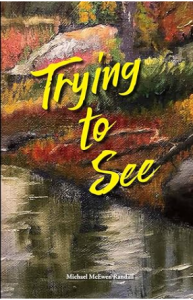 Mike Randall has written freelance articles and opinion columns for several newspapers here and in the Midwest. He is author of the non-fiction book, “Becoming Human: A Servant of the Map,” and a novel, “Into the Unknown Country.” He recently published his book, “Trying to See.” All three books are available for purchase on Amazon.
