



By Kiandre O’Neaque Clark
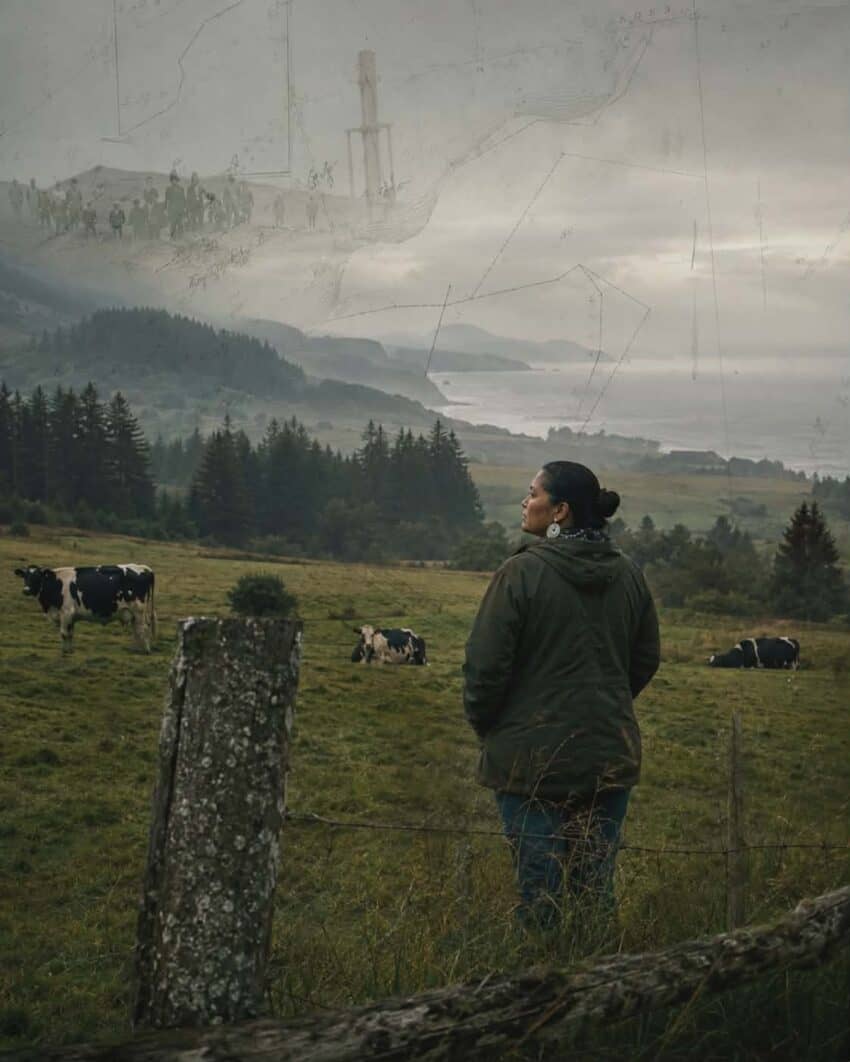
Since June is Dairy Month, let’s talk about the land underneath the dairy farms.
Tillamook’s dairy history is usually told as a pioneer success story: settlers arrived, cleared the land, raised cattle, built farms, formed a cooperative, and passed those farms down through generations.
That story is not entirely false. It is simply incomplete.
Before there were white-owned dairy farms, this was the homeland of the Tillamook people. They were not temporary visitors wandering through unused wilderness. They lived here, sustained communities here, fished these waters, gathered food, raised families, practiced spiritual traditions, and held established relationships with this land long before Oregon or Tillamook County existed.
Then white settlers began arriving in the 1850s.
The Oregon Donation Land Law gave large parcels of Oregon land to eligible white settlers. The law did not merely reward people for working hard. It transformed land already inhabited and used by Native people into property the United States claimed the authority to grant to incoming settlers.
The law’s own history is remarkably direct: federal officials wanted Native title extinguished so that the most desirable land could be opened to white settlement.
In Tillamook, the timeline is especially worth sitting with.
The first recorded white settler arrived in 1851. The first settler families arrived in 1852. Tillamook County was created in 1853, and dairy products were already being transported to outside markets by the mid-1850s.
Meanwhile, in 1855, the Tillamook and other coastal tribes entered into a treaty that was supposed to exchange their lands for compensation and a reservation. The United States never ratified that treaty.
Native people were nevertheless confined to reservation territory. The reservation was later reduced, and additional land was opened to public settlement. In United States v. Alcea Band of Tillamooks, the U.S. Supreme Court recognized that the Tillamook had established original Indian title and that their land had been taken involuntarily and without the compensation originally promised.
After that land entered the American private-property system, it could be granted, patented, purchased, mortgaged, divided, and inherited. That is how a family can honestly say, “We have farmed this land for five generations,” while the first generation’s access to it was still made possible by a government system that displaced Native people.
This does not mean every current dairy farmer is personally guilty of stealing a farm. Many local farmers work incredibly hard. Their families may have spent generations caring for their animals, surviving floods and economic hardship, and contributing to this community.
But hard work and inherited advantage can exist at the same time.
Land is capital. A family that inherits productive acreage, housing, equipment, water access, borrowing power, and a place in an established agricultural economy does not begin at the same starting line as the people whose ancestors were removed from that land.
Acknowledging that history does not require us to stop appreciating Tillamook’s dairy culture. It asks us to tell the whole story.
We can celebrate the farms and ask how the farms came to be.
We can appreciate multigenerational family businesses and recognize that Native families also had generations here before those property lines existed.
We can enjoy the cheese without pretending the land beneath the cows began its history when white settlers arrived.
And for anyone who wants to investigate rather than argue, Tillamook County maintains deed indexes, federal patents, Donation Land Claim records, homestead filings, surveys, and tax-lot records. We can trace individual properties and learn exactly how particular parcels entered private ownership.
Dairy Month can be more than celebration. It can also be an invitation to understand the full inheritance beneath our feet.
 Kiandre O’Neaque Clark is a counseling student, writer, and community advocate living in Rockaway Beach. She is preparing for a career as a research-oriented therapist working with diverse and underserved communities. Her interests include addiction, mental health, cultural identity, racism, stereotypes, prejudice, and using research and writing to raise public awareness.
Sources to begin with:
– Oregon Encyclopedia, “Oregon Donation Land Law”
– Oregon Encyclopedia, “Tillamook Cheese”
– United States v. Alcea Band of Tillamooks, 329 U.S. 40 (1946)
– Oregon State Archives, Tillamook County Records Inventory
– City of Tillamook historical records
