










The point is not to win every argument. The point is to understand each other well enough to live together.

EDITOR’S NOTE: Here’s an installment from Tillamook County’s State Representative Cyrus Javadi’s Substack blog, “A Point of Personal Privilege” Oregon legislator and local dentist. Representing District 32, a focus on practical policies and community well-being. This space offers insights on state issues, reflections on leadership, and stories from the Oregon coast, fostering thoughtful dialogue. Posted on Substack, 7/8/26
By Cyrus Javadi
This week, while at a legislative conference in Charlottesville, Virginia, I reread Plato’s Allegory of the Cave.
That is either the kind of sentence that makes you think, “Well, good for you, nerd,” or the kind of sentence that makes you remember why you stopped reading philosophy after college.
Fair enough. But stick with me.
To be clear, this was not recreational reading. I did not wake up one morning in a hotel room and think, “You know what this day needs? Ancient Greek metaphysics.”
Actually, no. “The Cave” was assigned reading for the conference, and it became part of our discussion about public service, politics, the duty of legislators, and the hard work of living in a republic with people who do not see the world the same way we do.
For the conference, I was at the University of Virginia, walking through the Rotunda, which Thomas Jefferson designed as the architectural and academic heart of the university. Monticello, Jefferson’s home, is just down the road. The whole place feels like it was built to remind you that ideas matter (not in the bumper sticker sense, but in the much older, heavier sense). The kind of ideas that shape republics, bind people together, split them apart, and occasionally make everyone in the room wish the moderator had cut off questions five minutes earlier.
So, fair warning: this week we are not going deep on a bill, a budget line, or the latest political food fight. We are going underneath all of that — to politics, leadership, truth, and the strange human habit of mistaking shadows for reality.
“Wait, Remind Me Who Plato Is Again?”
Before we get to “The Cave”, it is worth saying a quick word about Plato.
Plato was not just some ancient guy in a toga having deep thoughts near a column—although, that does sound like a nice way to spend an afternoon, as long as it’s not in July, in Greece, and without shade.
But I digress.
He was an Athenian philosopher, a student of Socrates, and the teacher of Aristotle. He was born into a prominent family and, by most accounts, seemed headed toward public life himself. But the politics of Athens (including the trial and execution of Socrates) changed him. Instead of becoming a politician, he opened a school of philosophy called the Academy.
That school, and the tradition it started, shaped Western thought for centuries—think Harvard, Oxford, or Cambridge but with more sandals and fewer alumni fundraising emails. And nearly a thousand years later, people were still arguing with Plato, borrowing from Plato, correcting Plato, and trying to figure out whether Plato had already said the thing they were about to say, only better.
Which is irritating, but impressive.
So when a room full of legislators sits down to talk about Plato, the cave, and the nature of truth, it is not just an academic exercise. It is a mirror.
And nobody particularly enjoys mirrors when the lighting is honest.
“The Cave” and the Shadows on the Wall
Plato’s story is simple, but it gets under your skin.
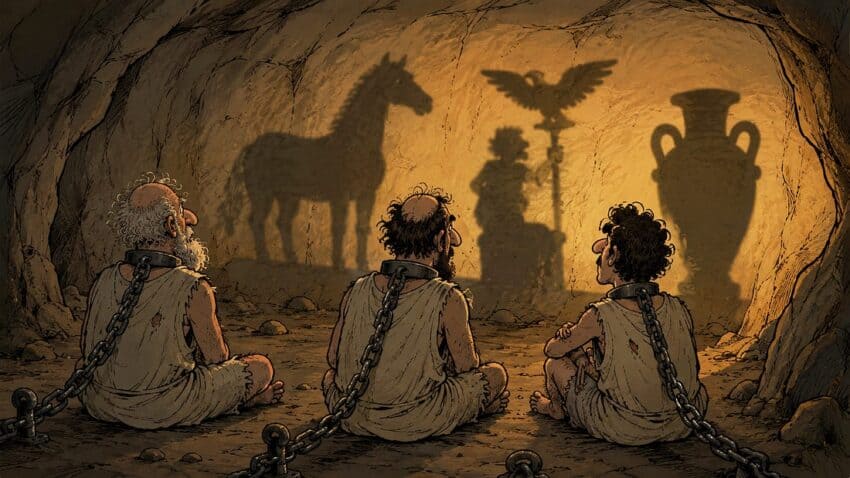
Once upon a time there was a group of people who were chained inside a cave. They had been there their whole lives. They could not turn around or move their heads even to the side. All they could see is the wall in front of them.
Now, behind them was a fire. And between the fire and the prisoners, people carried objects that cast shadows on the wall—similar to the shadow puppets we made as kids in our rooms during sleepovers with friends. But in this story, the prisoners see the shadows and assume those shadows are reality.
Why? Because it is all they have ever known.
Then one day a prisoner is freed. The shackles are removed, but his buddies are still bound. He turns around. At first, the bright fire hurts his eyes. Then he is dragged outside. The sunlight is overwhelming. He cannot see clearly. But slowly, painfully, he begins to see. And he begins to understand. The shadows were not reality. They were images. Copies. Distortions.
Eventually, he sees the world as it is. Trees. Water. People. The sky. The sun.
Then he returns to the cave. And that is where the story gets interesting.
Because when he goes back and tries to explain what he has seen, the others do not thank him or actually even believe him. They do not say, “Wow, we appreciate your perspective and for bringing us this helpful new information.” And they do not create a bipartisan task force on shadow accuracy.
No. Instead, they think he is crazy. Worse, they think he is dangerous.
Sound familiar?
We Are All in the Cave
Ok, you might be saying to yourself, “Rep. Javadi this is pretty cringy. Are you suggesting that you are the enlightened prisoner who has returned to tell your constituents the truth? How convenient for you.”
I don’t blame you for thinking that. But before you send me an email telling me how egocentric I am, let me explain.
You see, we all like to imagine ourselves as the person who escapes the cave. We are the brave truth-seekers. We are the ones willing to follow the evidence wherever it leads. And we are the ones who see through the propaganda, the spin, the tribal loyalties, the algorithms, the talking points, the nonsense.
Maybe.
But here is the uncomfortable part: we are also the people still in the cave. All of us.
Every one of us lives inside some version of the cave. Our cave may be built out of family history, religion, education, class, geography, race, profession, political party, social media feeds, personal wounds, or the simple fact that we tend to confuse “what I have experienced” with “what is universally true.”
That does not mean everything is relative. It does not mean there is no truth. Quite the opposite. Plato’s point was not that everyone has their own truth and we should all just sit in the dark and validate each other’s shadows.
The point is that reality exists, but seeing it clearly is hard.
And it takes effort. It takes humility.
It takes the willingness to ask, “What am I missing?” which, in politics, is roughly as popular as asking a room full of candidates to answer the question directly.
Why People See the Same Facts Differently
One of the great temptations in public life is to assume that the people who disagree with us are either stupid, dishonest, or evil.
Well, sometimes people are dishonest. Yes, sometimes people do act in bad faith. And sometimes people really are selling a bad idea with a nice label and hoping no one reads the fine print.
But most of the time, people are working from the world as they understand it.
Their education shaped what they trust. Their community shaped what they fear. Their losses shaped what they protect. Their successes shaped what they assume is possible for everyone else.
It is absolutely true and we must learn to accept that two people can look at the same fact and see different meanings.
For example, a rural farmer may hear a proposal from Salem and think, “Here comes another rule written by people who do not understand how we live.” An environmentalist in Portland may hear opposition to that same proposal and think, “Why are they resisting something that seems obviously compassionate or necessary?”
Both may be sincere. Both may also be missing something.
That is not a call for mushy thinking. I am not suggesting that every idea deserves equal respect. Some ideas are wrong. Some are foolish. Some are destructive. Some should be defeated decisively and then escorted politely but firmly out of the building.
But people are not the same as their worst idea. And that truly matters.
The Duty to Tell the Truth
Especially for those of us who are entrusted with public responsibility.
Since being elected to public office, I have said from time to time that if you are elected to serve, you do not get to represent only the people who already agree with you. You represent everyone in your district. That means the people who voted for you, the people who voted against you, the people who will never vote for you, the people who think your yard signs ruined an otherwise pleasant drive, and the people who are not paying attention until the pothole outside their house reaches geological significance.
You have a duty to tell the truth as best you can see it. But you also have a duty to remember that your own view is not perfect.
That is a difficult combination. Humility without cowardice. Conviction without arrogance. Curiosity without surrender.
The person who leaves the cave does learn something. But that knowledge creates a moral burden. Because once you have seen more, you are responsible for what you do with it.
On the one hand, you can go back into the cave and tell the truth. Maybe some will respond positively. Maybe some will ignore you. And maybe some will start looking around for a rock to throw.
It’s a risk you must take.
Or, you can choose another option. You can use what you know to manipulate the people who do not know it yet.
That second option is always available. And sadly, politics is full (and likely always will be) of people who choose it.
Like so many leaders both in history and today have learned, if you understand what people fear, you can exploit it. If you understand what they do not know, you can hide behind it. If you understand which shadows they believe are real, you can move the puppets behind the fire and make the wall say whatever you want.
That is not leadership. That is stagecraft. That is theatrics. That is deception.
You Cannot Drag People Into the Light
But even here, we have to be careful.
The goal of teaching people is not to force them to think exactly as we do. The goal of explaining what we have learned is not simply to win an argument, score a point, or collect another convert for our side.
The goal is better understanding.
That’s it.
It is to help people see what we see, and to let them help us see what they see. It is to make it possible for people with different histories, different experiences, different wounds, different loyalties, and different views of reality to still live together in peace.
That is simple, but it is definitely not easy.
And it is not the same as saying all views are equally true. They are not. Some things are real. Some things are false. Some arguments are better than others. Some policies work, and some policies fail. Some claims are supported by evidence, and some are just shadows with a good press secretary.
But human beings rarely grow because someone drags them into the light and yells, “Behold, idiot.”
Each of us has to walk toward the light ourselves.
Others can point. Others can invite. Others can explain. Others can bear witness to what they have seen. But real growth requires a person to turn, to look, to question, to adjust, and to keep walking even when the light hurts their eyes.
That is why humility is not optional.
We may be out of the cave on one issue and deep inside it on another. A dentist may know a lot about oral health and still be utterly baffled by the emotional politics of a homeowners association. A legislator may understand transportation funding and still need help finding the correct button on a hotel thermostat.
Human beings contain multitudes, and some of those multitudes are embarrassing.
That is why the goal cannot be domination. It cannot be manipulation. It cannot be using our knowledge to move the shadows around for people who trust us.
The goal has to be to live honestly with one another.
To say, “Here is what I have seen.”
And also, “Tell me what I may be missing.”
We Do Not Escape the Cave Once
The final realization is this: the cave is not something we escape once and for all.
Rather, life is more like moving from one cave to another cave, each time discovering that some part of what we thought was real was only a shadow. Maturity is learning not to resent that process. Wisdom is learning to welcome it.
The hard part is that leaving one cave can feel like betrayal to the people still inside it. When you change your mind, some people will think you changed your character. When you say, “I see this differently now,” some will hear, “I think I am better than you.” When you try to explain what you have learned, some will assume you are attacking what they love.
That is why truth has to be paired with kindness. Not softness. And not weakness.
Kindness.
There is a difference.
Kindness says, “I am going to be honest with you because you deserve honesty.”
Manipulation says, “I am going to tell you what keeps me popular.”
Contempt says, “I do not owe you an explanation.”
Leadership says, “Here is what I see. Here is why I see it. I may be wrong, but I will not pretend to believe something I do not believe just because the shadows are familiar.”
Walking Toward the Light
That, to me, is one of the central obligations of public service.
We owe people honesty. We owe them respect. We owe them the humility to admit when we are still learning. We owe them the courage to say what we believe is true, even when it would be easier to leave the shadows undisturbed.
Because the truth is, the cave we are in is comfortable.
The cave has certainty. The cave has belonging. The cave has familiar voices telling us the wall is the world and anyone who says otherwise is the enemy.
Whereas the light is harder.
It exposes things. It disorients us. It forces us to revise. It asks us to give up easy explanations and trade them for better ones.
But if we care about truth, and if we care about each other (which I believe we do), then we cannot be content with shadows.
We have to keep walking toward the light. And when we come back inside, as all of us must from time to time, we should tell the truth about what we have seen.
And not to win, or dominate, or prove we are smarter than the people still adjusting their eyes.
But because honesty is one of the few ways we can help each other become free.
And freedom is something we all have a right to claim.
If this made you think, or at least made Plato slightly less annoying, I hope you’ll subscribe.
I write about politics, public service, Oregon, and the strange human habit of mistaking shadows for reality. My goal is not to tell you what to think. It is to think out loud honestly, invite better conversations, and make a little more room for people who see the world differently to still live together in peace.
