


“In Idaho, one specter haunted me. What if nuclear waste – whatever its level of contamination – ever found its way into the groundwater used for irrigation?” – Former Idaho Governor Cecil D. Andrus
By Marc C. Johnson
Here we go again, Idaho.
While most Americans have been preoccupied with rising food and fuel prices, an ongoing war in the Middle East and the various comings and goings of the Epstein Class, the Trump Administration – and accomplices in a few very Trump friendly states – have been quietly concocting a plan to make three “willing” states home to the vast stockpile of the nation’s high level nuclear waste. ¹
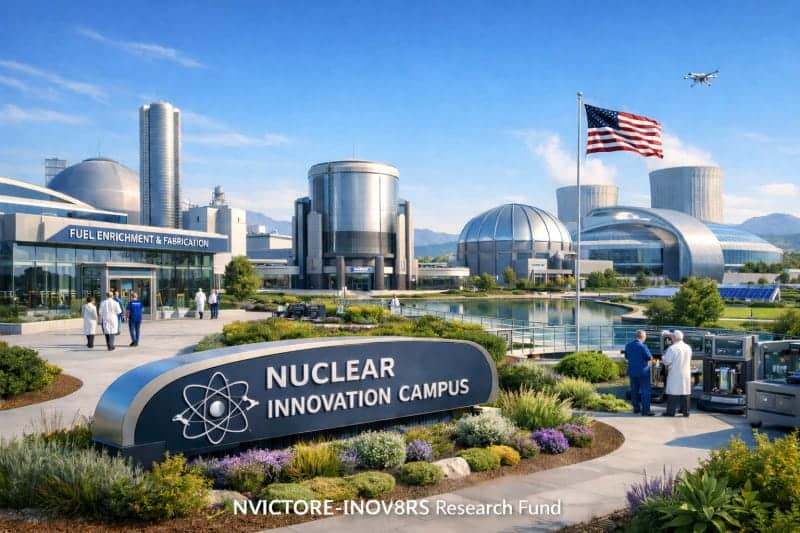
The plan, in the works for months, was finally publicly revealed this week by the Department of Energy (DOE), innocuously described as a “Nuclear Lifecycle Innovation Campus.” The “campus” designation is promising billions in pie-in-the-sky economic benefits to states “lucky” enough to be named to the Trump Administration’s short list.
DOE generated a bit of AI slop to promote it’s cash for trash scheme – see above AI-generated illustration.
But like all things from this administration the breathless hype conceals an ill-conceived plan, guided by reckless “science” that is more like a blackmail scheme, seeking to entice Idaho – and at least two other states – to accept one-third of the country’s now homeless nuclear waste cache for a “promise” of a big pay day … sometime. ²
Yet as audacious as the Nuclear Lifecycle Innovation Campus plot is – and it is truly and nakedly risky in its ambitions – it is even more outrageous that Idaho’s governor, its U.S. senators, eastern Idaho congressman and most of the state legislature have embraced an Idaho nuclear waste disposal scheme masquerading as an economic windfall. ³
As the Idaho Statesman’s Mark Dee succulently reported this week: “Idaho is on the shortlist to become the center of America’s nuclear energy industry — and a warehouse for much of its radioactive waste.”
One has to be living in the Trump DOE’s house of mirrors not to understand that creating a permanent waste storehouse is vastly more important to the administration and its political cheerleaders than any vague promise that Idaho, or Tennessee, Utah, Oklahoma or Louisiana will reap some huge financial windfall.
Becoming the center of a revitalized nuclear energy industry, an industry most clearly defined not by the jobs, energy or cash it generates but rather by the highly radioactive waste it produces carries an enormous caveat for Idaho – you might get some cash, but you must take the trash.
Idaho’s application for this “windfall,” signed by Governor Brad Little and warmly endorsed by Senators Mike Crapo and Jim Risch, Congressman Mike Simpson and most state legislators – sadly and astoundingly including most of the Democratic leadership – isn’t bashful about just how willing Idaho leaders are to warehouse the nation’s waste.
“Once Congress has acted to address and update the existing legal framework,” the Idaho proposal says, “Idaho is poised to engage in discussions about the eventual siting of a permanent national repository. Idaho intends to collaborate closely with the federal government and neighboring states that are interested in serving as long-term repository locations, ensuring the responsible disposition of waste streams.”
While the Idaho proposal hints that a “permanent” waste repository might be sited in Utah, Idaho’s cheerleaders also say more “temporary” storage in Idaho sounds just fine by them.
“While Idaho will not consider the establishment of a deep geologic repository below the INL site or above the Snake River Plain Aquifer … Idaho is willing to consider additional long-term monitored storage solutions for the DOE, possibly including deep bore hole storage, in exchange for significant financial consideration in anticipation of development of a recycling and reprocessing (R&R) capability near the INL site.” ⁴
Not Idaho’s first rodeo
Perhaps some of you are old enough to remember that Idaho has been here before.
From the early 1970’s to the end of the 1990’s Idaho governors of both parties resisted repeated federal efforts to turn Idaho into what former Democratic Governor Cecil Andrus called the nation’s “de facto nuclear waste dump.” When Andrus became governor in 1971 the state had been quietly serving for decades as a convenient “out of sight, out of mind” location for “temporary” waste storage. Andrus famously closed the state’s borders to additional waste in 1988 when he became frustrated by DOE’s lies and incompetence in addressing waste issues, including failure to create a plan to clean up and remove waste already sitting in Idaho.
Andrus’s successor, Republican Phil Batt, carried the fight forward and secured a landmark agreement sharply restricting movement of new waste into Idaho and proscribing how existing waste would be treated and removed.
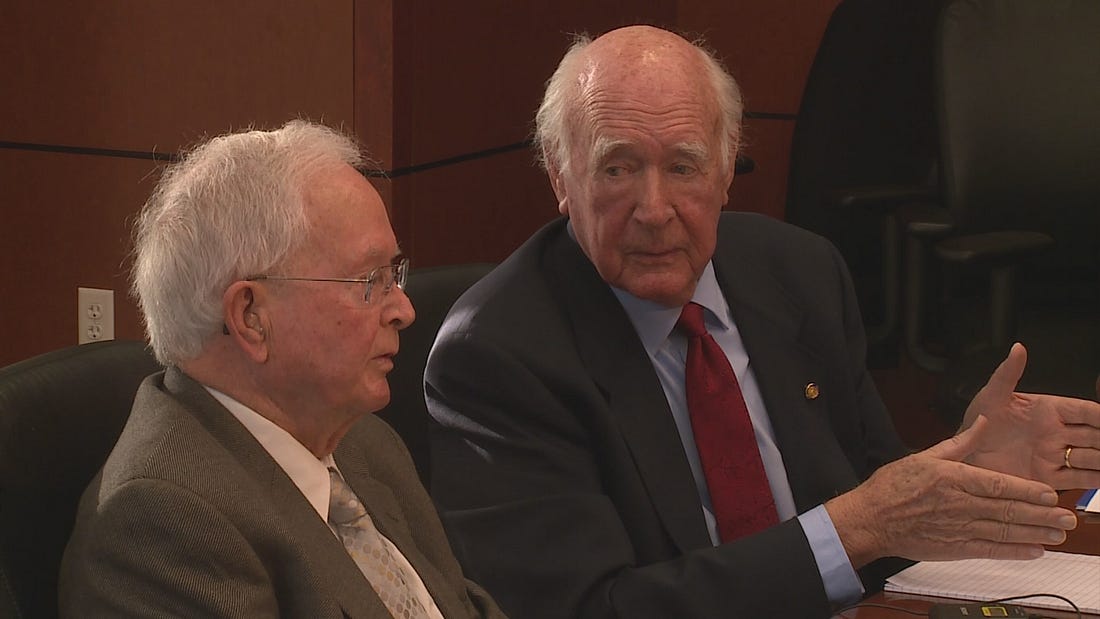 |
Former Idaho governors Phil Batt, a Republican, and Cecil Andrus, a Democrat cooperated on nuclear waste policy issues – KTVB photo
Both Batt and Andrus shamed their critics, including many Republican politicians and deep pocketed industry concerns, into submission because they were right on both the policy and the politics.
Survey after survey over decades have shown that the state’s fight to avoid becoming a nuclear waste dump has enjoyed widespread public support. Batt’s agreement was immensely popular in part because the feisty, no-nonsense governor effectively told DOE to clean up its old mess and stop making a bigger mess in the future.
Now Idaho’s nuclear waste dump application clearly envisions junking Batt’s 1995 agreement, saying “future modifications will be discussed when relevant and appropriate.”
In other words, Little and the state’s political elite are poised to tear up Batt’s agreement and decades of bipartisan resolve, and for what? A promise to welcome more than 30,000 metric tons of the most dangerous material on the planet for at least “temporary” storage above the Snake River Aquifer in southeastern Idaho?
To make sure the Trump Administration understands how completely prepared Idaho is to become a waste disposal site, Little’s proposal underscores that “Idaho is actively reforming its internal codes to consolidate authority and simplify the pathway for complex nuclear and hazardous waste facilities.”
In other words, we won’t bother with any public process around this wonderful scheme. We’ll short circuit any safeguards and make sure the decision-making is “consolidated.”
This fantastic scheme, like all things emanating from this administration, is full of bluster, wild promises, scientific and regulatory shortcuts (or abandonment) and utter disregard for basic common sense. If you think all this blue smoke is good for Idaho then you’ll probably making a killing trading Trump crypto currency. ⁵
Here’s the bottom line: American needs safe, reliable nuclear energy, and the industry needs a safe, scientifically sound basis for dealing with the vast waste stockpile that exists and that will only grow in the future.
Instead the Trump Administration has produced a jerry rigged, phantom economic development concept that is really just a plea to states like Idaho to take some garbage “temporarily,” while we kick the waste can down the road to places like Butte County, Idaho.
If this were a nuclear waste version of “The Apprentice,” the Idaho politicians endorsing this nonsense would be fired since they clearly have no idea what they are doing.
2) – Cally Younger, administrator of Idaho’s Office of Energy and Mineral Resources, provided the Idaho Statesman with comments about the state’s application, including seeming to contradict the application on whether permanent waste disposal in Idaho is on the table: “That’s great, and that’s what got us to apply,” she said of the economic boost on Tuesday, “but if we’re really talking about permanent storage, they’re going to have to pay.”
I confess to not having a clue what Younger is saying beyond the state wants money and is open to negotiating the terms of getting it.
4) – There is much to be said about recycling and reprocessing spent nuclear fuel and I’ll leave that subject for another day. What strikes me in this sentence is the reference to “deep bore hole storage.” As Lindsay Krall – she’s a Stanford nuclear researcher – wrote in 2020 in The Bulletin of Atomic Scientists:
“The deep bore hole concept is relatively simple and has been around since the 1950s. Rather than excavate one enormous mine like Yucca Mountain to store all US civilian nuclear waste, this solution would involve depositing nuclear waste in hundreds of narrow holes drilled into the earth’s crust.
“The idea has plenty of boosters, among them a start-up called Deep Isolation, based in Berkeley, California. Founded by physicist Richard Muller and his daughter Elizabeth Muller, the company launched a Series A investment round earlier this year on the promise that it can bring the borehole concept to fruition. By leveraging the lateral drilling technology developed for tapping into shale gas deposits, the company that professes to be the “SpaceX” of nuclear waste claims to have hacked a solution for the permanent disposal of the United States’ 82,000 metric ton inventory of commercially-generated spent nuclear fuel.
“Unfortunately, the proposal is full of holes.”
5) – Reading the Idaho application carefully and along side the DOE request for proposals one gets the sense, perhaps not surprisingly given the source, that the administration seeks fast, compliant action featuring little or no technical analysis. The application is ripe with chamber of commerce boosterism and promises that Idaho is ready to welcome pretty much whatever the feds want. In other words – it’s very Trumpian.
About Marc C. Johnson: I am a Nebraska native, grew up in South Dakota and migrated to Idaho after college to work in broadcast journalism. In 1986, I joined the “comeback” campaign of a legendary Idaho political figure – Cecil D. Andrus – who eventually served four terms as governor and four years as Secretary of the Interior, not bad for a Democrat in a very conservative state. I had a small role in helping Cece Andrus win his last two gubernatorial terms. I did communication and crisis consulting work, and since “retiring” to the beautiful north coast of Oregon have written three books on U.S. Senate history. I’m working on a new book on another legend – this one a legend in journalism.
You can find my books here:
I write this Substack to scratch my itch to connect history with current politics. I hope, in some small way, to contribute to understanding of this perilous moment for our democracy, for free speech and facts. Subscribe here for more.
