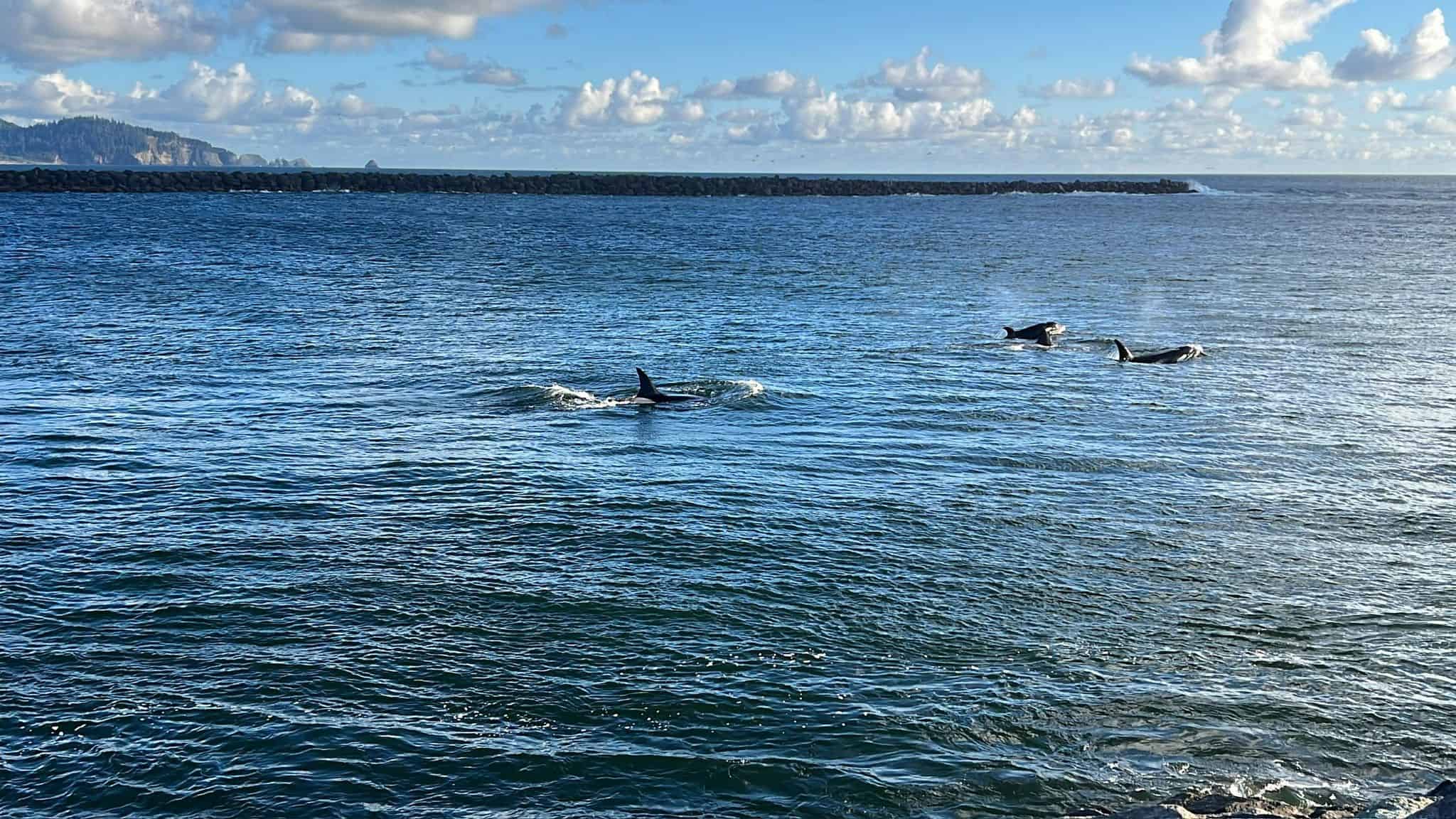



Since 2019, the Oregon Department of Fish and Wildlife (ODFW) has been implementing measures to reduce the risk of whale entanglements in the commercial crab fishery. These measures are foundational to ODFW’s proposed conservation plan that lays out a strategy to minimize and mitigate the impacts of incidental take (i.e., entanglement) of federally-protected humpback, blue, and fin whales by the crab fishery off Oregon to the maximum extent practicable.
On August 14, 2026, the Oregon Fish and Wildlife Commission (Commission) adopted several regulatory changes in the ocean commercial Dungeness crab fishery to address whale entanglements. All meeting materials, including the background, rationale, and rule language, are located here: https://myodfw.com/articles/commission-agenda-august-13-14-2026. ODFW is sending this notice to provide information on these regulatory changes and changes for the 2026-27 season.
l. REGULATORY CHANGES ADOPTED
Please see the draft Oregon Administrative Rules (OARs) for specific details on adopted rules here: https://myodfw.com/sites/default/files/2026-07/Exhibit%20B_Attachment%203_Draft%20Oregon%20Administrative%20Rules%20.pdf
a. Electronic Monitoring (EM), effective February 1, 2027.
All vessels participating in Oregon’s ocean commercial crab fishery will be required to use an EM system that automatically determines a vessel’s position, records individual pot retrieval via a hydraulic pressure reading, and transmits this information to an EM system service provider by February 1, 2027. The EM service provider must provide automated data access to the Pacific States Marine Fisheries Commission (PSMFC) in a format that meets the PSMFC’s specifications, where it then becomes available to ODFW for management and enforcement. This will streamline data collection and greatly improve the speed at which vessel and gear location data are usable, providing critical information to assess overlap between whales and crab gear closer to real time. The rules also strengthen crab traceability regulations, improve tracking of fishery reference points, and help enforce season openings, area closures and other regulations.
Logbooks are still required in the commercial crab fishery. ODFW will make an electronic version of the logbook that integrates with EM available for voluntary use by December 1, 2026. Those who choose not to use the electronic logbook application will be required to maintain a paper logbook.
b. Experimental Fishing Gear Permits (EFPGs)
Alternative pot or trap gear configurations have the potential to reduce marine life entanglement risk by reducing or eliminating persistent vertical lines. However, longlining is currently prohibited in the crab fishery, and pop-up gear is currently unlawful because all pot and trap gear must be marked at the surface with a buoy. Information gaps and outstanding questions related to management and enforcement of both longline and pop-up gear can be addressed by testing under an EFGP. Due to anticipated interest and the need for collaboration to ensure testing addresses information gaps, the adopted rules provide a more structured program with additional guidelines for issuing EFGPs. ODFW anticipates completing pre-implementation work over the winter and beginning to take EFGP applications for pop-up and crab longline gear in the spring of 2027. Information about how to apply for an EFGP will be forthcoming.
c. Surface Gear Housekeeping Amendment, effective August 14, 2026.
In August 2023, the Commission adopted a regulation limiting the amount of surface gear allowed to be used on ocean commercial Dungeness crab gear to reduce the risk of marine life entanglement. The rule specified that a maximum of 36 feet of line may be used between the main buoy and final trailer buoy, measured “between the front end of the main buoy to the tail end of the last trailer buoy”. However, outreach materials were broadly distributed indicating that measurements should be made between the front end of the main buoy and the front end of the last trailer buoy. To correct this mismatch, the Commission adopted a minor rule amendment to align rule language with outreach materials. Since all gear that complied with the previous rule language also complies with the new language, this change should not require any action by industry.
ll. WHAT YOU NEED TO DO THIS SEASON
a. SURFACE LINE MARKING – REQUIRED FOR THE 2026-27 CRAB SEASON
In September 2024, line marking requirements were adopted for the Oregon ocean commercial Dungeness crab fishery as part of a coordinated West Coast approach to improving gear identification. Starting December 1, 2026, all line between two buoys (except for buoy gangions) must be yellow and black line or contain one set of solid yellow and black marks. If only one buoy is used, the upper one fathom of the vertical line must be yellow and black line or contain one set of solid marks.
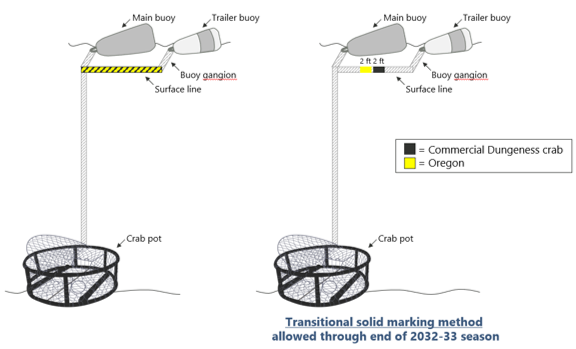
Please note: This is the first phase of a comprehensive line marking approach, which will be implemented over several seasons to spread out the cost of compliance. Starting with the 2028-29 season, the upper 15 fathoms of the vertical line will be required to be marked. Starting with the 2033-34 season, only yellow and black line may be used to meet the surface and vertical line marking requirements above (sets of solid marks will no longer be permitted).
More information about line marking requirements can be found here: https://www.dfw.state.or.us/mrp/entanglement/linemarking.asp
b. PURCHASE, INSTALL, AND ACTIVATE AN ELECTRONIC MONITORING SYSTEM ON YOUR VESSEL – REQUIRED BY FEBRUARY 1, 2027
Owners/operators are responsible for purchasing, installing, and activating an EM system through a service provider and ensuring that their equipment is working properly and transmitting data before participating in the crab fishery. Vessels are responsible for the annual subscription cost for data transmission to the service provider.
The regulations do not specify a particular vendor or type of equipment to provide maximum flexibility, but the EM system must comply with the regulation requirements (ping rates, data access, etc.). If you have questions about whether a particular system will comply with this requirement, please contact ODFW at crab.em@odfw.oregon.gov.
Vessels that participate in the Washington coastal commercial crab fishery and have EM units that comply with Washington’s EM rules are already compliant with Oregon’s EM rules. Vessels that participate in the California commercial crab fishery and have EM units that comply with California’s EM rules may become compliant with addition of a hydraulic pressure sensor.
To offset industry costs, ODFW has secured funding to provide reimbursement of up to $800 to Ocean Dungeness Crab Permit holders for units that record vessel location and hydraulic pressure readings. Based on the lowest cost estimates from service providers whose units are known to meet ODFW’s specifications, this would equate to a full reimbursement for purchased units.
Some service providers offer discount pricing for regulatory programs. ODFW will provide further information on how to purchase compliant EM systems and apply for reimbursement in September 2026.
c. ORDER YOUR 2026-27 CRAB BUOY TAGS (SEE LAST PAGE FOR ORDER FORM) – REQUIRED FOR THE 2026-27 CRAB SEASON
For Ocean Dungeness Crab Permit holders, the link to the 2026-27 buoy tag order form can be found here. Please provide all requested information and mail or fax the completed form to ODFW Licensing Services (number and address listed on the top of the form). Once you submit your order, please allow up to 3 days to receive them via FedEx or UPS. Note that tags will not be mailed until after September 1, 2026.
Please contact us if you have any questions, comments, or concerns about the management of the ocean commercial Oregon Dungeness crab fishery at any time.
Cathleen Vestfals, Commercial Crab Project Leader, 541-961-6924, Cathleen.D.Vestfals@odfw.oregon.gov
Troy Buell, State Fishery Manager, 541-961-8135, Troy.V.Buell@odfw.oregon.gov
