




How Columbia Memorial Hospital prepared for the Big One—and got caught in Washington’s decision to cancel BRIC funding.
 EDITOR’S NOTE: Here’s an installment from Tillamook County’s State Representative Cyrus Javadi’s Substack blog, “A Point of Personal Privilege” Oregon legislator and local dentist. Representing District 32, a focus on practical policies and community well-being. This space offers insights on state issues, reflections on leadership, and stories from the Oregon coast, fostering thoughtful dialogue. Posted on Substack, 8/21/26
 By State Representative Cyrus Javadi
Good governance has a lot in common with going to the dentist, which is probably not a great slogan for government.
I say this as someone who has spent a fairly significant portion of his adult life trying to convince people that coming to see me every six months is a good idea. This is harder than you might think.
Everybody agrees with the basic proposition. Teeth are useful. Keeping them seems preferable to the alternative.
And yet.
Only about 45 percent of Americans see a dentist in a given year. Among working-age adults, it is closer to 40 percent.
I don’t take this personally. Well, at least not very personally.
There are plenty of reasons people avoid the dentist. It costs money. It takes time. Some people are scared of us. Others simply have more interesting things to do, which is admittedly a fairly low bar. Nobody has ever canceled a trip to Hawaii because they had been looking forward to their cleaning.
Mostly, though, I think it is because nothing hurts. And nothing hurting is an enormously persuasive argument.
You can have a cavity quietly getting larger for years and feel perfectly fine. The tooth isn’t sending emails. There’s no dashboard light. Nobody from the tooth calls to say, “Just circling back on that structural integrity issue.”
So you wait.
Then one day it hurts. Hello, root canal.
This is the point in my professional life where patients occasionally ask some version of, “How did this get so bad?”
Usually the answer is: very slowly. Which, come to think of it, is how a surprising number of government problems get bad too.
Let’s Talk About Sewage
I have increasingly come to believe that one of the most important jobs of government is to be extremely good at boring things.
This is unfortunate because nobody gets into politics to talk about wastewater treatment plants.
Well, almost nobody. I have met some city managers. Mention secondary treatment capacity to the right one and you will see a light come into his eyes normally associated with new grandchildren.
There are good reasons for this.
A wastewater treatment plant is one of those things modern civilization has arranged so you almost never have to think about it. You turn on the faucet and water comes out. You flush the toilet and, without getting overly technical here, the contents cease to be your problem.
Who doesn’t love indoor plumbing?
The Romans built aqueducts across valleys. London spent much of the nineteenth century discovering that dumping raw sewage into the Thames had drawbacks. Chicago eventually became so annoyed with its sewage problem that it reversed the direction of a river.
I have always admired that one. Most cities faced with pollution form a task force. Chicago looked at the river and essentially said, “What if it went the other way?”
And then they did it.
Today we have settled on less dramatic solutions involving pipes, pumps and people who understand “million gallons per day” without consulting Google.
Until the system runs out of capacity. Then the boring wastewater plant becomes a housing policy.
A town wants more housing. We change zoning rules. We argue about density, parking requirements, urban growth boundaries and whether a four-story apartment building will destroy the character of a neighborhood currently occupied by a tire store and a vacant lot.
And somewhere in the back of the room, the public works director is waiting patiently to explain that none of it matters because the sewer plant is full.
Turns out you cannot zone your way around a pipe.
And the same is true everywhere else. Schools are teachers and kids, but also roofs and boilers. Roads are asphalt, but also culverts and drainage. Bridges are apparently made up of all sorts of things engineers worry about that the rest of us prefer not to know exist.
Most of us have two categories for bridges: bridge and not-bridge. If I drive across one and arrive on the other side, I consider the matter settled. And when the engineers do their jobs correctly, that’s exactly what happens.
Nothing. Nothing happens. Thankfully.
The bridge remains stubbornly bridge-like. The school roof keeps the rain outside. The drinking water contains water and, ideally, not much else.
Civilization is mostly a giant collection of things we don’t notice because somebody else noticed them first.
That is what governing should look like. Which is a problem, because politics rewards almost exactly the opposite.
Which brings me to a hospital in Astoria, Oregon.
BRIC without the K
A few years ago, Congress came up with an idea that was almost suspiciously sensible.
The thought was this: Instead of waiting for disasters and then spending enormous amounts rebuilding things, perhaps we should spend some money beforehand making those things harder to destroy.
And that is the basic idea behind FEMA’s Building Resilient Infrastructure and Communities program, or BRIC. Yes, BRIC. Washington spends billions every year and somehow still cannot afford the K.
So last week I got a call from Congresswoman Suzanne Bonamici’s office asking if I wanted to come up for a press conference at Columbia Memorial Hospital.
I’ve known about the hospital project for years, but this was my first time walking through what they are actually building.
I should probably disclose here that I have a little skin in this game. Last year, I helped secure $6 million in state funding for the project.
Which, in legislative terms, means I spent a fair amount of time helping move money from one spreadsheet to another so that someday a hospital on the Oregon Coast might still be standing after a magnitude 9 earthquake.
Again: boring.
Also: kind of important.
The tour was great. I’d been hitting my daily steps goal, so the five-story climb didn’t require them to activate a code blue. But if it had, this was the place for it to happen. In the new expansion, the emergency department remains downstairs, with huge elevators to move patients quickly upstairs. Surgery and recovery occupy the next floors. Higher up is a command center. On top are a helipad and massive diesel generators.
There is a reason for all this.
Astoria is beautiful. It is also, geologically speaking, located in an unfortunate neighborhood. Just offshore sits the Cascadia Subduction Zone. The last full Cascadia earthquake occurred in 1700. We know the date partly because Japanese records describe an “orphan tsunami” arriving across the Pacific without a local earthquake.
Today, more than 300 years later, the thinking is that the next time the plates slip the result could be around magnitude 9.
That means the earth will shake for minutes. Bridges will fail (and there are a lot of bridges). Roads will slide into the ocean. Power will disappear. And water lines will break.
No power. No water. No guarantee that emergency services can reach you.
Then when you thought it was over, the ocean arrives. And that means that depending on where someone is, people on parts of the Oregon Coast may have only minutes to reach high ground.
And here is the even more nightmarish part: imagine it happens on a beautiful summer weekend. Hotels full. Campgrounds full. Highway 101 full. Tens of thousands of visitors whose biggest concern fifteen minutes earlier was whether to get clam chowder before or after walking on the beach.
This is the maddening economics of prevention. Before the earthquake, resilience looks expensive. Afterward, it looks priceless.
Because when the ground finally stops shaking and the ocean finally recedes, nobody will be asking what the seismic upgrades cost.
They’ll be asking one question:
Is the hospital still there?
And Then Politics Screwed It Up
Recognizing the problem, Columbia Memorial Hospital did exactly what we tell communities to do.
Plan ahead. Identify the risk. Do the engineering. Put together the local money. Navigate enough federal paperwork to make War and Peace look concise. Compete against projects from around the country.
CMH did all of that and was selected for roughly $14 million through BRIC.
That was good news! Government doing boring things! Right?
But hold up. Just kidding.
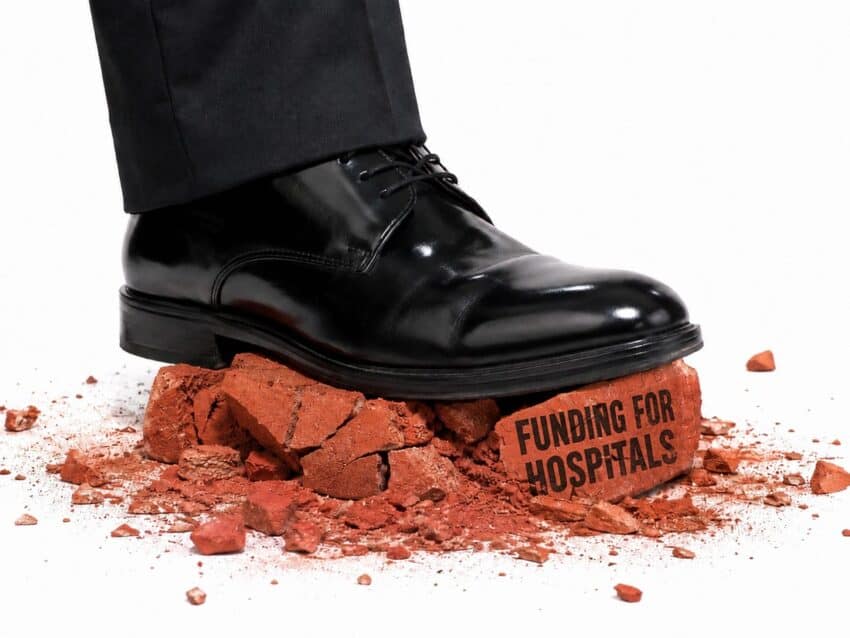
Because in April 2025—several months and one new president later—the Trump administration announced it was ending the program.
Why?
Because FEMA called the BRIC grants “wasteful and ineffective” and canceled funding. Which created an awkward situation for communities that had already been told they won a grant.
Imagine getting into college, paying the deposit, renting an apartment, buying the sweatshirt, arriving for orientation and receiving an email saying the university has reconsidered the whole concept of higher education.
You would have questions. So did Astoria.
The hospital hadn’t become less vulnerable. Cascadia hadn’t moved. Engineers hadn’t discovered the project wouldn’t work. Nobody had found a cheaper way to keep an emergency department running after a magnitude 9 earthquake.
None of that. The facts hadn’t changed, but the politics had.
See, this is one of government’s most frustrating contradictions. We ask communities to plan in decades while Washington operates in election cycles. A bridge may serve generations. A wastewater plant may last 50 years. A hospital being built today may still be treating patients long after everyone currently fighting about it is gone. But federal policy can reverse direction every four years.
Eventually states sued—thank you, Attorney General Rayfield. Courts got involved. A judge ordered FEMA to restore the program.
All fixed, right?
Nope.
As of last week’s press conference, CMH still hadn’t received the $14 million. The hospital says it has received little word from FEMA about when—or whether—the money will actually arrive.
Think about that for a moment. The community identified the risk. It did the engineering. It raised the match. It competed nationally. It won. The federal government canceled the program. A court told the federal government it couldn’t do that.
And the hospital is still waiting.
Meanwhile, construction doesn’t wait. Contractors don’t wait. Concrete certainly doesn’t wait. The bill keeps arriving whether Washington has finished arguing with itself or not.
That’s what happens when politics beats governing.
Please Don’t Make Me Think About the Bridge
This is why I have a lot of respect for leaders willing to govern. There aren’t many political rewards.
If you strengthen a bridge and the bridge survives an earthquake 30 years from now, nobody will know which bolt, bearing or engineering decision saved it. People will simply drive across. Maybe a nurse on the way to the hospital. Maybe an ambulance. Maybe some dentist listening to a podcast on his way to work.
But you know what won’t happen? They won’t stop halfway across and applaud the seismic retrofit.
And they shouldn’t—especially since they are probably 20 minutes late for a meeting in Cannon Beach because the driver of the RV with Washington plates has been driving 20 mph under the speed limit for the last 20 miles.
Ask me how I know.
Anyway, nobody should stop and admire the retrofit because the whole point was to make the bridge forgettable. And that’s the strange reward for good government: sometimes success means spending a lot of money so that absolutely nothing happens.
The bridge stays up. The water is clean. The kid learns to read. The road gets you home. The hospital is there when you need it.
There will always be more exciting things for politicians to talk about. Another outrage. Another fight. Another election. Another clip bouncing around the internet for 36 hours before everybody forgets what they were angry about.
Let politics have the excitement. I’ll take boring. I’ll take a drive to work across a bridge so reliable that I forget there are several hundred tons of concrete and steel underneath me holding my car above a river.
I’d rather zone out to a podcast. Maybe something about gum disease. Or cavities. You know, the important stuff. And somewhere underneath me, an engineer I will never meet will have done his job so well that I never think about him or her at all.
That’s not much of a political slogan. But it sounds like pretty good government to me.
