











By Jim Heffernan
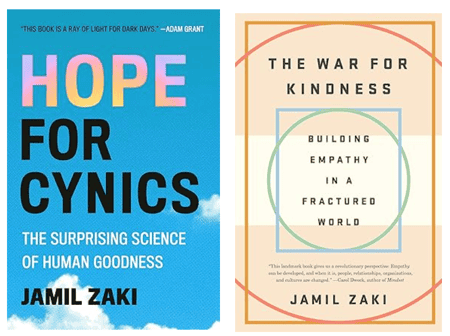
I’m not sure where I came across it, but this two-fer began with the 2019 book dedicated to “building empathy in a fractured world”. I then found out about his 2024 Hope for Cynics and I found myself reading both books, not always positive which e-book was my screen. Both books are about 300 pages. Both books offer valuable insights into changing our personal viewpoints. If enough of us change, our society will change along with us.
Jamil Zaki was born in 1980, the son pf a Peruvian mother and a Pakastani father who met as immigrant students in Pullman, WA. They divorced when he was 8 and his formative years were spent in shared custody. It was an ideal incubator for developing a keen sense of empathy.
He became a psychologist and has specialized in studying the qualities we lack as a society and the qualities we cling to too tightly.
Hope and empathy are qualities that our society needs more. We could also benefit from having more skepticism about our personal beliefs.
Cynicism is an attitude that we gravitate toward too easily. It makes us mistrust others as a reflex. Cynicism extinquishes hope.
Maybe I’m a frustrated psychology major, but I enjoyed the books and highly recommend them.
I’ll close with some excerpts that make his points better than I can.
“Cynicism is not a radical worldview. It’s a tool of the status quo. This is useful to elites, and propagandists (use it to) sow distrust to better control people.”
― Jamil Zaki, Hope for Cynics: The Surprising Science of Human Goodness, Page 7
“Lawyering is a fine way to argue, but a terrible way to learn. A growing science finds that real wisdom arrives when people know what they don’t know. Likewise, social wisdom doesn’t mean believing in everyone or no one. It means believing in evidence–by thinking less like a lawyer and more like a scientist. And despite the different instruments they use, all sorts of scientists share an intellectual tool: skepticism, the questioning of old wisdom and hunger for more information. Skeptics update their beliefs based on new information, allowing them to adjust to a complex world.”
― Jamil Zaki, Hope for Cynics: The Surprising Science of Human Goodness, Page 31
“Studies reveal a recipe for disagreeing better:
1) Good disagreers ask questions instead of making statements.
2) They work to get underneath people’s opinions to their stories.
3) When they spot common ground, good disagreers name it.
4) When they are unsure about something, they say so rather than pretending to be confident.”
― Jamil Zaki, Hope for Cynics: The Surprising Science of Human Goodness Page 145
“When problems hide under the surface, light can be the best disinfectant. But in our politics, plenty of rot is visible already. What’s hidden all around us is a peaceable, inquisitive majority drowned out by extreme voices.”
― Jamil Zaki, Hope for Cynics: Hope for Cynics: The Surprising Science of Human Goodness Page 143
“In humans, empathy took an evolutionary quantum leap. That’s a good thing for us, because physically, we’re unremarkable. At the dawn of our species, we huddled together in groups of a few families. We had neither sharp teeth, nor wings, nor the strength of our ape cousins. And we had competition: Just thirty thousand years ago, at least five other large-brained human species shared the planet with us. But over millennia, we sapiens changed to make connecting easier. Our testosterone levels dropped, our faces softened, and we became less aggressive. We developed larger eye whites than other primates, so we could easily track one another’s gaze, and intricate facial muscles that allowed us to better express emotion. Our brains developed to give us a more precise understanding of each other’s thoughts and feelings. The War for Kindness: Building Empathy in a Fractured WorldPage 6
Both books are available at Cloud and Leaf Bookstore, Manzanita and Tillamook County Library.
As always, discussion welcome at codger817@gmail.com
