











“No death is so sad and final as the death of an illusion.” – Arthur Koestler
By Marc C. Johnson
Labor Day, the unofficial start of the political campaign season, seems like an appropriate point in time to offer a suggestion or two about how we might think about the 2026 mid-term election, a genuine reckoning, I think, where we decide the near – and possibly long – term direction of the country.
But before I go there …
Not to kick ol’ Joe Biden, even if everyone seems to enjoy it, but it now seems to me that Biden’s effort to cast his presidency and his ill-fated re-election bid in 2024 as a fight to save democracy was a strategic misfire.
Truth be told many Americans either really don’t embrace the fundamentals of a democratic system or they slept through what little education about our system they were subjected to in school.
After all, you can’t “save” or “defend” democracy if you don’t really understand the basics of what life in a democracy requires, or more correctly demands. Simply put, the constiuency for democracy has been steadily evaporating for a long time due to cynicism, bad leadership in both political parties, failure (by both parties) to really address big, important issues, and partisan anger. Lots of reasons for the anger, but that’s for a different day.
So when Biden said he was fighting for the “soul of America” I think many Americans just didn’t get what he was saying. And if what many Americans were seeing and feeling was Biden’s idea of “democracy” many didn’t value it much, if at all.
An even more pessimistic view – and there is considerable evidence for this – is that a significant number of our fellow Americans don’t really want to “save” democracy. They don’t embrace the messiness of the decision making, the ambiguity and incompetency of what passes for much of Washington, DC government today, the need for real compromise, the even greater need for restraint, and the necessity of respect for tradition and institutions that is inherent in a democratic system.
As long as their side wins, at least most of the time, a system that permits the “winning” is A-OK with those who could largely care less about democracy. The current would be American strongman’s cult following is largely of this persuasion.
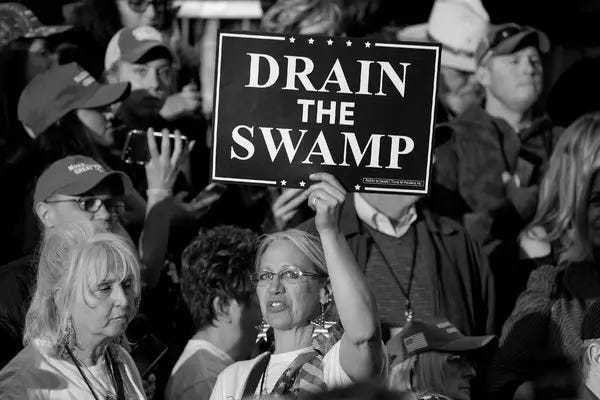 |
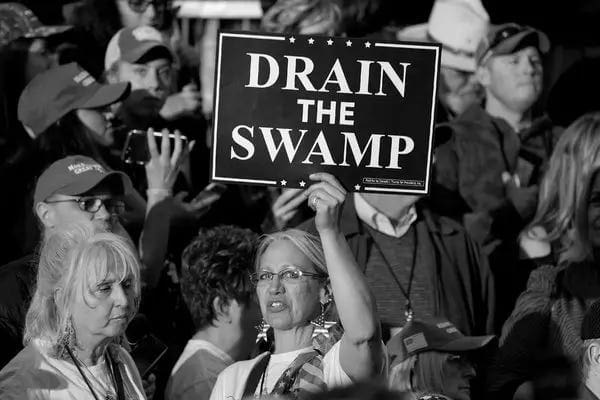
A Trump rallying cry has become a central feature of his corrupt tenure
So, I think Joe Biden had the right objective in mind, but the wrong strategy. Rather than saving democracy we need reform of democracy and an end to public corruption that now runs wild in the American system.
And bringing about real reform and ending real corruption is what the mid-term elections should be about.
It’s the corruption, stupid
One of my go-to sites for political news is Political Wire, a curated digest of daily, even hourly political news. The site does a great job of weeding out the best political coverage from the mass of garbage.
I was struck by this piece on Political Wire on Labor Day. The account is from Forbes:
“Donald Trump loves hot dogs—loves them. But he reserves a particular devotion for the ones served at the snack shack beside the 11th tee box at Trump National Golf Club outside Washington, D.C.—wieners that, on Trump’s personal scale of human achievement, probably rank somewhere between mankind’s first glimpse of gold in a riverbed and the construction of Trump Tower.”
Said a former club employee: “He has this weird, very odd pride about how good the hot dogs are. That’s his thing. The chef has to be out there. And he’s like, ‘Chef, get everyone a hot dog—all these guys.’”
“And everyone means everyone—roughly 30 carts full of Secret Service agents included. But the president’s frankfurters are not free … Ethics rules restrict agents from accepting gifts from those they serve. So Trump’s club charges the agency that protects him.”
“There, in one all-beef transaction, is the Trump presidency in miniature: Trump owns the club. Trump controls the chef. Trump doles out the hot dogs. Trump watches everyone eat them. Then Trump’s business sends the government the bill.”
There is such a vast network of official corruption now that it is truly impossible to keep track of even the worst of it – cryptocurrency, grifting off gold coins (talk about devaluing the dollar), the foreign deals benefiting Trump and his family, the Qatar jet, the investments in nuclear energy (highlighted so well here recently by my friend Rod Gramer), and on and on.
Maybe Trump’s hot dogs will start to register amid all this corruption.
Opinion polling seems to suggest something is finally breaking through.
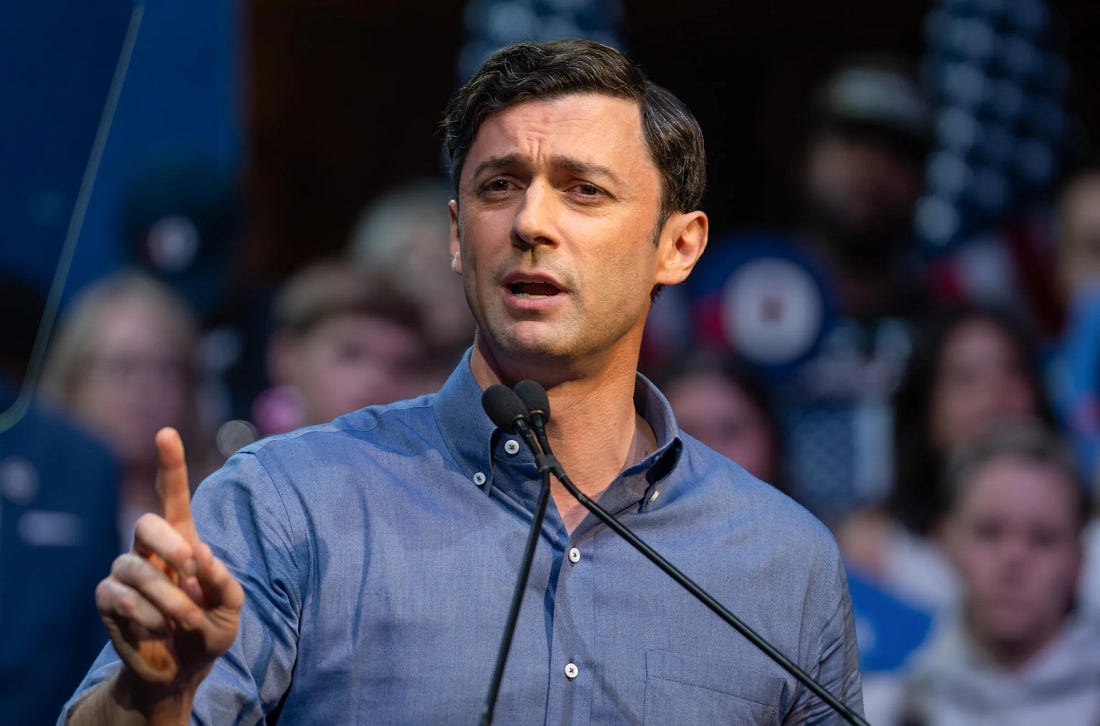 Jon Ossoff of Georgia has made corruption the centerpiece of his campaign, and he’s right to do so
Georgia Democratic Senator Jon Ossoff has made public corruption the centerpiece of his re-election campaign and the young senator delivers a powerful message.
If you haven’t heard Ossoff this is a good example of what he’s been saying about corruption and self-dealing from the very top of American politics.
Ossoff says simply of Trump: “He’s trying to get money … he is an absolute crook.”
He speaks directly, simply and powerfully to the “rot” in the American political system personified by Donald Trump.
As the AP reported about Ossoff:
… his 2026 breakout has been anchored by a stump speech built around a withering take down of the president. He mocks Trump’s social media blitzes on Truth Social and proposals to put his face on U.S. money.
“When he’s not posting, he’s been trying to rob us. Have you seen it?” Ossoff asks, shifting to allegations of corruption and incompetence.
He ticks through Trumps’ lawsuit against the Internal Revenue Service, his idea for a restitution fund that could compensate Jan. 6 rioters and foreign business deals by his sons. “Prince Don and Prince Eric,” Ossoff calls them.
He blasts Trump’s tax cuts as tilted to the rich, his effort to shield the Jeffrey Epstein case files, and an Iran war that “no one voted for and no one can explain.”
“All this while you pay more for gas, for groceries, for healthcare,” he says.
This is, I submit, a powerfully effective indictment against Trump and the larger movement he has spawned.
And reform democracy, don’t just save it
While many of us were getting on with our lives, raising kids and helping them get through school, working hard and (I hope) saving a little money, our democracy was truly rotting away. Too much money; too many old white men holding on to something like power, too much insider dealing with members of Congress trading stocks on the kind of information that could send most of us to jail, attacks on institutions like the military and on common sense.
A reform agenda is emerging, too slowly I fear, but still emerging.
- Fixed terms for members of the Supreme Court.
- An ethics code for members of the Court.
- Expansion of the Court. (I can’t believe I’m saying this, but it has to happen to bring new people and ethics back to the Court.)
- Establish clear and enforceable conflict of interest rules for federal officials, particularly including the president.
- A Constitutional amendment that says no president is above the law. The Supreme Court’s immunity decision emboldens political corruption and it must be changed. Let Republicans vote against it while the backlash builds.
- Bans on stock trading for the president, his Cabinet and every member of Congress and the judiciary. Getting elected or appointed to high office shouldn’t be a license to get rich, but it has become that.
- Statehood for the District of Columbia – finally – and Puerto Rico if they want it.
- Get at least some of the money out of politics. This is difficult (see Supreme Court), but Montana is about to test the limits of what can be done at the state level to limit money in politics.
- End gerrymandering by mandating that redistricting be done by independent commissions in every state.
- Restore and to the extent possible, strengthen the Voting Rights Act.
- Since the so called “American healthcare” system is broken, too costly and leaves too many people to fend for themselves, reform it. I’m not sure of the answer – Medicare for all, a public option or a Canadian-style system – but what we have is simply not sustainable. It must be fixed, or at least improved.
I’m sure there is more. And none of this will be easy, but we must get started.
The death of illusion
I began this piece with a quote about the death of an illusion from the Hungarian-born journalist and anti-fascist Arthur Koestler.
George Orwell wrote, not always approvingly of Koestler, including an essay written in 1944 in which the also anti-fascist Orwell – a Brit – names several contemporary writers of whom he says:
Some of these are imaginative writers, some not, but they are all alike in that they are trying to write contemporary history, but unofficial history, the kind that is ignored in the text-books and lied about in the newspapers. Also they are all alike in being continental Europeans. It may be an exaggeration, but it cannot be a very great one, to say that whenever a book dealing with totalitarianism appears in this country, and still seems worth reading six months after publication, it is a book translated from some foreign language.
Koestler was a controversial and often conflicted character (deeply flawed by many accounts), but he had observed totalitarianism up close in Spain and in Soviet Russia in the 1930’s and he managed to get out of France just before the Nazi invasion only to be imprisoned by the British when he got to England. ¹
Koestler’s quote: “No death is so sad and final as the death of an illusion,” speaks to me as I deal with the death of my own illusions about the country.
We have, I think, one more election to start to turn the ship of state in a better direction. And the ultimate goal is to save democracy, but we start to save it by acknowledging and resisting with all we have the corruption we see daily, while hoping it hits home with enough Americans, and then by reforming democracy to give a new generation a fighting chance to make America what I once thought it had the ability to become.
Thanks for reading.
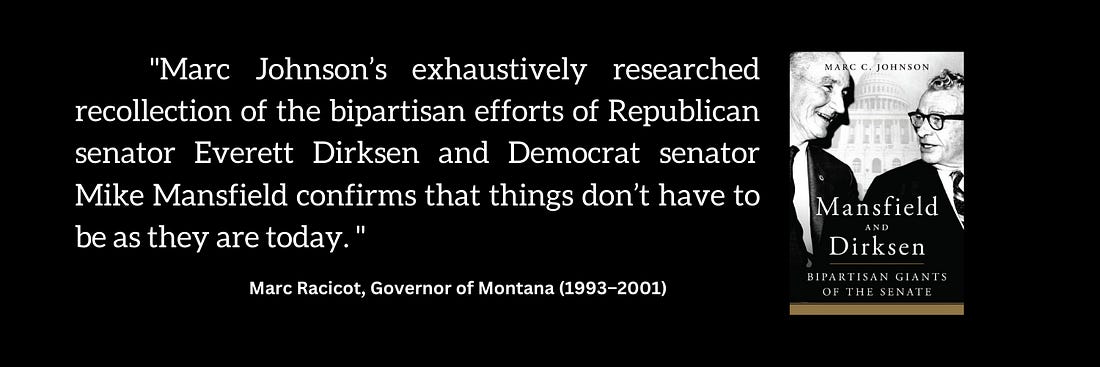
It’s difficult to be an optimist in today’s world and I’m not all that optimistic, but I do focus on realism and try to populate my writing with solid sourcing and not merely opinion. I write these pieces to offer a perspective based on history and particularly American political history since 1900.
These essays are free, but a financial contribution helps support my writing and research, including a new book in progress.
Subscribe to Marc’s Substack for $8 a month or make a pledge.
Many thanks.
 Subscribe here for more