By Representative David Gomberg, House District 10
9/28/2026
Dear Neighbors and Friends,
In about two weeks, Oregon voters will receive ballots for the November General Election.
This is a consequential election. And while we will not be selecting a new president, we will vote for a US Senator serving Oregon in Washington DC, all six representatives in the United States House of Representatives, our Governor, 60 members of the Oregon House, 15 members of the State Senate, county commissioners, mayors, and city council members along with a number of local bonding measures.
There are no statewide measures on the November 3, 2026 ballot. That’s particularly notable in a state with a long history of citizen-led initiatives. Nearly 90 prospective statewide initiatives were proposed for the 2026 election cycle, but most never made it through the signature-gathering process.
Voting matters, and I want to take some time today to ensure that your vote counts and is, in fact, counted.
State election records show approximately 3.2 million people are eligible to vote in the state and approximately 2.99 million are actually registered.
To be eligible, you must be a U.S. citizen, a resident of Oregon, and at least 16 years old. If you are not yet 18 years of age, you can register but will not receive a ballot until an election occurs on or after your 18th birthday.
You can register online, or you can complete a Voter Registration form and return it to your county elections office.
October 13, 2026, is the last day to register to vote. Registration cards postmarked by this date or submitted online no later than 11:59 pm are valid.
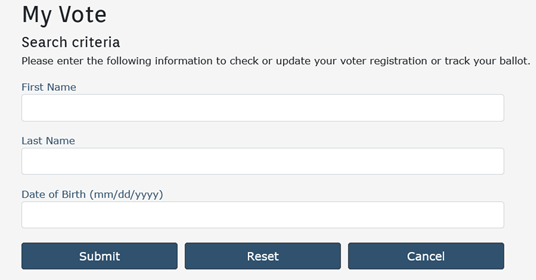
If you are already registered or think you might be registered to vote, use My Vote to:
- check if you are registered to vote
- view your voter registration information
- update your voter registration
- check the status of your ballot
- find contact information for your county elections office
- find contact information for your elected officials
- find a ballot drop site
|
|
| Starting September 29, the State Voters’ Pamphlet will be available online. Between October 7 and 9, the official State Voters’ Pamphlet will be delivered to every residential address in Oregon.
The Pamphlet you receive in the mail will cover races in your region with inserts for local races. If you are interested in legislative races for other parts of the state, check out the complete State pamphlet online. To see local races, go to the county web page.
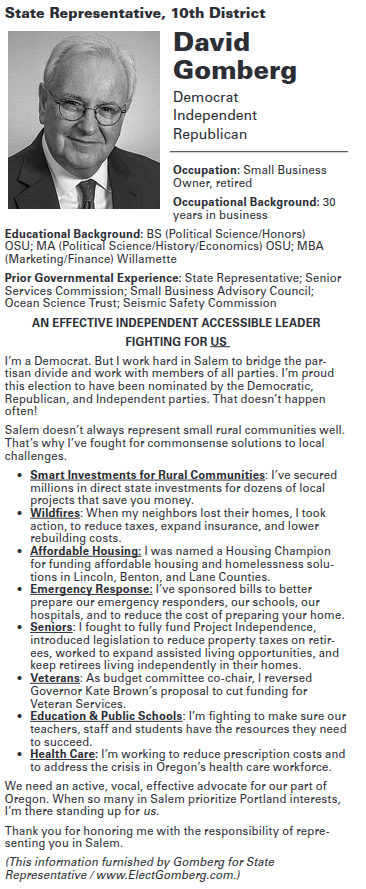
Unfortunately, not all candidates appear in the pamphlet. To be included, you must provide the necessary information, verify any quotes you include with signed authorization from the person or organization, and pay a fee. And of course, there is a limit on the number of words you can include.
There are three parts to each posting. There is a photo along with your name and the position you seek. There is required information including your occupation, education, and experience. Publishing inaccurate information here is a serious election violation. And finally, there is a narrative section where candidates can offer their positions on issues, endorsements, opinions, or just about anything else.
Here is an example from 2024: |
|
| The official Voter Pamphlet is an important tool for comparing and contrasting candidates. And of course, you will see plenty of other information in your mailbox, television and radio, social media feeds, text messages, and on lawns and vacant lots everywhere.
Ballots will be mailed to voters on October 14. |
|
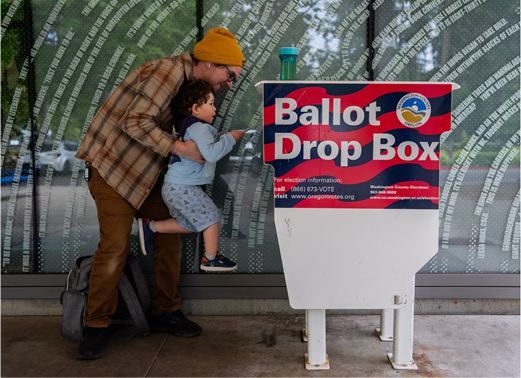
| Matt lifts up his 3-year-old son, Theo, to cast his ballot at a ballot drop box in May 2026. Election officials are increasingly recommending voters plan to use drop boxes rather than mailing their ballot. (Photo by Eli Imadali/OPB) |
|
| Here in Oregon we pride ourselves on our mail-in voting system. We enjoy the convenience, the time we have to carefully consider ballots at home, and the increase in participation that mail-in encourages.
Oregon was the first state to establish vote-by-mail. Political scientists say Oregon’s system contributes to its highest-in-the-nation rate of voter turnout. The voting equipment is never connected to the internet. We avoid computer-based voting machines and maintain a “paper-trail” for each ballot. And while there has been concern voiced of late about mail-in security, a review of the vote by mail system by the state’s Legislative Fiscal Office found from 2000-2019 there were approximately 61 million ballots cast. Of those, 38 criminal convictions of voter fraud were obtained. This amounts to a 0.00006% rate.
Earlier this year, the federal government proposed limits on mail-in voting. But this month, the U.S. Supreme Court rejected President Donald Trump’s attempt to restrict mail-in voting ahead of the 2026 midterm elections, blocking changes that would have caused major disruption just days before the first ballots are sent to Oregon voters.
The decision was the latest in a series of court rulings preserving states’ constitutionally-granted authority to administer elections and allowing existing mail-voting rules to remain in place for the midterms.
So to be clear, Oregon voting will continue as usual. Oregon will vote-by-mail in the November election.
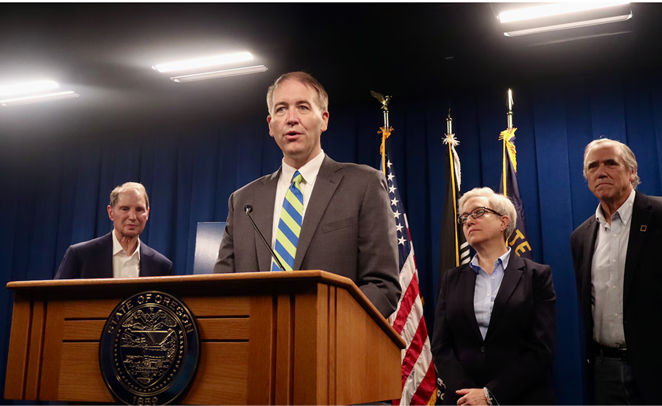
“Our elections will go forward as they normally do,” Secretary of State Tobias Read said at a press conference at the Oregon State Capitol in Salem. “All eligible Oregonians will receive their ballots by mail for the upcoming election and should plan to return them using a secure official dropbox or by mail.” |
|
| Oregon Secretary of State Tobias Read expresses confidence in Oregon’s election system at a press conference on Tuesday. He was joined by U.S. Sen. Ron Wyden, Gov. Tina Kotek, and U.S. Sen. Jeff Merkley. Carlos Fuentes/The Oregonian |
| That said, voting by mail has become a bit more difficult.
To be counted, ballots that are mailed must be postmarked by election day, November 3. That used to be as easy as dropping an envelope in the mailbox. But the struggling US Post Office has been consolidating its operations with an emphasis on regional hubs in an effort to save billions of dollars. That means mail posted from Yachats or Eddyville or here in Otis goes to Portland to be postmarked. And that can take an unpredictable number of days.
According to Secretary Read, some 7,314 ballots that arrived in the mail during Oregon’s May primary election were not counted, because they were postmarked after Election Day —a rejection rate of 13%, up from 9.5% two years earlier.
In a written statement, the Postal Service acknowledged that changes in how it transports mail could result in postmarking delays. It noted that anyone who wants to ensure their ballots are postmarked on time can go into a post office and ask for it to be stamped manually, free of charge.
For this reason and others, I’m asking you to vote earlier. You will have your ballot about two weeks before election day. If you are going to post it, do so by October 27—a week before the deadline.
Better yet, use an official ballot drop box. |
|
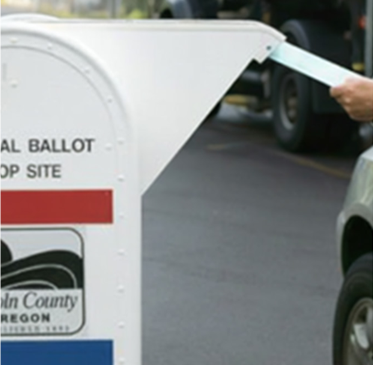
| Ballots placed in official drop boxes go straight to county election workers without passing through external shipping networks. Drop boxes are heavy-duty, locked, and securely anchored. Election staff collect ballots on a strict, monitored schedule.
There is a drop box at each county courthouse and city hall. You can also locate drop box sites at My Vote. Ballots deposited in an official drop box must be received by 8 pm on election day.
Relying on a drop box is possibly an inconvenience for some older or rural voters. During Legislative Days this month, the Emergency Board where I serve approved nearly $500,000 to purchase more drop boxes for the November election, and to compensate elections officials for the increased use of ballot drop boxes anticipated this year.
So again, you can use a drop box, post your ballot early, or take it to a post office and request a postmark at the counter.
Election day is November 3. Preliminary results are announced on county and the Secretary of State web pages just after 8 p.m. when the polls close. (Remember that county sites only report county results. For statewide or larger district elections, a county will only report their own portion of the total.)
Because mailed ballots may continue to be received for several days, closer races may remain undecided for several days. Final election results are certified by December 10.
And that, dear readers, is probably more than you wanted to know about our current election. But as I said earlier, elections matter, and I want your vote to count and be counted.
I won’t use these newsletters to advocate for any particular candidate or measure. But I will remind you that races lower on the ballot—city and in other elections, school boards, college boards, and special districts—get less attention but often have a greater effect on your daily life.
As a legislator, I can send money to schools or local sewer districts. Local electeds allocate that money. City leaders decide to fill the pothole in front of your house, school boards negotiate class sizes, fire districts keep you safe, and water districts decide if clean water comes out of the tap. So please take time to educate yourself about local candidates and the important work you entrust them to do.
Please vote thoughtfully, early, and use drop boxes if you can. |
|
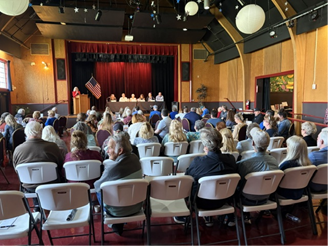
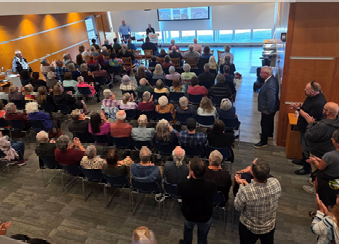
| Last week, I attended and even moderated candidate forums in Newport and Lincoln City. And I attended a remarkable state-of-the-city presentation in Newport. |
|
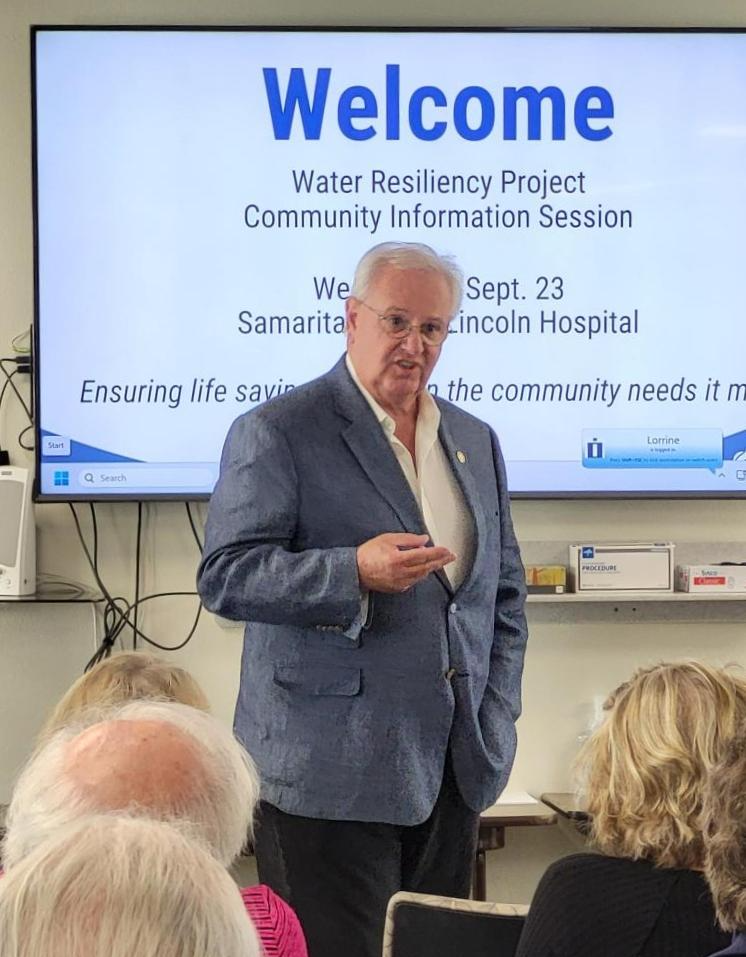
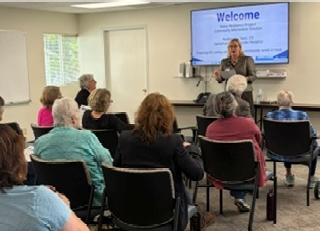
| I also met with community leaders from our Samaritan hospitals to talk about water and generator fuel storage. Across Oregon, we urge families to be two weeks ready, but our dozen coastal hospitals can, on average, store only three days of water and fuel.
I’m proud of our new hospitals here at the coast and understand that budgets were tight building them. But we failed back then to invest in resilience and are working now to make thoughtful adjustments. Samaritan has received $500,000 for water storage planning, and I’ll continue to pursue state dollars to help all of our hospitals be better prepared for outages and emergencies. |
|
| I also met with the Oregon Ports Association to discuss dredging, tariffs, and needed repairs. Reductions in transportation funding this year hit our ports hard as they rely on Connect Oregon funds for freight, harbors, and working waterfronts.
Tuesday, I will be in Coos Bay to chair a meeting of the Blue Economy Task Force.
Oregon’s blue economy includes the businesses, industries, Tribal Nations, technologies, and practices that use and support the state’s ocean, coastal, and working river resources in ways that strengthen economic opportunity, create and sustain good jobs, and protect the health of our marine and coastal ecosystems.
The Task Force will examine opportunities and challenges across sectors including fishing, aquaculture, seafood processing, ports and shipping, tourism and recreation, marine science, renewable energy, and other related industries.
Tuesday evening, I rush back to Newport to address the Oregon People’s Utility District Association (OPUDA) Annual Conference.
Then Wednesday, Susan and I will drive north where one of our district’s many wonderful artists will be celebrated at the Seattle Art Museum.
The Oregon Coast Jazz Party begins on Friday, and there may still be a few tickets left.
And then the following week, I’ll be packing and finalizing plans as I lead an Oregon Trade Delegation to China and discuss ports, commodities, and even kites. More about that in my next report. |
|