| With all of that said, each year, Oregon sends several trade delegations to China. For many years when Susan and I ran our small business, we successfully worked with small family enterprises in China. I traveled there annually. We imported containers each year. We built relationships.
That is a unique background among Oregon legislators, few of whom are engaged in any business enterprise. And so I’ve been kindly invited to participate in these trips each year. Usually the timing did not work. This year it does.
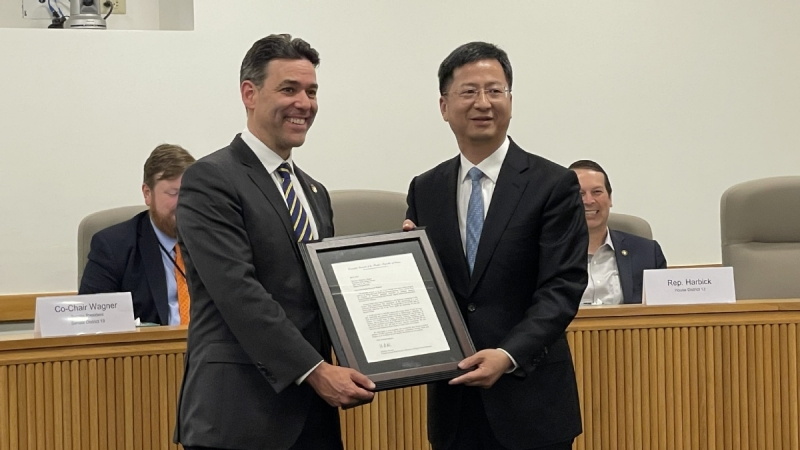
In 2025, Senate President Rob Wagner led a bi-partisan Legislative and Trade Mission. He later said firsthand experience and collaborative action drive progress and reflect the power of subnational diplomacy. A Senate-led group went again to China earlier this year with a focus on Oregon farmers and exporters. The delegation resulted in a landmark commitment to purchase 80,000 metric tons of Oregon alfalfa hay annually.
As Speaker Pro Tempore, I’ve been asked to lead another small group this Fall.
Why go to China?
China remains one of the most consequential markets for a broad range of Oregon products and services, including agricultural commodities, consumer and industrial goods, clean-technology inputs, and advanced manufactured products. Oregon’s export profile—particularly in semiconductor-related products, agriculture, and globally recognized outdoor, athletic, and consumer product ecosystems—depends on access to large-scale international markets. In that context, China is not simply another trading partner; it is a market of sufficient scale to influence production, investment planning, supply-chain stability, and the commercial confidence of Oregon businesses.
Trade with China outpaced Mexico by $900 million, exceeded Canada by more than $3 billion, and was more than four times the size of Japan as an export destination for Oregon goods.
Oregon–China Trade in 2025:
- China: $5.4 billion in goods exports (19% of total goods exports)
- Mexico: $4.5 billion
- Malaysia: $3.5 billion
- Canada: $2.3 billion
- Japan: $1.3 billion
International trade plays a critical role in sustaining Oregon jobs, particularly in manufacturing, agriculture, logistics, and related services. Oregon–China trade supported approximately 21,600 to 27,000 jobs across manufacturing, agriculture, transportation, warehousing, wholesale trade, and professional services. Export-supported jobs in sectors such as advanced manufacturing, semiconductor-related production, agriculture, transportation, and trade-supporting logistics tend to be more productive and better compensated than many locally oriented service jobs.
According to data from the Office of the United States Trade Representative, Oregon exported billions of dollars in goods to China.
- Computer and Electronic Products: High-tech goods—especially semiconductors, microchips, and electronic components—make up roughly 73% of Oregon’s total exports to China and Hong Kong.
- Industrial Machinery and Equipment: Factory machines, engines, and industrial tools are major drivers of the trade.
- Chemicals and Fertilizers: Specialized chemical preparations, pesticides, and fertilizers also rank high on the shipping list.
- Agricultural Products and Lumber: Local farms and ranches ship goods like wheat, hazelnuts, berries, and timber overseas through regional shipping hubs managed by the Port of Portland.
All of that is to say that international trade produces Oregon jobs. Here on the coast, we don’t produce industrial machinery or semiconductors. But we do produce and export some of the finest seafood in the world, are planning a major international port expansion that could produce 2,500 coastal jobs, and explore the ocean science on which all of this depends.
Relationships matter in business. That includes student-to-student, manager-to-manager, and government-to-government. So as a leader in our legislature, I’m pleased to accept the responsibility to lead this 2026 effort.
Let me share a very small example of how that works.
Many of you know that I’ve spent a lifetime as a hobbyist and entrepreneur building, flying, and selling kites. Forty-five years ago, I traveled to Weifang, a city in China’s Shandong Province regarded as the actual birthplace of kite flying.
Among the many, many people I met was a young family that shared my passion and business interests. We became friends and collaborators. Susan and I designed, and they produced. Over the following decades, Gomberg Kite Productions became industry leaders and the fifth largest wholesaler of kite products in the USA. I was named an honorary citizen of Weifang and later inducted into the International Kite Hall of Fame. All of that was based in little Neotsu, Oregon and largely resulted from relationships and common interests across the Pacific. |