











By Leanna Coy, FNP-BC
Mark has struggled to keep a job. At 35, he hasn’t worked in one place for more than a year, citing frustrations with coworkers or problems keeping up with the work. In his free time, Mark spends hours focused on his computer. He admits he loses track of time because he gets so absorbed in a game or goes down an internet rabbit hole.
Some might see him as lazy, but these issues have plagued Mark since his childhood. Teachers called him a distraction. He never completed his homework and failed to graduate. Once, a teacher suggested he had attention deficit disorder (ADHD), and his parents took him in for an assessment. The doctor said he wasn’t hyperactive and dismissed an ADHD diagnosis without completely assessing him. More than 55% of adults with ADHD aren’t diagnosed until after age 18, and Mark is one of them.
Changes with diagnosing ADHD
For many years, ADHD was considered just a childhood illness. But over the last several years, adult ADHD has received much more attention. So much so that the first treatment guidelines for adults are under development by the American Professional Society of ADHD and Related Disorders (APSARD). The guidelines, expected later this year, are intended to help health care providers diagnose and treat adult ADHD.
According to the Centers for Disease Control and Prevention (CDC), as of 2023, the most recent statistics available, an estimated 15.5 million adults in the United States are diagnosed with ADHD. That’s 1 out of every 16 adults.
Why so many diagnoses are missed
ADHD was historically considered a condition only expected in children. If someone didn’t show symptoms before age 12, or if the symptoms were mild, they often weren’t diagnosed. ADHD was also most often diagnosed in boys, so many girls went undiagnosed. In adulthood, the sex differences in diagnoses begin to level off.
Because ADHD was previously only treated in children, many health care providers did not receive training in diagnosing and treating the condition in adults. Without comprehensive guidelines, many providers remain unsure how to diagnose adults. The look-alike symptoms of other conditions such as anxiety, depression, sleep problems, or addiction issues also confound diagnosis. When these individual conditions are taken as a whole, a better and more accurate picture of ADHD is formed.
The impact of untreated ADHD
 Untreated ADHD in an adult can negatively impact many aspects of their life. They’re often impulsive – spending money recklessly or acting without considering consequences. They may feel an inner restlessness that often shows as an inability to sit still, constant leg shaking, or finger tapping. Time management is problematic, with them constantly running late or leaving multiple projects unfinished.
Communication with others is often challenging, as they struggle to focus and maintain conversation threads. This can strain both work and personal relationships. Coworkers may perceive them as inattentive, disorganized, and less reliable, and frequent miscommunications can occur. Family and friends may feel frustrated and undervalued when important details are missed because of untreated ADHD. The individual can struggle to remember important dates, appointments, or follow through with commitments. Friends and loved ones may interpret this as a lack of interest or dependability.
A lack of treatment for ADHD can lead to emotional and mental health issues. Emotionally, the person may experience rapid mood changes and struggle to manage stress. Anxiety is common due to feeling overwhelmed with persistent concentration and time management issues impacting daily life. Poor social interactions can lead to low self-esteem. Long-term, these issues can lead to depression.
How adult ADHD is managed
Effective treatment can improve the quality of life for many adults and their families. Treatment helps reduce symptoms and improve the ability to function. Common treatment options include medication and psychotherapy. Medications are usually in the form of stimulants, but non-stimulants are also prescribed. The medication doesn’t cure ADHD but helps to reduce and manage symptoms. Users can more easily ignore distractions, improve their focus, and better control their behavior.
Psychotherapy helps adults with ADHD learn skills to manage day-to-day functions better. This therapy helps adults better understand their thoughts and feelings. This can improve relationships and self-esteem. Cognitive behavioral therapy (CBT) teaches coping strategies and how to change negative thought patterns. Often, adult ADHD treatment combines elements of psychotherapy along with medication.
Taking the next steps
If you are wondering if some of your life struggles may relate to ADHD, it’s time to talk with a health care provider. Use the attached self-assessment tool to help you determine if you have symptoms consistent with ADHD. If it shows you have symptoms consistent with ADHD, it may be helpful for you to talk with your healthcare provider about getting formally evaluated. Be aware that your health care provider may fall into the category of someone who is not comfortable or familiar with diagnosing ADHD in adults. They can, however, refer you to someone who can assess you.
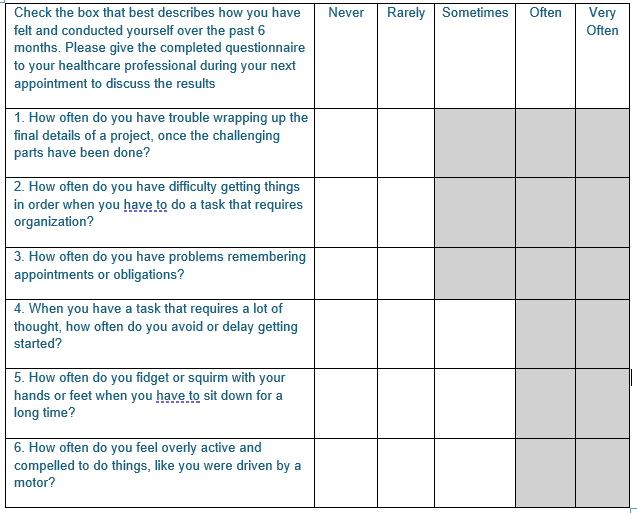
Add the number of check marks in the darkly shaded area. Four or more check marks indicate that your symptoms may be consistent with Adult ADHD.
