








“Too bad that all the people who know how to run the country are busy driving taxicabs and cutting hair.” – George Burns
By Marc C. Johnson
Horse race reporting on politics is about 97.3% of all the reporting we get in our crazy, misinformed country. So we shouldn’t be surprised that an old-time political dirty trick is, to borrow a phrase, “roiling the Alaska U.S. Senate campaign.” We always need a story that “roils” right before we vote.
You’ve probably read the details from the Last Frontier:
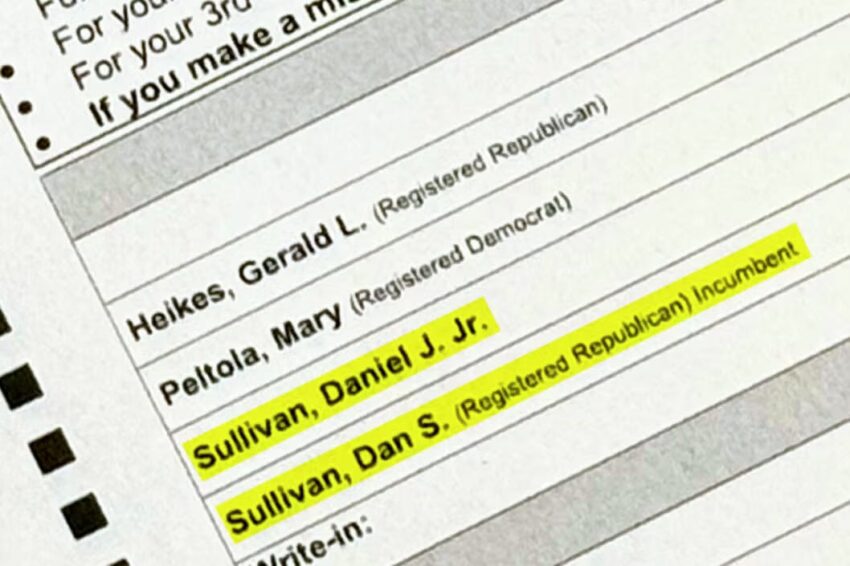
- Political consultants (read: often stupid, but very aggressive people who get paid way too much to produce way too little) associated with Democrat Senate candidate Mary Peltola apparently engineered a scheme to get an Alaska guy with the same name as the Republican incumbent – Dan Sullivan – to run for the Senate.
- The idea, apparently, was to confuse the rubes up in Nome and down in Wrangell so that Senator Dan S. Sullivan loses a few votes to the other Dan Sullivan – Daniel J. Sullivan, Jr.
- The New York Times, in particular, made this junior high school-level prank a front page story for most of last week conjuring up reminders – for those with memories – of the way the paper vastly overplayed the Hillary Clinton email “scandal” just before the 2016 election.
- Today the Times has a story to the effect that the old Dan Sullivan Shuffle will (maybe) be the death knell for Alaska’s experiment with ranked choice voting. Yet, the fact that Alaska has rank choice voting make the other story, oh, never mind …
- For her part, Peltola says she had nothing to do with the recruitment of the other Dan Sullivan, but our president, the sage oracle of all that is appropriate and holy in politics, immediately sicced his private law firm, the U.S. Justice Department, on the case and said Peltola ought to be “criminally charged” and removed from the ballot. We have come to rely on Deranged Donnie to give us the straight scoop, right?
- An Alaska judge on Sunday denied the Justice Department’s request to block the certification of Peltola if she is elected.
The actual ballot that is clearly designed to confuse the good people of Alaska is shown above.
I have thoughts about this very late “October surprise”:
- Peltola and everyone else in politics would benefit from depending less – or not at all – on the cunning, cynical political consulting class for campaign expertise. Even if the candidate didn’t know what her consultants were doing in her name she clearly didn’t pick the best people. Most politicians would do better to adopt the wisdom the great House Speaker Sam Rayburn displayed when he discussed the “brilliant” staff and Cabinet that John Kennedy assembled. Rayburn reportedly told Lyndon Johnson that the Kennedy men – they were all men – might truly be very smart, but Rayburn said, “I’d feel a whole lot better about them if just one of them had run for sheriff once.” I’d like to think that a smart Alaska state legislator, county commissioner or sheriff might have provided infinitely better political advice to Mary Peltola.
- Second, this kind of BS happens all the time, including in many Republican campaigns. A dirty trick – unless you’re breaking into the Democratic National Committee headquarters – is hardly a disqualifying offense.
- It is merely stupid. And if stupid is disqualifying, the Senate would struggle to produce a quorum.
- Political reporting is really broken. ¹
The case of the two guys from Nebraska
One of my personal political heroes is probably not someone many of you will recognize.
George W. Norris of McCook, Nebraska was, however, one of the great senators of the 20th Century.
Norris was a Republican at a time when you didn’t have to join a cult or disavow vaccines in order to be in the party. Moreover Norris was a genuine “liberal” Republican. Typically working against the grain of the very conservative national GOP, Norris championed the rights of organized labor and sponsored what became the 20th Amendment to the Constitution moving the presidential inauguration from March to January. Almost singlehandedly Norris conceived of and created the Tennessee Valley Authority, opposed U.S entry into World War I and helped break up the “power trusts” that dominated the electric utility industry before 1935.
As a congressman he took on dictatorial Joe Cannon, the imperious speaker of the house, and broke Cannon’s stranglehold on power.
Norris also invented of and personally helped establish the Nebraska unicameral (one chamber) legislature. A truly remarkable career.
In 1930 Norris was running for re-election to the Senate from Nebraska when a bunch of rich Republicans aligned with utility interests – they hated Norris – came up with the idea of getting a small town grocer from Broken Bow, Nebraska to challenge the senator in the Republican primary.
The grocer’s name – George W. Norris.
But the best laid plans to knock off Senator George W. Norris were derailed when grocer George W. Norris just missed getting his nomination papers to the Nebraska secretary of state before the filing deadline. Grocer Norris mailed the documents before the deadline, as confirmed by the postmark, but the paper work arrived in Lincoln after the deadline.
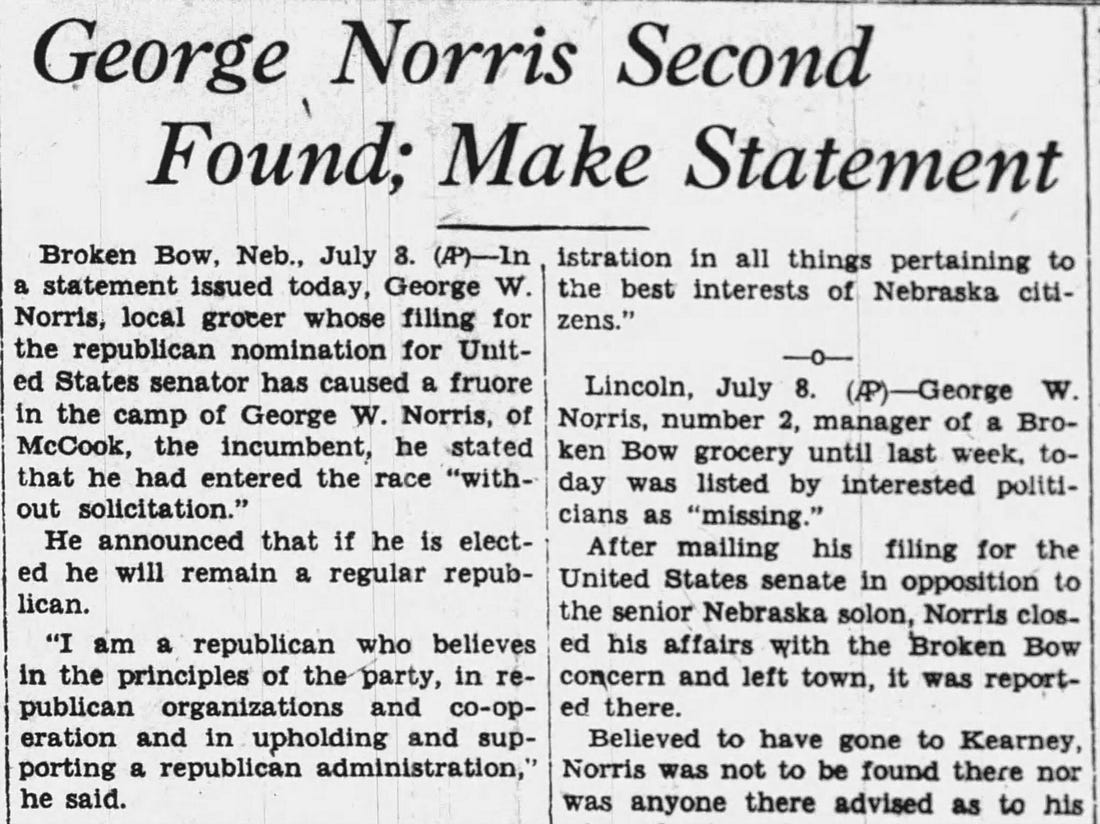 |
Front page Grand Island, Nebraska Daily Independent – July 8, 1930
A legal row ensured, as happens with such things, and while the Nebraska secretary of state ruled that grocer Norris had actually met the deadline requirements, the state attorney general – a close friend of the senator’s – decided that since the paperwork hadn’t physically arrived before the filing deadline it was invalid. A judge upheld that interpretation and the grocer went back to stocking his shelves.
Still a congressional investigation followed and a good deal of good government handwringing.
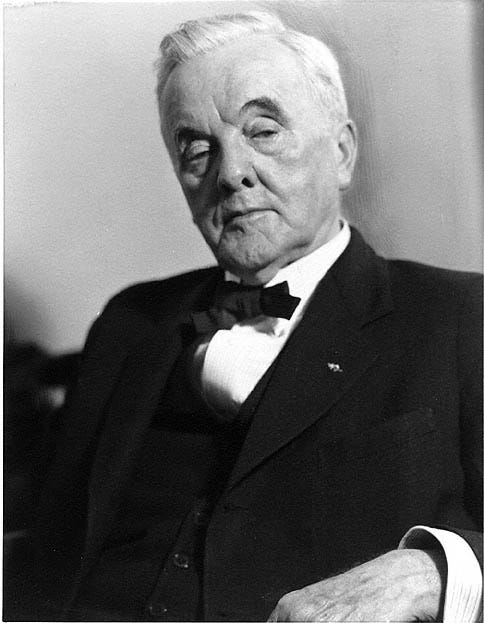 |
The real George Norris
By the way, this additional fact adds some credence to the notion that the political universe is a indeed a small place. The Nebraska attorney general at the time of the Norris caper was a guy named Christian A. Sorensen, father of Theodore “Ted” Sorensen who later served as a key advisor and gifted speechwriter to John F. Kennedy. ²
Like Dan Sullivan, the senator in Alaska, George Norris, the senator in Nebraska, was, as his biographer Richard Lowitt wrote, outraged by this namesake opponent caper, calling the scheme:
“ … one of the most dastardly tricks yet undertaken by any man or set of men who lay claim to respectability.”
It was a dirty trick, underhanded even, but hardly the worst thing that has ever happened in a U.S. Senate race. Lowitt suggests Norris overplayed the entire event for political effect, meaning even a generally exceptional politician can succumb to the tendency to make a mountain out of a mole hill.
Norris easily won re-election in 1930, amid considerable evidence that the dirty trick actually helped his campaign, and then again in 1936. After abandoning the Republican Party to run as an independent Norris lost re-election in 1942, mostly due to his stubborn rejection of conservative politics and his consistent support for Franklin Roosevelt’s New Deal. ³
I’m not sure there is a moral to this story, but there maybe a lesson for political reporters. There have always been small bore scandals in politics and it’s fair and important to examine how a scandal reflects on the character and honesty of a candidate.
Read the Times response to the fairly substantial criticism the paper received for how it has chosen to cover the Alaska story and decide for yourself how big a deal this really is. And then look at the actual ballot again and ask yourself “would I be confused by this ballot” … and then remember that Alaska does have ranked choice voting.
I hope its clear I don’t condone what the less than bright Peltola aides reportedly did to aid her candidacy. They should be named and shamed for the trick, but mostly for their stupidity.
I firmly believe the Times should have written the story, and perhaps even a follow up. It’s the tone and emphasis of the coverage that is problematic.
As media analyst Dan Kennedy – another good source to follow – noted in his newsletter this morning:
It’s not journalism’s role to cover up for a candidate just because we’re in the final days of a campaign. But neither is it to take a routine instance of political gamesmanship and play it up like a major scandal, either.
And to some degree the response from the Trump Administration to the Alaska story was to be totally expected – lock her up, disqualify her, don’t seat her if she wins, the election is rigged, but only if the Republican loses of course.
The Times owns some of that, too.
I’m certainly not alone in believing that political coverage by major national news organizations is badly missing the overriding story of our times, and it’s not a name confusing trick in Alaska.
Covering politics like a football game is just wrong. What needs to be covered – before and after the stupid, dirty trick in Alaska – is what is at stake in the looming election.
What does it mean to the Senate and country to have a Dan Sullivan returned? Another Republican vote for a partisan Supreme Court nominee, the continuing Senate failure to address the Constitutional responsibility of an undeclared war, more support for a Pentagon chief who has brought disgrace and utter incompetence to the job?
I hope Mary Peltola wins tomorrow. I suspect given her background and priorities she’ll bring a lot to a Senate that badly needs new talent. True enough her campaign screwed up. They look stupid for what they have done and deserve to look stupid.
But this was a venial sin, not a mortal one.
The mortal sin occupies the White House.
Be sure and vote.
It’s difficult to be an optimist in today’s world and I’m not all that optimistic, but I do focus on realism and try to populate my writing with solid sourcing and not merely opinion. I write these pieces to offer a perspective based on history and particularly American political history since 1900.
These essays are free, but a financial contribution helps support my writing and research, including a new book in progress.
Subscribe to Marc’s Substack for $8 a month or make a pledge.
Many thanks.
Subscribe here for more
