








By Leanna Coy, FNP-BC
Oregon hasn’t had a reported case of measles since the second week of September this year. That sounds like good news, but it’s only half of the story. Cases this year are higher than average, and many counties are losing herd immunity as vaccination rates continue to decline.
The United States has reached the worst level of measles cases since 1991, with 5,182 confirmed measles cases as of November 5, 2026. This is more than double the 2,289 cases in 2025 and 18 times the 285 in 2024. This week, the Pan American Health Organization (PAHO) is meeting to determine whether the U.S. will lose its measles elimination status. Losing that status would indicate that measles is officially back as an endemic, serious public health concern.
Measles nationally
Measles is a highly contagious disease. For the last two decades, herd immunity from vaccinations controlled the spread. Childhood vaccinations against measles began declining nationally during the 2019-2020 school year and have continued every year since. It is estimated that about 280,000 kindergarteners are unprotected this year.
So far this year, 43 new measles outbreaks have occurred, with cases more than doubling the 2025 case count and jumping more than 18 times the 285 measles cases in 2024. With over a month left in the year, there is speculation that U.S. measles cases could top 7,000. The speed of case growth is not surprising with this highly contagious disease, especially as herd immunity declines. The herd immunity target is a vaccination rate of 93% or higher. This year, kindergarten measles vaccination rates dropped to 92.4%.
A lack of herd immunity is what could lead to the country’s loss of official measles elimination status. This status is a global designation by PAHO, which verified measles elimination in the Americas in 2016. Last year, Canada lost its official measles elimination status due to declining herd immunity and rising measles cases. In addition to the U.S., Mexico, Honduras, and Venezuela are on the cusp of losing their measles elimination status.
Where Oregon stands with measles cases
In April of this year, Oregon’s measles outbreak began. So far this year, 60 cases of measles were reported, with nearly all of the cases found in someone who was unvaccinated or whose vaccination status was unknown. This is the highest number of measles cases in Oregon since 1991. “It used to be if we had a measles case, that in and of itself was big news here in Oregon,” says Dr. Dean Sidelinger, Oregon’s State Health Officer. “Usually, it was an imported case.”
Dr. Sidelinger says that in the past, with so few cases, public health officials could more easily contain outbreaks. With declining herd immunity, that is no longer the case. He says wastewater reports indicate there are cases public health officials don’t know about. His messaging is, “It’s spreading. If you’re not vaccinated, you don’t have protection against the disease – you’re at risk.”
Declining vaccinations for children
Oregon is seeing a record number of vaccine exemption requests for kindergarteners. This has led to 1 in 3 schools falling below the target vaccination rates. In Tillamook County, only 89% of children ages 1 to 4 have at least one dose of the measles vaccine, below the 93% needed for herd immunity. But so far, the overall county rate of at least one measles vaccination is 95%.
Dr. Sidelinger notes that despite the number of parents choosing not to vaccinate rising nationwide, in Oregon 9 out of 10 parents still choose to fully vaccinate their children by the time their child starts kindergarten. “The vast majority of people still believe in the safety and the protection that vaccines offer, and I appreciate that.”
Why a pause in cases isn’t an all-clear
Oregon’s measles outbreak is what Dr. Sidelinger calls a “slow burn.” Oregon hasn’t experienced the large outbreaks with hundreds of cases and associated deaths that states such as Pennsylvania, Utah, and South Carolina have seen. But he warns the potential is there because some communities and schools have low levels of vaccine coverage. “If someone with measles goes into those settings, we know the spread can be fairly rapid.”
What you can do
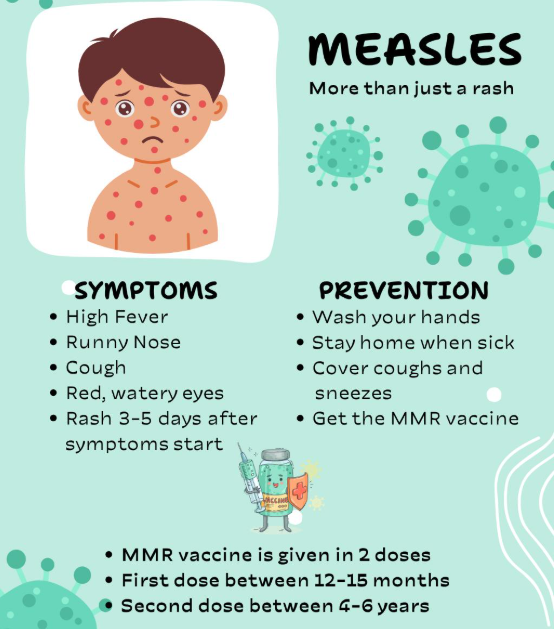
Measles is a highly contagious airborne disease. Typical symptoms include:
- Fever
- Runny nose
- Cough
- Red eyes
- Sore throat
- Rash of flat red spots on light skin, purple or brown spots on darker skin
A measles rash is one of the later symptoms, appearing 3 to 5 days after other symptoms. The rash may begin on the face or around the hairline and quickly spread down the neck to the rest of the body. About 1/3 of cases have complications such as pneumonia, ear infections, inflammation of the brain, hospitalization, and death.
Prevention is key. A safe and effective vaccine is available for all children under one year of age. The vaccine provides immunity to the child and helps prevent the spread of measles in the community. This includes approximately 38,000 children in Oregon who aren’t yet old enough to be vaccinated against measles.
