










On gas prices, political promises, the inconvenient nature of reality, and why I’m still optimistic about Oregon.
I have a confession to make.
I occasionally find myself sitting at a stoplight by Fred Meyer in Tillamook, staring at the price of gasoline, wondering what exactly I’m or supposed to do about it.
This is a somewhat awkward predicament for someone who has spent the better part of two election cycles asking people to send him to Salem to make their lives better.
You’d think I’d have something more profound going through my head. Perhaps some clever legislative maneuver involving energy markets, tax policy, and the interstate commerce clause.
Nope.
In that moment, mostly, I’m just irritated that I need gas. And that every gallon I buy means less money for my kids’ college educations.
There’s something useful about these little moments, though. They remind me that the problems we talk about in legislative hearing rooms aren’t theoretical exercises. Somewhere on the other end of every chart, budget projection, and economic forecast is a person standing at a gas pump watching the numbers go up faster than they’d like.
And there are an awful lot of people feeling that way right now.
When Ordinary Became Expensive
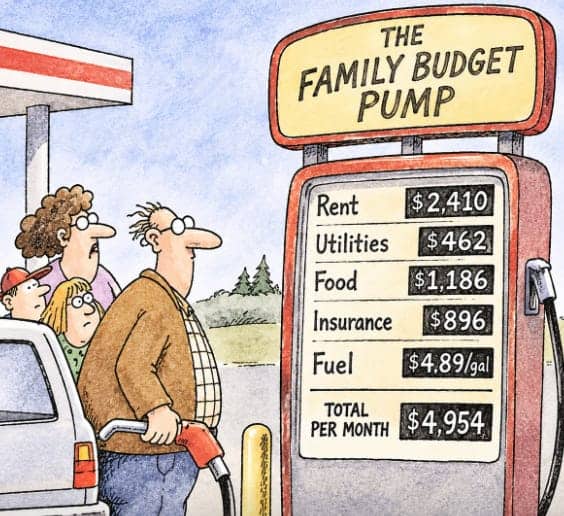
One of the interesting things about our current economic circumstances is that you can be doing reasonably well by historical standards and still feel as though you’re losing ground.
You have a job. Your spouse has a job. Neither of you has developed an unfortunate addiction to collecting vintage Corvettes. And yet, somehow, there isn’t much money left at the end of the month.
Scratch that—for an awful lot of families in Oregon there isn’t any money left.
And who is to blame?
That’s a hard question to answer, but I think this explains a good deal of the anger in American politics.
You see, I don’t think people are necessarily expecting to get Elon Musk-level rich. Most would happily settle for a life in which a flat tire on the family car constitutes an inconvenience rather than a financial catastrophe.
But there’s also something deeper going on.
We want our children to have opportunities we didn’t have. We want them to be able to buy homes, raise families, and build lives of their own. We want to grow old without becoming a financial burden to the people we love.
These are modest ambitions in a remarkably wealthy country.
And when people begin to suspect that those ambitions are slipping beyond their reach, telling them that the economy is headed in the right direction is a bit like telling someone who’s seasick that the boat is making excellent time.
Technically, you may be correct. But you’re missing something important.
And I think that’s why people are angry. They’re beginning to suspect that the people steering the boat either don’t realize how miserable the passengers are or don’t know what to do about it.
Neither possibility is particularly comforting.
So what can be done?
The Uncooperative Nature of Reality
In politics, there is an enormous appetite for solutions that don’t require trade-offs.
I’d like to find some myself. Please email me with any leads.
And, while you are at it, I’d also like any tips on how to lose a few pounds without making any meaningful changes to my relationship with desserts.
My point is that reality, unfortunately, has opinions about both propositions.
Take transportation. Oregon’s transportation department is operating with its smallest workforce in more than a quarter century. Meanwhile, our population has grown, our infrastructure has aged, and the cost of maintaining it has increased.
We could spend an entire legislative session arguing about whose fault that is.
Oh wait, we did.
But assigning blame doesn’t repair bridges and roads.
So, yes, we need to figure out how to maintain our transportation system without putting an unreasonable financial burden on the people who depend on it.
Therein lies the dilemma.
Healthcare gives us an even more interesting conundrum.
As a dentist, I’m accustomed to living on both sides of the healthcare debate. I buy health insurance for my employees, and I run a healthcare practice. I get to be irritated by the economics of healthcare from multiple vantage points.
It’s quite the arrangement.
When the government reduces what it pays healthcare providers, it spends less. But the costs—payrolls, supplies, medications—of providing that care to patients don’t go down.
The dental assistant still needs a paycheck. The equipment still needs servicing. The electric company has yet to introduce a special rate for businesses engaged in noble pursuits.
Now that’s an interesting bill idea!
But, look, cut enough funding, and eventually a doctor, a hospital, or a pharmacy stops providing a service.
Those are just the stubborn facts.
And yet, simply spending more money without addressing why healthcare is so expensive can leave us with a considerably more expensive version of the same problem.
The lesson here isn’t that government should spend more or spend less.
It’s that we should be very clear about what we’re buying, why we’re buying it, and whether it’s still worth paying for.
If a government program has become the bureaucratic equivalent of an AOL email subscription we forgot we were paying for, perhaps it’s time to cancel it.
The money, after all, could be doing something useful elsewhere.
In Defense of Small Victories
Americans love to declare wars on things.
Poverty. Drugs. Inflation.
We announce sweeping reforms and historic investments. We are forever standing at the threshold of something transformative.
Sometimes I wonder whether we’d be better served by a little less grandeur and a little more practical.
During my time in the Legislature, I was particularly happy to help secure $6 million to make Columbia Memorial Hospital in Astoria more resilient to earthquakes and tsunamis. We also saw dialysis services return to the community.
Neither development is likely to make it into a future presidential debate.
But imagine being someone who needs dialysis three times a week and no longer has to make a long drive to receive it.
Think about what that means over the course of a year. The hours recovered. The gasoline not purchased. The time spent with grandchildren instead of sitting in a car.
There is no particularly sophisticated political philosophy required to appreciate the value of that.
And it reminds me that the scale of an accomplishment looks very different depending on where you’re standing.
What might seem like a relatively small victory in Salem can be an enormous one in somebody’s living room.
In fact, we should spend more time thinking about government from the living room.
Reasons to Be Optimistic
I’m not particularly interested in becoming cynical.
Cynicism is easy. It requires very little imagination, and there’s virtually no risk of being disappointed. You can sit on your porch predicting the decline of civilization and occasionally enjoy the satisfaction of being right.
But I don’t think that’s what people elected me to do.
And there is considerably more reason for optimism than our daily consumption of political news would suggest.
Every community I represent is full of people who solve problems without making much fuss about it. Volunteers who keep food banks running. Teachers who refuse to give up on struggling students. Business owners who find ways to keep their employees working through difficult times.
These people aren’t waiting for the world to become perfect before making their little piece of it better.
There’s a lesson in that for those of us in Salem.
I can’t guarantee we’ll solve every problem facing Oregon in the next legislative session.
And there are some doozies.
But the fact that we can’t fix everything is a remarkably poor argument for not fixing something.
Somewhere in Oregon, there’s a regulation that no longer makes sense, a public dollar that could be better spent, a good idea that hasn’t gotten a fair hearing, and a problem that persists largely because nobody has taken the time to solve it.
Finding those things is part of my job. Fixing them is the other part.
And here’s why I’m optimistic: progress has a way of accumulating. A little more money left over at the end of the month. A little less time spent getting medical care. A few more homes built in a community that desperately needs them.
Individually, these things might not amount to much of a political headline. Collectively, they can change the trajectory of people’s lives.
And that, I think, is how we begin to restore people’s confidence in government and, more importantly, their confidence in the future.
Which brings me back to that stoplight.
I suspect I’ll still find myself staring at the price of gasoline and muttering something unflattering under my breath. I’m reasonably certain the Oregon Legislature isn’t going to bend the global oil market to its will.
But perhaps we can make it so that filling up the tank doesn’t mean putting something else back at the grocery store.
Perhaps we can make a few of the other numbers in the family budget a little smaller.
Perhaps we can give people a little more room to live, rather than simply making it possible for them to get by.
Wouldn’t that be something?
The light is green. Time to get to work.
If you enjoy these conversations about politics, policy, and the occasionally uncooperative nature of reality, consider subscribing. I’ll keep sharing what’s happening in Salem, what I’m wrestling with, and where I think we can make things better.
Subscribe here for more
