

Stand Up for Drinking Water
Here’s some information from North Coast Communities For Watershed Protection about what you can do!
Update: “Save Our Wetlands” LUBA No. 2025-069 Nedonna Development v. City of Rockaway Beach
You can watch, in real time, the oral arguments that will be presented before the Oregon Land Use Board of Appeals (LUBA) on Tuesday, January 13, at 10:45 a.m. Or if you are unavailable then, you can watch the recording of the hearing later on YouTube: https://www.youtube.com/@landuseboardofappeals8802/streams. Your virtual attendance at the hearing on January 13 would be valuable in that it would show that people in the community are concerned about protecting our natural resources.
Background: In June 2025, Oregon Shores, represented by Crag Law Center, successfully appealed to the Oregon Land Use Board of Appeals (LUBA) the City of Rockaway Beach’s decision to allow the 28-lot Planned Unit Development (PUD) in Nedonna Beach to move forward. That LUBA decision was a major step in protecting ecologically vital wetlands as well as safeguarding Rockaway Beach’s backup aquifer that’s below the Nedonna Beach neighborhood. That aquifer is a critical source of drinking water for the community. Subsequently, on September 25, the RB City Council voted unanimously to reverse its prior approvals for the 28-lot Planned Unit Development (PUD) in Nedonna Beach. The applicant, Nedonna Development LLC, then chose to appeal that decision to LUBA. The intervenors in the current case, the Oregon Shores Conservation Coalition and North Coast Communities for Watershed Protection, will be represented by the Crag Law Center at the hearing on January 13.
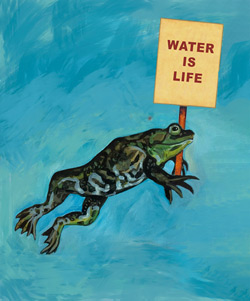
Meanwhile, the beavers and frogs stand alert.
Informational Link: “The Rising Risk of Flooding and the Role of Nature-based Solutions” https://www.eurekalert.org/news-releases/1111761
Thanks to Ernie Niemi
Oregon Department of Forestry Western Management Plan
The Oregon Department of Forestry is now asking for public comments on the final draft of its Western Oregon State Forests Management Plan (FMP). The plan can be accessed at the following link:
https://www.oregon.gov/odf/board/Documents/fmp-hcp/western-oregon-state-forests-management-plan-draft-september-2025.pdf
As many of you know, the mission of North Coast Communities for Watershed Protection states: “NCCWP wants no more logging and pesticide use in community water sources regardless of who owns the land, and wants an end to pesticide applications near where people live, work, and recreate.” It seems safe to say that everyone agrees that safe drinking water and clean air are part of the public trust that we all are entitled to have. There may be no greater importance to individual and public health than the quality of the water we drink and the air we breathe. Over 70 percent of Oregonians get their drinking water from forested lands. An example of how important this is are United States Environmental Protection Agency and Oregon Department of Environmental Quality studies that list 46 percent of Clatsop County as having “impaired” water quality.
This FMP will become the “mothership” of forest practices in Western Oregon for decades to come and this is a rare opportunity to demand language that will protect all drinking water sources from the sediment and pesticides that enter them due to logging practices. We respectfully ask each of you to consider providing written and/or oral comments using the opportunities described below.
WRITTEN COMMENTS
How to provide written public comment:
By email: odf.sfcomments@odf.oregon.gov
By mail: Justin Butteris, State Forests Division
2600 State St., Salem, OR 97310
Deadline: Jan. 31, 2026, at 11:55 p.m.
ORAL COMMENTS
Virtual Hearing
Join the virtual public hearing that will be held on Tuesday, January 13, at 5:30 p.m.
Register for the virtual meeting
Or, on that day, you are invited to join, in-person, NCCWP and the Wild Salmon Center in Astoria for the same virtual event: Tuesday, January 13, from 4:00 to 7:00 p.m. at KALA; 1017 Marine Drive. Since ODF decided not to hold a public hearing in Astoria, NCCWP and WSC are holding this event. At this event, if you have registered with ODF ahead of time, you can provide testimony during the ODF virtual hearing using the facilities at KALA. However, you MUST register ahead of time with ODF to give testimony. We will have supplies for submitting written comments. ODF has scheduled the public hearing to begin at 5:30 p.m.; so, our timeline is as follows: Doors to KALA will open at 4:00 p.m., allowing time to grab food and drink (for purchase), mingle, and compose written comments for ODF. At 4:30 p.m. there will be short presentations by NCCWP and WSC with thoughts, ideas and suggestions for talking points addressed to ODF. At about 5:15 p.m., there will be a short break before the 5:30 p.m. log-on to the official hearing site. If you registered ahead of time with ODF, you can give testimony when your name is called.
In-Person Hearings
Attend an in-person ODF public hearing, (All three hearings will begin at 5:30 p.m.)
Jan. 15 – Forest Grove
Forest Grove Community Center, 1915 Main St., Forest Grove, OR 97116
Jan. 20 – Tillamook
Tillamook ODF offices, 5005 3rd St., Tillamook, OR 97141
Jan. 22 – Eugene
Lane Events Center, 796 W 13th Ave., Eugene, OR 97402
Suggested talking points for comments to ODF:
There are several important issues that are not in the FMP draft. The following points could be used as a guide to develop your individual comments. Note: The majority of the Forest Management Plan’s coverage of drinking water is on page 3-46. https://www.oregon.gov/odf/board/Documents/fmp-hcp/western-oregon-state-forests-management-plan-draft-september-2025.pdf
1. Figure 1-1 does not list drinking water as a Greatest Permanent Value. It may be one of the most important. Drinking water must be included as a Greatest Permanent Value. This is supported by the Forest Practices Act section 527.710: “…the rules shall provide for the overall maintenance of the following resources: (a)Air quality; (b)Water resources, including but not limited to sources of domestic drinking water.”
2. The Forest Management Plan (FMP) must protect all domestic water sources regardless of type (surface water, spring, shallow well) or registration status. It’s a public health issue. Water sources must be protected from sediment, diminished quantity and pesticide/herbicide contamination.
3. The FMP must require ODF to send notifications of any planned activity to all those downstream and downwind in the watershed and request that property owners notify them of their domestic drinking water source location. Once notified, ODF must work with the landowner using best available science to protect the property from harm.
Forestry activities must never negatively impact drinking water sources. Currently, consumers pay for the treatment of drinking water affected by logging. The FMP needs to include a process in which consumers can be compensated
Forestry activities must not impair personal and public health. Those costs are currently passed on to consumers. The FMP needs to include a process in which consumers can be compensated.
United States Environmental Protection Agency and Oregon Department of Environmental Quality (DEQ) studies list 46% of Clatsop County as having “impaired” water quality. Sediment and temperature standards are often in violation. The FMP must be more specific as to how those parameters will be complied with.
The draft FMP references the Oregon DEQ and Oregon Health Authority (OHA) as the responsible state agencies to assure drinking water quality is protected. There must be much more specificity as to how that interagency process will be implemented to prevent contamination, and to remediate contamination when it occurs.
Unfortunately, the draft FMP applies only to the lands managed by the Oregon Department of Forestry and owned by either the Department of State Lands or the Department of Forestry. Private lands, including the enormous privately owned industrial timber properties are regulated by the Oregon Forest Practices Act (FPA). The draft FMP must acknowledge this disparity, and provide assurance that these industrial properties are regulated in a manner that is, at a minimum, as protective to drinking sources as those properties covered by the FMP.
One statistic in the draft FMP states: “Less than 1% of Oregon surface water drinking water source areas are located on ODF lands (DEQ 2017).” It is difficult to determine how this statistic was derived. Watersheds are connected hydrologically via headwaters, streams, rivers, wetlands, and groundwater. This being the case, even municipal wells on the coast are impacted by logging practices upgradient. As a consequence, the FMP must include more realistic data with respect to the number of citizens that are impacted. An independent statistic reports 25,000 people (or 46%) in Tillamook County receive drinking water from the Tillamook State Forest.
From page 8 of the Oregon Forest Resources Institute Trees to Tap report summary it is stated “The total number of treatments [pesticide applications] on a seedling plantation ranges from one to four, depending upon the severity of competing vegetation.” “While glyphosate (the most used chemical) is less mobile in soil, most of the others commonly used (e.g., Imazapyr, MSM, SMM) are moderately to very mobile in soil.” (MSM = Metsulfuron methyl and SMM = Sulfmeturon methyl.) The FMP must include language that requires minimized use of pesticides and/or provide alternatives to pesticides to protect drinking water sources and wildlife.
Logging practices that include slash burning issues and pesticide overspray/drift can compromise air quality, a public health risk. ODF shall provide air monitoring to determine exposure. These practices are destroying our fragile native coastal ecosystems and threatening our communities’ health. These practices need to be STOPPED today. According to the Oregon Health Authority, drift and re-volatilization is known to occur at least two to four miles away from an aerial spray site.
Informational Link: “Help Enlist Folks Who Like Birds to Support Reductions in Pesticides”. https://www.thecooldown.com/outdoors/pesticide-ban-bird-populations-study-france/ Thanks to Ernie Niemi.
 NCCWP wants no more logging and pesticide use in community drinking water sources regardless of who owns the land, and wants an end to pesticide applications near where people live, work, and recreate. Safe drinking water and clean air are part of the public trust that we all are entitled to have. Please help North Coast Communities for Watershed Protection safeguard and restore our drinking watersheds. . www.healthywatershed.org | www.facebook.com/NCCWATERSHEDPROTECTION
For more information, or to unsubscribe, contact rockawaycitizen.water@gmail.com
Please consider making a tax-deductible donation to NCCWP.
You can donate by check or online via debit or credit card by visiting: https://healthywatershed.org/donate/.
Thank you, everyone, for working to protect drinking water!