
 EDITOR’S NOTE: Here’s an installment from Tillamook County’s State Representative Cyrus Javadi’s Substack blog, “A Point of Personal Privilege.” Oregon legislator and local dentist, representing District 32, a focus on practical policies and community well-being. This space offers insights on state issues, reflections on leadership, and stories from the Oregon coast, fostering thoughtful dialogue. Posted on Substack, 3/26/26
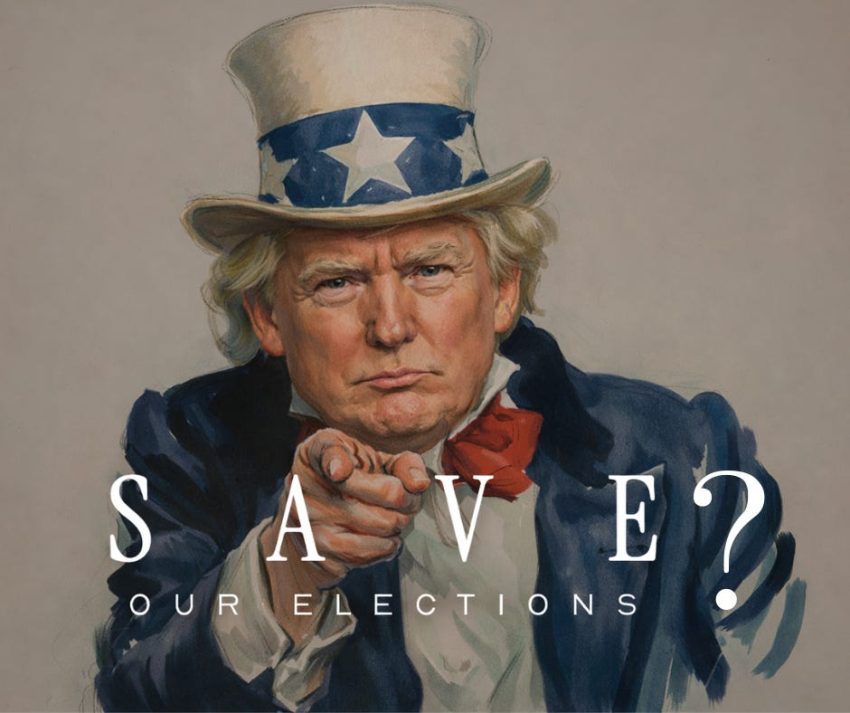
Why Vote-by-Mail Isn’t the Problem, and the SAVE America Act Solves the Wrong One
By Cyrus Javadi, State Representative
Not long after I announced my run for State Representative in 2022, I found myself at Arnie’s on Main Street in Warrenton, Oregon making my case to the Clatsop County Republican Party faithful.
Yes, the Republican Party. I was a Republican then. I became a Democrat later. The short version is that I wanted my party registration to reflect my convictions. For the long version, read my reasons here.
Now, if you know Arnie’s, you know the kind of place I’m talking about. Good food. A little nostalgic. The sort of diner where the coffee is hot, the chicken fried steak is a miracle-on-a-plate, and the opinions come preloaded.
The meeting started, and it was my turn to answer questions. One came quickly.
What did I think about ending vote by mail? My answer was simple then. It is still simple now.
I didn’t have a problem with vote by mail. What I had a problem with was distrust.
Because that was the real issue in the room that night. Not envelopes. Not stamps. Not even party, really. It was trust. Or more precisely, the lack of it.
For a lot of people, vote by mail is no longer just an election system. It’s a symbol. A tribal marker. A Rorschach test with postage.
Why This Matters Right Now
This debate is back for three reasons: the Supreme Court is hearing a vote-by-mail case, Congress is considering the SAVE America Act, and Donald Trump just voted by mail after spending years talking about it like it was the electoral equivalent of money laundering.
That would already make the subject worth revisiting.
But there is also something revealing about the timing. Americans are getting hammered by the cost of groceries, gas, housing, and insurance, and Washington has once again decided that election procedure is the hill to charge.
Election rules matter. Of course they do. But if we are going to change them, we should at least be honest about the problem we are solving, the tradeoffs we are making, and how many lawful voters we may shove out of the process along the way.
Which means the first step is separating the myths from the mechanics.
What People Are Actually Afraid Of
One thing I’ve learned in politics is that people don’t obsess over process unless they think process is being used against them (for example, setting the date for the transportation vote to May 19 instead of Nov 2).
That’s what lies underneath so much of the vote-by-mail debate.
People worry the system is too loose. Too anonymous. Too easy to manipulate. Too far removed from the old picture in their head of a person walking into a polling place, standing in line, casting a ballot, and going home with an “I voted” sticker and mild self-satisfaction.
Some of those concerns are sincere. Some are exaggerated. Some are fed by social media, rumor, partisan messaging, and the modern American habit of becoming wildly certain about things we haven’t actually studied. But they are real in the sense that people genuinely feel them.
And if you read through the Facebook comments on this issue, the pattern becomes obvious. Some people are convinced that any ballot counted after Election Day must be suspicious. Some think voter rolls are packed with dead voters, noncitizens, or ghosts with forwarding addresses. Some argue that if a person can make it to Costco, they can make it to a polling place. Others treat convenience itself as proof of corruption.
Underneath all of it is the same assumption: if voting is easy, cheating must be easy too. And that sounds reasonable right up until you think about it for more than six seconds.
I mean, sure, a front door is easy to open with the right key. But, that doesn’t mean the prudent next step is a moat, a drawbridge, and armed sentries asking for your baptism certificate.
No. The real question is not whether voting should be easy or hard as some kind of moral test. The real question is whether it is easy for lawful voters and hard for cheaters.
That should be the standard every time. Voting should be easy, but hard to cheat.
So, is Oregon’s system vulnerable? Is it easy to cheat? And, is there any evidence to support those claims?
Because if any of that is true, we are obligated to fix it.
Oregon Didn’t Dream This Up Last Tuesday
One of the stranger features of the current debate is how often people talk about vote by mail as though it was invented during the pandemic by a task force of graduate students and county clerks in sensible shoes.
It wasn’t.
Oregon voters approved Measure 60 in 1998 by a margin of 69.4 percent to 30.6 percent (yes, that’s a landslide), making Oregon the first state to conduct elections entirely by mail. By 2000, Oregon became the first state in the country to hold a presidential election entirely by mail.
And here’s the fun part. This did not begin as some anti-Republican conspiracy. Republicans were part of the story too. Vote by mail in Oregon started as a practical reform, not a partisan weapon.
It was defended on practical grounds too: easier voting, better access, lower administrative cost, and higher participation. Supporters argued it would save the state about $3 million in years with both a primary and a general election.
And for a long time, people liked it.
A 2003 survey found 81 percent support for Oregon’s vote-by-mail system, including 85 percent of Democrats and 76 percent of Republicans. Oh, and this fun fact: thirty percent said they voted more often after it was enacted.
That last number matters. Oregon has the highest voter participation rate of any state in the country. That’s amazing.
Because here’s the thing we have to believe: a self-governing country should not treat participation like a design defect. If a voting system makes it easier for working people, rural voters, elderly voters, disabled voters, military voters, and parents trying to keep life together to cast a ballot, that isn’t evidence the system is broken. It’s evidence the system is doing at least part of its job.
And Oregon isn’t alone. Utah also votes heavily by mail, and you don’t hear nearly as many theories about vote by mail being the secret engine of permanent Democratic rule there.
Funny how that works.
Security Matters. Hysteria Doesn’t Help.
Now for the part that irritates the absolutists—
Concern about election security is not crazy.
Of course voter rolls should be accurate. Of course signatures should be checked. Of course chain of custody matters. Of course deadlines should be clear. Of course the public should have confidence that lawful ballots are counted and unlawful ballots are not.
But seriousness about security does not require melodrama.
No election system is perfect. In-person voting is not perfect. Machine voting is not perfect. Same-day registration is not perfect. Human beings are involved. That guarantees mistakes, edge cases, confusion, and the occasional bureaucratic comedy of errors.
The case for vote by mail is not that it is flawless. The case is that it can be secure and accessible at the same time if it is paired with sane safeguards.
In other words, the choice is not between complacency and panic.
The Numbers Are Not on the Side of Panic
This is where the argument gets awkward for people who talk as though every mailbox in America is an active crime scene.
A 2020 analysis by Oregon’s Legislative Fiscal Office found 38 criminal convictions for voter fraud across 20 years and nearly 61 million ballots cast in Oregon. That works out to roughly 0.000006 percent.
Thirty-eight. Out of 61 million. (How can you not be impressed by that?)
And, the Brookings Institution later found that nationally, mail-voting fraud occurred at an average rate of about four cases per 10 million votes, or roughly 0.000043 percent.
None of that means fraud never happens. It does. Human beings will cheat at anything that offers power, money, or a free toaster.
But scale matters.
If the problem is microscopic, the solution should be proportionate. Tighten safeguards where needed. Improve auditing. Improve transparency. Improve public confidence.
What you don’t do is redesign the whole system around a statistical speck and then congratulate yourself for saving the republic.
Kansas Already Released This Movie
This is where the SAVE America Act starts to look less like a solution and more like a remake of a bad film nobody asked to see again.
Kansas tried a stricter proof-of-citizenship system for voter registration. The result was ugly. Around 31,000 otherwise eligible voters were blocked. Roughly 12 percent of first-time registrants got caught in the system. Meanwhile, only 28 noncitizen applicants were stopped during the relevant period. And in the 13 years before the law took effect, just 39 noncitizens had successfully registered.
That is the whole story in four numbers.
- 31,000 blocked.
- 12 percent of first-time registrants.
- 28 stopped.
- 39 prior cases.
If you want an example of government using a bulldozer to deal with a housefly, there it is.
Kansas did not show what smart election reform looks like. It showed what happens when lawmakers respond to public anxiety with paperwork and call it wisdom.
Why the SAVE Act Gets It Wrong
That is why the SAVE America Act worries me.
On paper, it sounds simple. Require documentary proof of citizenship to register to vote. Easy. Clean. Tough. Politically marketable.
But life is not lived on paper.
People change their names. People misplace documents. People don’t have passports. People don’t spend their weekends cheerfully digging through old file boxes to prove to the government that they are, in fact, who the government already generally knows they are.
Only about half of Americans have passports. Critics have also warned that married women whose legal names differ from their birth certificates could face particular problems.
And the broader problem is obvious: if you pile enough documentation requirements onto voting, you will absolutely make it harder for some ineligible people to get through. You will also make it harder for a much larger number of eligible people to get through.
That is not targeted reform.
A good election reform should solve a real problem in a targeted way without sweeping lawful voters into the same trap. Too much of this legislation fails that test.
Back to Arnie’s
Which brings me back to Arnie’s in Warrenton.
Back to the coffee. Back to the pancakes. Back to the room full of people who were convinced vote by mail was the reason Republicans couldn’t win.
What I sensed in that room was real. Not because every claim was right. Not because every fear was justified. But because distrust itself was real.
People wanted to know whether the system could be trusted. Whether their vote mattered. Whether the rules were fair. Whether anybody in government was taking their concerns seriously.
That is still the real question.
It is the question behind the Supreme Court case. It is the question behind the SAVE Act. It is the question behind Trump attacking mail voting while using it. It is the question behind every town hall where one person asks if I’ll end vote by mail and another asks if I’ll protect it.
And my answer is still basically the same as it was that night at Arnie’s.
Fix what needs fixing. Make it more transparent. Make it easier to understand. Make it easier for lawful citizens to vote. Make it harder for anyone to cheat. That is the standard.
Don’t burn the system down because people are afraid. Fear is useful for spotting danger. It is much less useful for drafting policy.
If this kind of argument is worth your time, subscribe. I write about Oregon politics, policy, and the increasingly radical idea that facts should matter. Subscribe here for more