
 EDITOR’S NOTE: Here’s an installment from Tillamook County’s State Representative Cyrus Javadi’s Substack blog, “A Point of Personal Privilege.” Oregon legislator and local dentist, representing District 32, a focus on practical policies and community well-being. This space offers insights on state issues, reflections on leadership, and stories from the Oregon coast, fostering thoughtful dialogue. Posted on Substack, 4/12/26
One of the Great Tricks in Politics is the Art of Describing Costs in Detail and Consequences in Fog
By State Representative Cyrus Javadi
It’s 37 days until the May primary election, and campaign season has officially arrived.
A few things are on the ballot. County commissioner races in Tillamook and Clatsop counties. Candidates for State Representative and State Senator. Judges. Mayors. And, of course, ballot measures.
Which means Oregon has entered that special time of year when roadsides start to look like a cross between democracy and a yard sale.
The signs are going up along Highway 101. In people’s yards. On farmers’ fences. On billboards. Everywhere you look, there is a slogan, a promise, a warning, a plea. Vote for this. Vote against that. Save the county. Stop the madness. Restore common sense. Stand up. Fight back. You know the genre.
Campaign season is a very creative time for people who enjoy reducing complicated questions into six words and a large font.
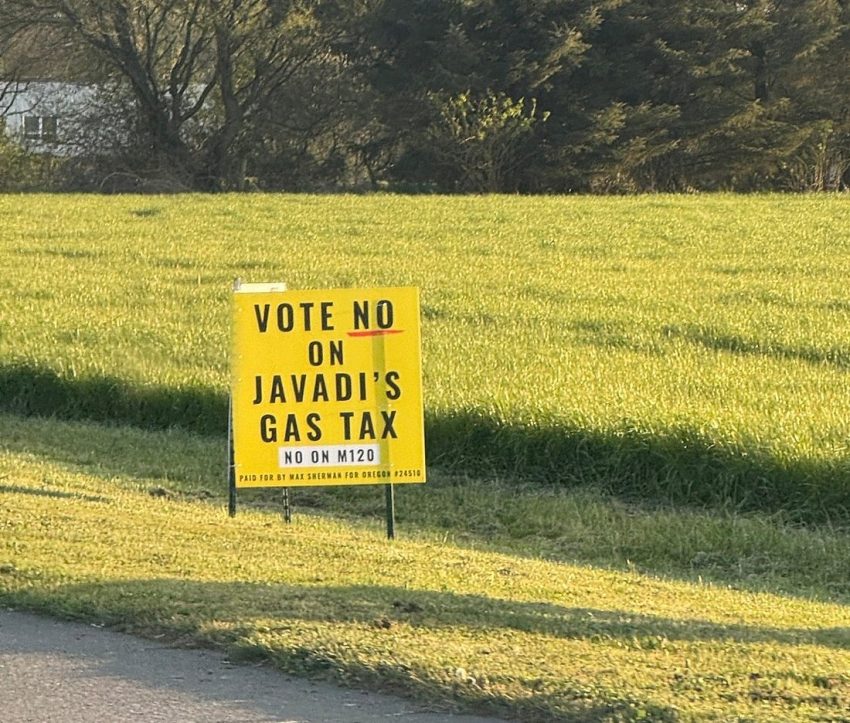
And somewhere in that sea of signs, one of them caught my eye.
Vote No on Javadi’s Gas Tax.
Now, I have to admit, as political slogans go, it’s not bad. It’s short. It’s sharp. It sounds like a scandal.
Clever.
But the more I thought about it, the less I minded.
Because if by the “Javadi Gas Tax” you mean 6 cents a gallon to help fix roads, support cities, and deal honestly with infrastructure problems that politicians have been ducking for years, then yes. Fine. Call it that.
In fact, put up more signs. At least then we’d be advertising a solution instead of just another complaint.
That, really, is the difference between slogans and governing. A slogan only has to sound good. It does not have to explain anything. It does not have to tell you what problem it solves. It does not have to level with voters about cost, tradeoffs, or consequences. It just has to trigger the right emotional reflex and move on.
Governing is harder than that.
Because governing eventually runs into reality. Into roads that are falling apart. Into sewer systems that need work. Into local governments trying to stretch too little money across too many problems. Into the plain and unfashionable truth that if you want to fix what is broken, you have to be willing to pay for the fix.
And that is what brought the “Javadi Gas Tax” sign into clearer focus for me.
The Sign Is Cute. The Road Is Not.
On Friday, I spent part of the day driving around Tillamook with City Manager Sean Lewis. We drove on Ninth Street. We drove on Sixth Street. We drove out by the water treatment plant. And after that drive, I can tell you this much: the slogan lands a little differently when you’ve just spent an hour looking at roads that are patched, cracked, and hanging on mostly through prayer and inertia.
The problem is not hard to see. The hard part, apparently, is admitting what it takes to fix it.
These roads are not in bad shape in the abstract. They are rough in reality.
And why are they not getting fixed? Funding. That’s it.
The city does not have enough money to keep up with the road needs in front of it. It does not have enough money to fully tackle sewer issues that also need attention. It does not have enough money to do all the things people assume local government is somehow just supposed to do.
So what happens?
Band-Aids. Delay. Temporary fixes. One more patch. One more postponement. One more year of telling ourselves we will get to it later.
Well, later is here. And later looks terrible.
What the Javadi Gas Tax Actually Is
So let’s discuss this alleged menace. This terrible six cents. The Republican’s boogeyman of the apocalypse.
The measure would add 6 cents per gallon on gas and diesel. Of that, 2 cents would go to counties and 1 cent would go to cities.
That’s it. Three cents. The last time we had to worry about what three cents could purchase it was the 1940s. You could almost buy a newspaper and maybe a Coca-Cola for 3 cents.
Now? Um, well, the penny has become so obsolete, the US Mint is no longer making them.
Ok, but I can already see the skeptics ready to object. Because, they’d correctly argue, that it’s 3 cents per gallon. And that gallons add up fast.
Yet, when you add those gallons up, the result is still pretty modest. In fact, for the average driver in Tillamook, we are talking about roughly $2.50 a month.
That’s the number.
Not $250. Not $25 a week. Not “your family can no longer afford Christmas because Javadi personally attacked the internal combustion engine.”
About $2.50 a month. Less than a candy bar. Less than a Grande Americano from Starbucks. Less than a bag of chips.
And what does that money do? It helps cities fix roads.
That should not be a hard sell. But modern politics has a way of turning basic maintenance into an ideological crisis. Somewhere along the line, we became a people who say we love infrastructure right up until someone mentions paying for it. Then suddenly everyone turns into a budget monk, clutching their robe and gasping at the very thought.
But roads do not get fixed with indignation. Sadly. But, money, it turns out, does fix roads.
The Part People Leave Out
Here is where the slogan starts cheating.
The people yelling the loudest about the “Javadi Gas Tax” talk as though the only thing happening here is that government wants more of your money. They skip the second half of the sentence. The half where the money does something.
That’s convenient.
Because once you start talking about what the money actually does, the conversation gets harder for them.
It is one thing to oppose “a tax.” Nice clean word. Easy to slap on a sign. Easy to shout. Easy to turn into a mini morality play where you are the brave defender of the common man against the wicked empire of public works.
It is another thing to say, plainly, “I oppose spending roughly $2.50 a month so Tillamook can better repair its roads.”
See the difference? That lands a little differently. And that difference matters.
Because one of the great tricks in politics is the art of describing costs in detail and consequences in fog. Every penny of a tax increase gets described like a personal mugging. Every consequence of doing nothing gets described like weather. Unfortunate. Mysterious. Regrettable. No one could have seen it coming.
Nonsense. We can see it coming. We are driving over it.
Funny How Some Costs Count and Others Don’t
This is the part that really gets me.
Some of the same people who are waving signs about the “Javadi Gas Tax” have shown remarkable emotional resilience when fuel prices rise for other reasons.
A two-dollar increase in gas prices because of war, instability, tariffs, supply shocks, or chest-thumping foreign policy? Suddenly it is all noble sacrifice. We are told this is the price of strength. The price of leadership. The price of standing tall on the world stage while ordinary people quietly stand shorter at the pump.
Interesting.
Six cents to help fix roads in your own community?
Now we are in the Book of Revelation.
That tells you something. And what it tells you is not flattering.
Because it means this is not really about the burden on working people. If it were, the concern would be consistent. It would show up when families get squeezed by higher healthcare costs, when tariffs raise prices on goods, when fuel spikes for reasons entirely unrelated to local road funding, and when politicians cheer on “strong” policies whose costs always seem to land on somebody else’s grocery bill.
But consistency is not really the point for a lot of these folks. Loyalty is.
If the cost comes from their side, it is patriotism. If the cost comes from a practical local solution, it is oppression. If their tribe causes the pain, we salute.
If someone proposes a measured fix for a problem everyone can see, we faint dramatically on the courthouse lawn.
People are tired of that act.
A Promise Without Funding Is Just Performance Art
This is where the piece stops being about a gas tax and starts being about political courage. Everybody says they support roads. Everybody says they support infrastructure. Everybody says they support housing, local communities, economic development, public safety, and whatever else tested well in the last focus group.
Fine.
Then how do you plan to pay for any of it? That is the question that turns half the room into vapor.
Because a lot of politicians love the promise and hate the invoice. They want the repaired road without the hard vote. The ribbon cutting without the revenue stream.
Political courage is not screaming “no taxes” when you know the crowd will clap.
Political courage is saying, “Yes, this costs something. Here’s why. Here’s what it does. Here’s why I’m voting for it anyway.”
That is less glamorous. It usually comes with fewer heroic Facebook comments and significantly less chest pounding. But it has the advantage of being real.
I would rather tell voters an uncomfortable truth than comfort them with a lie. I would rather be accused of supporting a tax than praised for pretending roads are free. I would rather attach my name to a solution than spend my days auditioning for the role of man most scandalized by arithmetic.
Put It on the Sign
So yes, put “Javadi’s Gas Tax” on the sign. Heck, like I said, make more of them too.
Campaign season will come with plenty of slogans, plenty of outrage, and no shortage of people promising results they have no serious plan to deliver.
Of all the things to have my name on, fixing roads is one I can live with.
Subscribe
I write about Oregon politics the way I think more politicians should talk about it: plainly, seriously, and with at least some tolerance for facts. Subscribe if that sounds like your kind of thing.
A Point of Personal Privilege is free.