

By Jim Heffernan
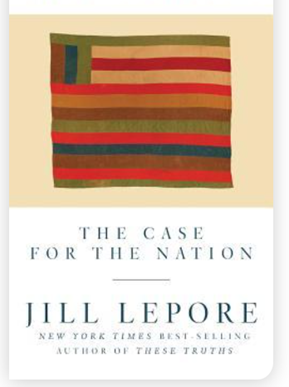
I loved this little book written by the woman I consider to be America’s best historian. The book was written in 2019, a year after her 933 page These Truths:A History of the United States.
The author calls this book a “long essay”. It’s 132 pages divided into 16 chapters. In a way, it’s a recap of her book from the previous year She covers much of the same material but mostly by talking about definitions to such terms as “nation”, “patriotism”, “nationalism”, and “liberalism”.
I particularly liked her definition of liberalism, “Liberalism is the belief that people are good and should be free, and that people erect governments in order to guarantee that freedom.” I’m tired of liberal being defined as someone who didn’t vote for Trump.
Call me lazy, but I think I will close this review with a 700 word excerpt that is the final chapter of the book. She does a much better job of summarizing than I ever could.
- XVI ·
A NEW AMERICANISM
The United States is a nation founded on a revolutionary, generous, and deeply moral commitment to human equality and dignity. In the very struggles that constitute this nation’s history, in the very struggles that lie ahead, the United States holds to these truths: all of us are equal, we are equal as citizens, and we are equal under the law. For all the agony of the nation’s past, these truths remain. Anyone who affirms these truths and believes that we should govern our common life together belongs in this country. That is America’s best idea.
Frederick Douglass once offered his understanding of this nation: “A Government founded upon justice, and recognizing the equal rights of all men; claiming no higher authority for its existence, or sanction for its laws, than nature, reason, and the regularly ascertained will of the people; steadily refusing to put its sword and purse in the service of any religious creed or family, is a standing offense to most of the Governments of the world, and to some narrow and bigoted people among ourselves.” These words are no less true a century and a half on.
Americans are bound by our past, but even more powerfully, we are bound to one another. A new Americanism would have to honor the striving and sacrifices of Americans whose families have been in the United States for generations, and those who have only just arrived. It would have to honor the sovereignty of native nations. It would have to uphold the aspirations of everyone. In 2011, the Pulitzer Prize–winning journalist Jose Antonio Vargas, an undocumented immigrant, began asking immigrants and the children of immigrants to define “American”: “American”: “I define American as my family,” said one little girl. A nation is that collection of definitions. This America is a community of belonging and commitment, held together by the strength of our ideas and by the force of our disagreements. A nation founded on universal ideas will never stop fighting over the meaning of its past and the direction of the future. That doesn’t mean the past or future is meaningless, or directionless, or that anyone can afford to sit out the fight. The nation, as ever, is the fight.
In a world made up of nations, there is no more powerful way to fight the forces of prejudice, intolerance, and injustice than by a dedication to equality, citizenship, and equal rights, as guaranteed by a nation of laws. A new Americanism would mean a devotion to equality and liberty, tolerance and inquiry, justice and fairness, along with a commitment to national prosperity inseparable from an unwavering dedication to a sustainable environment the world over. It would require a clear-eyed reckoning with American history, its sorrows no less than its glories. A lie stands on one foot, as Benjamin Franklin liked to say, but a truth stands upon two. A new Americanism would rest on a history that tells the truth, as best it can, about what W.E. B. DuBois called the hideous mistakes, the frightful wrongs, and the great and beautiful things that nations do. It would foster a spirit of citizenship and environmental stewardship and a set of civic ideals, and a love of one another, marked by benevolence and hope and a dedication to community and honesty. Looking both backward and forward, it would know that right wrongs no man.
“The history of the United States at the present time does not seek to answer any significant questions,” Carl Degler told an audience of historians some three decades ago. Degler, like all of us, had his own blind spots. But he did not sit out the struggle. And if people who care about the nation’s past and future and the endurance of liberal democratic nations don’t start asking and answering those sorts of questions, he warned, other people will. They’ll declare America a carnage. They’ll call immigrants “animals” and other countries “shitholes.” They call themselves “nationalists.” They’ll say they can make America great again. Their history will be a fiction. They will say that they alone love this country. They will be wrong.
As always, discussion is welcome at codger817@gmail.com