

By Jim Heffernan
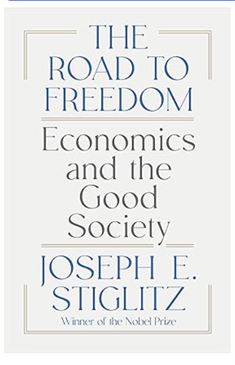
This is a book I’ve had in my kindle library since it was first published in 2024. Something distracted me and I lost track of it. My mistake. He has a lot of good things to say about where capitalism has taken us and where it should takes us. It’s 356 pages long and 65 of those pages are acknowledgements, notes and index. He’s a good writer and I enjoyed the book. I think he has a lot of good ideas about forming a good society, or at least a better society.
Joeseph Stiglitz graduated from high school in 1960, three years before I left my high school. He says he didn’t know it then, but now he recognizes 1960-1970 as the peak of capitalism. The capitalism of those days was a progressive capitalism. Despite some glaring faults, it was spreading wealth to the middle and lower classes. Since then, progressive capitalism has been replaced by neoliberalism, a system that takes very good care of those at the top, but exploits the majority of us.
Progressive capitalism arose after the crash of the world economy in the 1930’s. Joeseph Stiglitz champions that progressive capitalism.
Neoliberalism rooted itself in our system of capitalism in the early 1970’s. Fredrich Hayek and Milton Friedman pioneered neoliberalism. All were Nobel prize winning economists.
The argument between the two theories of economics is mainly how they define freedom. I like the quote from Isaiah Berlin he opens the book with, “Freedom for the wolves has often meant death to the sheep.”
Neoliberalism takes the stance that Adam Smith’s “invisible hand” of the market will take care of everything if we don’t let government mess it up.
Progressive capitalism thinks that the “invisible hand” doesn’t work because it’s not there. Stiglitz believes that our markets are not the free markets we think they are, but that they have been manipulated for the last 50 years. And not to the advantage of the lower and middle classes.
When I look back at my life, I believe Stiglitz was mostly right about what he said
Here are a couple of excerpts from his book
“Ideas are always contested, so the game is not over. But we’re not headed in a good direction, and we need to do something about it. There has long been a fear of an Orwellian world in which government shapes us to the point that we lose our human agency—in a deep sense, our freedom. We are now entering quite a different dystopia, in which certain private-sector firms have an almost Orwellian power to shape us, including the power to convince others to allow them to continue unchecked. But there is still time to put an end to this. We have the means to ensure that these powerful innovations serve society; we just need the collective will.” Pg. 192
”There is a real urgency to the progressive capitalism agenda set forth here and to the progressives recapturing the language of freedom. Progressive capitalism maximizes citizens’ real freedoms. But time is not on our side. The climate crisis won’t allow us to ignore the way unfettered capitalism has pushed us beyond our environmental limits; and the inequality/populism/democratic crisis won’t allow us to ignore how democratic ideals are being torn asunder. The collision of the two represents an especial threat. When we successfully dismantle the myths about freedom that have been propagated by the Right and arrive at a more nuanced and balanced perspective, we will have taken our first and most important step toward creating a good society, where the freedoms of citizens to flourish, to live up to their potential, and to live in harmony with each other and nature are most expansive. Progressive capitalism will allow us to construct a vibrant democracy in which people cooperate for the common good. It is the truly freeing economic and political system. Pg. 293
Book is available at Cloud and Leaf Bookstore, Manzanita and Tillamook County Library
As always, discussion is welcome at codger817@gmail.com