

By Neal Lemery
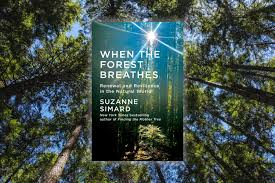
Rarely do I anticipate a new book that arrives in my mailbox with such curiosity and eagerness. Yet Suzanne Simard’s newest book has pushed my other reading aside as I delight in this new work. I greatly enjoyed her first book, Finding the Mother Tree, a captivating exploration of how trees communicate with each other and their surroundings, utilizing fungal webs to share nutrients as well as information. I wondered what else she could offer the world.
Her new book doesn’t disappoint, and pulls me further into my already deep and serious love of forests, nature, and the web of relationships that thrive literally in my neighborhood and throughout the world. Simard, a British Columbia forestry professor, researcher, TED Talk presenter, and spiritually vibrant native American, challenges us to explore new ideas. She looks at nature through the lenses of a well-educated academic, boots on the ground researcher, and her native heritage and spirituality to weave a warm welcome to those curious about the life cycles and world of our forests. This book is provocative and engaging.
“A masterclass on the inner workings of forests- a lush glimpse at the symphonic mutualisms and intergenerational cascades that sustain life at every scale. Simard, one of the boundary-pushing scientists of our time, is also a resplendent storyteller. Through her, new threads of connection between indigenous knowledge and Western science are formed. The experiments and ideas in When the Forest Breathes are quietly revolutionary. This is science as an act of love for the world.” —Zoe Schlanger, The Light Eaters.
Simard makes the life of trees an intriguing and captivating tale, and the book is much less an academic treatise on forestry than a delightful novel with complex, engaging characters and an intriguing tale. It is literally a page turner, with astonishing facts and complicated relationships on every page.
Part of the book digs deep into the biology of clearcutting and its game-changing impact on the ecology of forests. It’s an often insightful and sometimes disquieting journey, with serious discussion of alternative forest harvesting and management practices. Simard offers food for rich discussions of policy and our spiritual relationships with our fellow life forms.
Simard’s books have changed how I look at forests, and the web of life literally in my back yard. She challenges staid and academic forest science, and takes on corporate mentality, calling all of us to open our eyes to new thinking, new ideas, and new approaches to ancient forests and our role as fellow beings in this complex and beautiful world.