

By Gordon McCraw, Meteorologist for the Tillamook County Pioneer
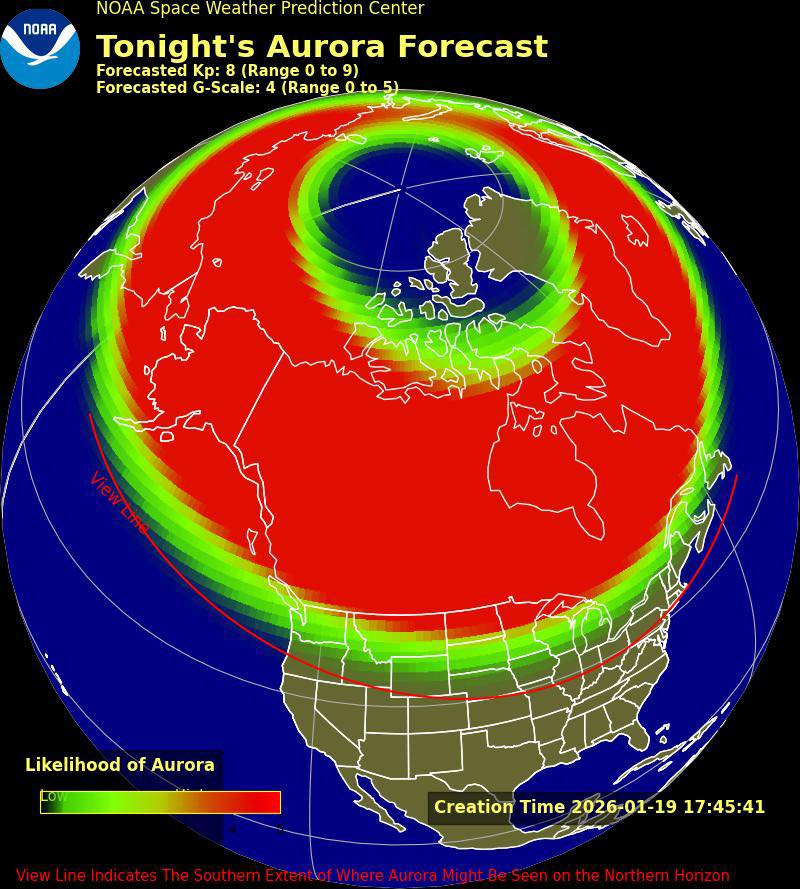
This time we are not looking at an atmosphere river, or a snowstorm, or anything like that. This time we could see the effect of a strong geomagnetic storm bringing some Northern Lights as far south as Oregon. It appears yesterday the sun had what is called a Coronal Mass Ejection, which is basically a massive burst of solar material from the sun’s outer atmosphere. This material will reach the earth this afternoon and interact with the earth’s upper atmosphere and could make the Aurora Borealis, or Northern Lights visible down to southern Oregon.
The Geomagnetic Storms are rated on a 5 level G-Scale with G1 being Minor and G-5 being Extreme. The greater the number, the greater chance of them being seen down in the mid latitudes. Tonight’s Storm is rated at a G4 or Severe. There is a slight chance it might be visible tomorrow night as well though would be considered at G3 or less strong by then.
The best chance of seeing the lights is between 10pm and 2am with the peak at midnight, and these chances are enhanced considering we are likely to have clear skies tonight. To improve your chances, you need to get away from low light pollution, also known as city lights. Next, face the north with an unobstructed view, and be patient. These lights can appear suddenly and change quickly.
Now these Geomagnetic Storms do have some negative side effects too. They have been known to cause radio blackouts, cause GPS inaccuracies and satellite disruptions. There is also a risk of inducing currents in power grids that can cause blackouts and damage transformers. So, if there is any disruptions in any of these areas, you now know the likely reason.
The last time there were aurora sightings in Oregon was in November of last year, but I think we were cloudy at that time. Before that was during the summer of 2025, I think it was around June. Our chances of seeing them again in the near future is pretty good as the sun is currently near its solar maximum, with these peaks leading to more frequent solar flares and coronal mass ejections, that drive the Northern Lights further south.
Lastly, I have read that using your phone’s timed exposure can help capture these lights that may not visible to the naked eye. So, put your phone in Night Mode, turn off the flash, stabilize the phone on a tripod for long exposures and tap the screen to lock the focus.
That’s it, and good luck!
If you get some photos tonight (or tomorrow night), please share them with Pioneer readers – send to editor@tillamookcountypioneer.net.