
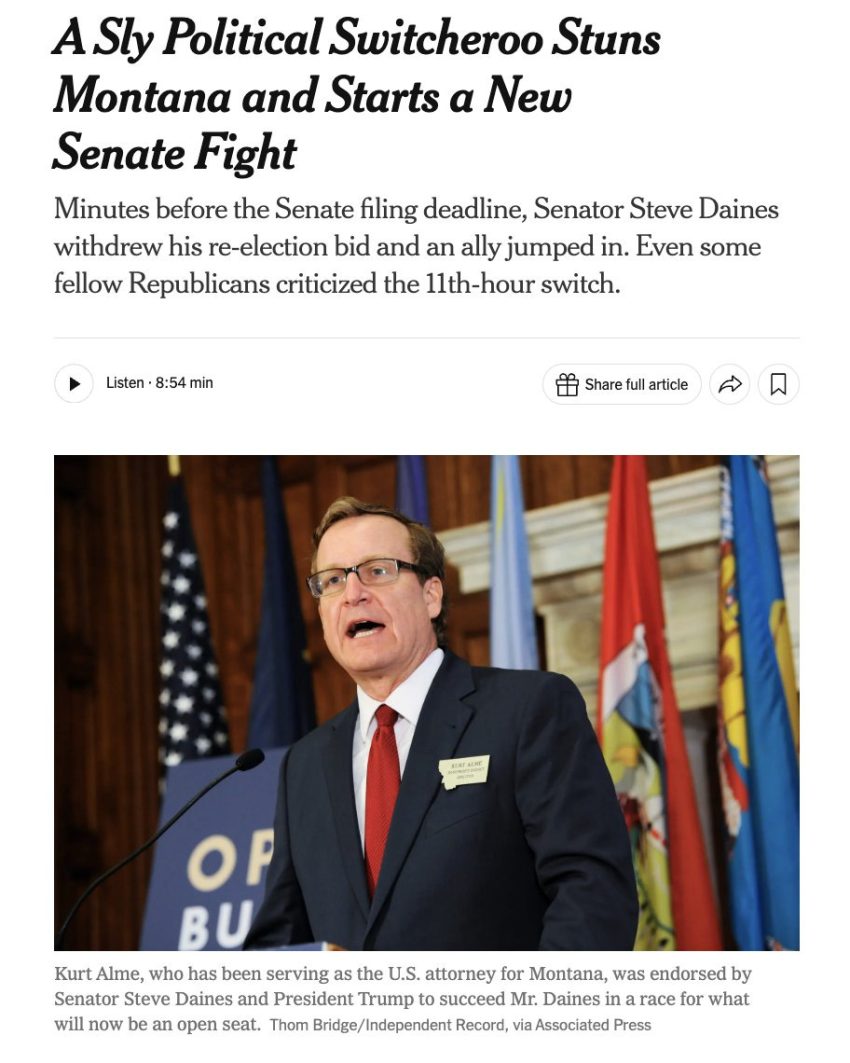

A Republican senator picks his replacement – cynical or just unethical?
By Marc C. Johnson
This piece originally appeared in The Daily Montanan, a non-profit news site in Big Sky Country, that (present company excluded) does really fine work.
The Daily is part of States Newsroom. If you don’t know of these good folks and the work they do to bring quality journalism to many, many states you should. Follow some of them and contribute if you can.
So, I wrote about the Senator Steve Daines scheme, in part, because I saw some parallels with similar bit of Montana political chicanery – that word means “trickery,” by the way – nearly 100 years ago.
Minutes before the Senate filing deadline, Senator Steve Daines withdrew his re-election bid and an ally jumped in. Even some fellow Republicans criticized the 11th-hour switch.
Montana Republican Senator Steve Daines set bipartisan tongues wagging last week when he pulled off an audacious scheme – one commentator called it an “arrogant and just deeply cynical move” – to ensure that his handpicked successor received an uncontested shot at a six-year term in the United States Senate.
Daines, who was widely believed to be coasting to a third Senate term with no serious GOP primary opposition, abruptly ended his own candidacy – with no public notice – minutes before the filing deadline so that Kurt Alme, the state’s little known U.S. attorney who has never held elective office, could slip into the race. Had other high profile Republicans been in the know about Daines plans, a primary election would almost certainly have attracted a host of candidates, potentially from both parties.
The Daines maneuver had to have been long in the planning, and near absolute secrecy was essential to its success. The only people who appear to have been in on the plan were Donald Trump, Montana Governor Greg Gianforte and Daines Senate colleague Tim Sheehy, all Republicans who immediately endorsed Alme.
The reaction was swift, if stunned. The Washington, D.C. publication The Hill saying, for example, “The Montana Republican’s decision left lawmakers slack-jawed …”
At least a few Republicans condemned Daines sleight of hand, and former Senator Jon Tester, one of the Democrats Daines said he was trying to keep out of the race, bluntly said: “None of us were running. [Daines] f—ed his own party.”
There is an old political axiom that holds that every politician – Daines surely included – longs to pick their successor and American political history is full of similar stories.
Last year Illinois Democratic Congressman Jesús “Chuy” García, for example, masterminded something similar, allowing his chief of staff to file for his seat apparently knowing that he was going to retire. Garcia’s decision, like Daines’s, drew bipartisan condemnation, with Sen. Andy Kim of New Jersey saying it “was undemocratic and should not be allowed.” The full House voted to reprimand Garcia.
There is some Montana political history that bears remembering in the context of Daines’ audacious maneuver. And a secret, backroom deal in Montana in 1933, also involving a coveted Senate seat, illustrates why historically these too-cute-by-half insider maneuvers rarely redound to the credit of anyone involved.
On March 2, 1933, Montana’s senior senator, Thomas J. Walsh of Helena, died suddenly while enroute to Washington, D.C., where he planned to join the Cabinet of president-elect Franklin D. Roosevelt. Roosevelt had tapped Walsh, a distinguished and widely respected senator, to be his attorney general. Walsh’s nomination was widely hailed, and it was expected that he would resign the Senate seat he had held since 1913 when confirmed by the Senate. Walsh’s unexpected death compressed the timeline for a replacement and put the political maneuvering into high gear.
As in most states, Montana law empowers the governor to fill a Senate vacancy when it’s caused by resignation or death. In 1933 Montana’s governor was Democrat John Erickson of Kalispell, described by one observer as “a gentle, sleepy, colorless conservative” with close ties to the state’s politically powerful corporations, particularly the Anaconda Mining Company and Montana Power, the influential “twins” of the early 20th Century Montana’s economy.
Montana’s other senator was a pugnacious Butte lawyer, Burton K. Wheeler, a Democrat, and a staunch opponent of the “twins” who fancied himself the power in the state party. While a good deal more progressive that Erickson, Wheeler believed he could influence the governor’s Senate appointment, and he set about making sure he could. Above all Wheeler was determined to prevent an arch political enemy, another Butte lawyer and Anaconda lobbyist, J. Bruce Kremer, from receiving Erickson’s endorsement.
Wheeler had ample reason to think that Kremer had the political juice to get the nod to replace Walsh. Kremer had long been a member of the Democratic National Committee, a therefore an experienced, well connected national and Montana power broker with close ties to the incoming Roosevelt administration. Anaconda and Montana Power supported his Senate ambitions believing Kremer would be a foil to Wheeler’s influence in Montana and in the Senate.
Wheeler, never shy about bullying his way to a desired outcome, pursued his own audacious three-part strategy to thwart Kremer’s ambition and make certain the state’s open Senate seat would be occupied by a politician Wheeler was comfortable with and could dominate.
In the first step of Wheeler’s strategy he summoned top Anaconda and Montana Power officials to a hotel room in Helena and read them the Riot Act. They must drop their support of Kremer, he said, or Wheeler would consider it a declaration of political war by the corporations. The corporate executives reluctantly agreed, but Wheeler was determined to make sure.
The next day – step two of his strategy – Wheeler brought the corporate bosses together with Erickson to make sure the governor heard firsthand that the business interests were no longer backing Kremer.
Yet, there still remained the question of who would replace Walsh. Wheeler had a strategy to answer that question, as well.
Like Steve Daines in 2026, B.K. Wheeler in 1933 executed an audacious scheme that reworked Montana’s political landscape for years to come and, at least temporarily, cemented his own grip on political power.
“I then persuaded Erickson to resign as governor,” Wheeler cynically and matter-of-factly explained years later, “and let the lieutenant governor, Frank Cooney, appoint him as Walsh’s successor in the Senate.”
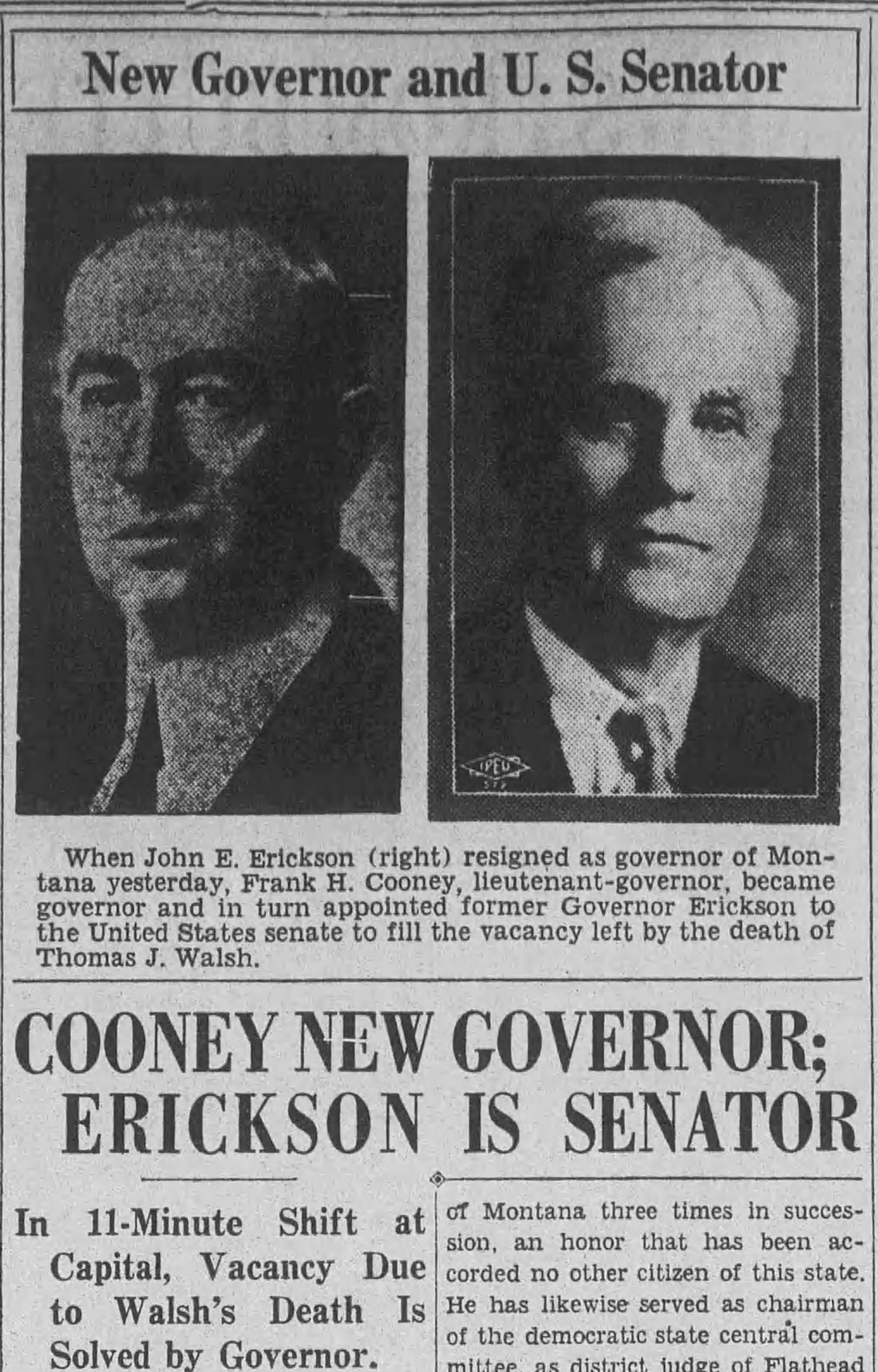 |
Butte Daily Post, March 14, 1933
Erickson apparently needed little encouragement – Erickson’s wife also liked the idea – and the governor agreed to switch offices. Erickson submitted his resignation on March 13, 1933 and 11 minutes later, new Gov. Cooney appointed him to fill Walsh’s Senate seat.
It appeared to be a clear victory for Wheeler, but the scheme engendered serious political fallout. Wheeler had politically knifed an old foe, thwarted his corporate adversaries and secured a lackluster and compliant colleague in the Senate who would never become a political threat. But things didn’t work out nearly as well for others involved in what became known as a “corrupt deal” over a Montana Senate seat.
One newspaper in the Flathead, Erickson’s backyard, accused him of “selfishness” and predicted “that future events will deal out justice” to a man who would shortly be forgotten.
Montana federal judge George Bourquin, a future Senate candidate himself, was outraged by the deal and wrote a scathing letter to every member of the Senate urging them to refuse to seat Erickson.
“This huckstering, horse trading, barter and sale of great public office … has been consummated by (Erickson and Cooney) to their large personal and financial advantage,” Bourquin said. The judge suggested that the Senate should find that Erickson couldn’t be seated because he had vacated the governor’s office for a fraudulent reason.
The Meagher County News, not knowing as most Montanans did not know that Wheeler had engineered the political swap, opined that Wheeler was disingenuous in denying that any deal had been struck, since with Erickson in the Senate, Wheeler would control all Montana patronage. By supporting Erickson, the paper said, Wheeler “tars himself with the same pitch that smears the new senator.”
The Montana Standard in Butte defended Erickson trading the governor’s office for the Senate floor saying, as Senator Daines also seems to suggest, that by anointing a candidate his party can avoid a lengthy and costly campaign that might cause party turmoil. Montana Democratic leaders in 1933 behaved much the same, generally supporting the Wheeler-Erickson-Cooney deal or choosing the expedient of simply keeping quiet.
The Senate ultimately seated Erickson, but not before Wheeler had to admit that the deal he engineered was unorthodox, but under Montana law not illegal.
Still the political fallout continued, and a few months later when Erickson had to face a special election to fill the remainder of Walsh’s term he lost the Democratic primary to Butte attorney James E. Murray, who would, ironically, become a bitter Wheeler adversary. That special election, vaulting Murray from local party politics in Silver Bow County to Senate prominence, began his 26-year Senate career.
Erickson, who had never lost an election while winning three times statewide, finished third in the special election primary and sank into political obscurity never again holding office.
There are no perfect parallels with Erickson switch to the Senate in 1933 and Daines coronation of his preferred Senate candidate this month, but there is one commonality. The ultimate outcomes of political maneuvers of this kind, even given the sharp political polarization Montanans confront today, are extremely unpredictable.
John Erickson certainly didn’t plan on spending a mere 20 months in the Senate after vacating the governor’s office, and Erickson, popular before the deal, likely couldn’t anticipate his popularity plummeting as far and as fast as it did. And Frank Cooney died of a heart attack in 1935 never overcoming the taint of his role in the “the deal.”
B.K. Wheeler, the architect of the long ago Montana Senate deal, increasingly expanded his reputation for ruthless political maneuvering, a reputation that many Montana Democrats – Jim Murray, Mike Mansfield and Lee Metcalf, among others – came to resent and reject. Wheeler, eventually losing the support of his party, lost his own Democratic primary in 1946.
The fallout in the Daines-Alme deal, if there is any fallout in our age of hyper-partisanship, may be just as unpredictable, particularly if voters conclude that the scheme was too cynical, too unfair or just plain unethical.
The Daines maneuver is likely to be remembered as a Montana test of whether expedient cynicism and norm shattering behavior, effectively minimizing the opportunity for voters to have their say in the stewardship of a seat in the United States Senate, carries any real consequences.
It’s difficult to be an optimist in today’s world and I’m not all that optimistic, but I do focus on realism and try to populate my writing with solid sourcing and not merely opinion. I write these pieces to offer a perspective based on history and particularly American political history since 1900.
These essays are free, but a financial contribution helps support my writing and research, including a new book in progress.
Subscribe to Marc’s Substack for $8 a month or make a pledge.
Many thanks.
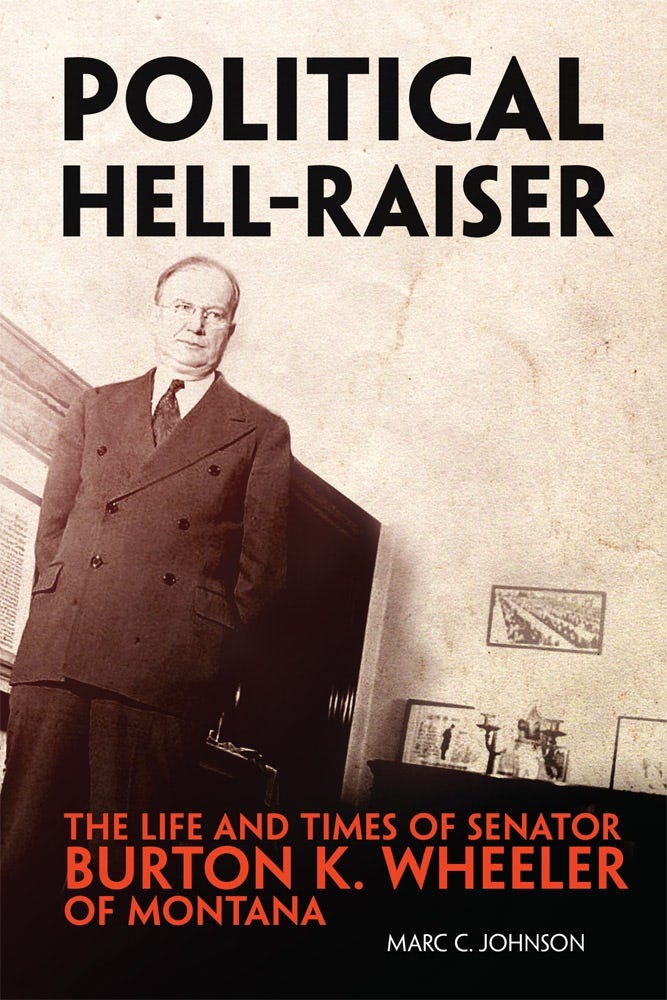
NOTE: My biography of Senator Burton K. Wheeler – Political Hell-Raiser – was published by the University of Oklahoma Press in 2019.
 |