

“They say we must fight to keep our freedom. But Lord knows there’s got to be a better way, oh … ” – Edwin Starr, 1970
By Marc C. Johnson
Winston Churchill, the greatest prime minister in British history and the indispensable man in ridding Europe of fascism 80 years ago, had an often problematic relationship with his generals.
Churchill was fundamentally a military man, or at least he thought of himself as such. He graduated from Sandhurst, the British West Point, fought in Cuba, Sudan, the Boer War and in India. Churchill served in France in World War I – he had a portable bathtub shipped to him for use in the trenches – and was twice First Lord of the Admiralty.
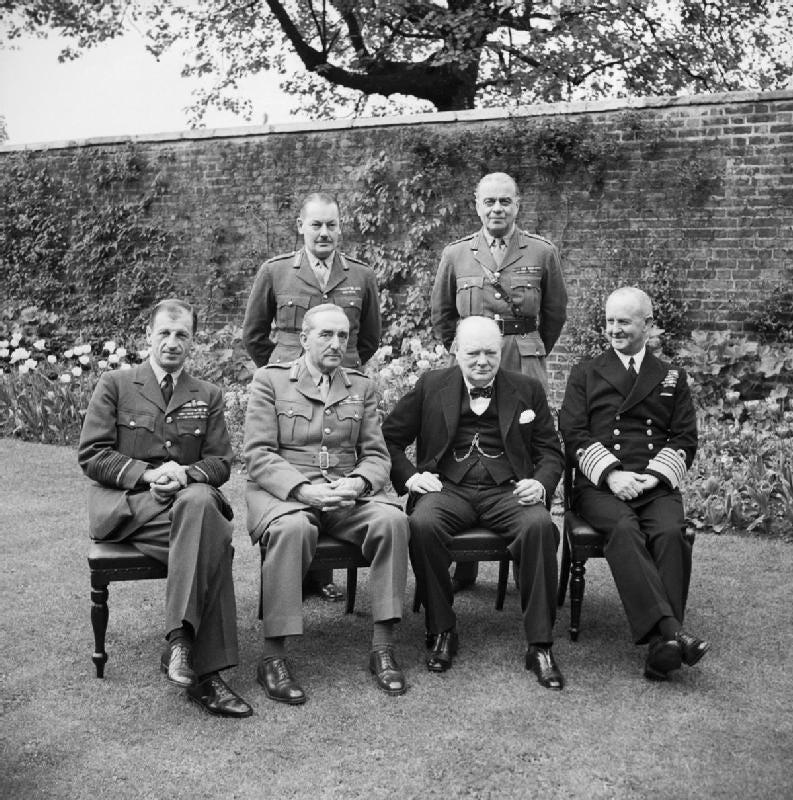
He had a military perspective and Churchill often fought with his generals. In the photo above, Churchill and the British chiefs-of-staff on May 7, 1945, the day World War II ended in Europe. He toasted them, they reportedly did not respond.
Historian Raymond A. Callahan relates in his fine book Churchill and His Generals a story that helps make the point I want to make today. ¹
Callahan tells of an evening Churchill spent in April 1941 with two senior British generals, John Kennedy, a top staff officer at the British War Office, and General Sir Alan Brooke, at the time chief of Britain’s Home Forces and later Chief of the Imperial General Staff, essentially the equivalent of the U.S. chairman of the Joint Chiefs.
The evening began with a Churchill radio address from Chequers, the prime minister’s country house, and ended hours later – 3:00 am apparently – with Churchill storming off to bed, mad as a hatter about a blistering exchange with General Kennedy that went on for some hours. ²
The details of the disagreement are less important than an enduring Churchill lesson about war and how to wage it. More on that in a moment. ³
The U.S. is currently at war with Iran with a diminished 80-year old man as commander-in-chief – a warlord who avoided military service, has repeatedly politicized the military, fired senior officers with no explanation, abused heroes and surrounded himself with an unbelievable collection of incompetent posers and sycophantic yes men.
What could go wrong?
Well, plenty.
It’s difficult to be an optimist in today’s world and I’m not all that optimistic, but I do focus on realism and try to populate my writing with solid sourcing and not merely opinion. I write these pieces to offer a perspective based on history and particularly American political history since 1900.
A lesson from history
British General John Kennedy, wisely perhaps, wrote a letter to Churchill after their dust up in April 1941 reiterating his belief that Britain could not lose a war to Nazi Germany, stressing “no one under your leadership can believe such a thing.”
Having calmed down, Churchill replied: “My dear General, our conversation was purely personal and private. I do not agree with your views but you were perfectly entitled to express them.”
Churchill had many, many clashes with his generals and top military advisors during World War II, and he was often dissuaded from pursuing some of his worst tactical or strategic notions when he received informed pushback.
The Prime Minister famously told Supreme Allied Commander General Dwight Eisenhower, with whom he had a complicated, often wary but ultimately successful relationship, of his worries about a premature landing in occupied France:
“When I think of the beaches of Normandy choked with the flowers of American and British youth and when in my mind’s eye I see the tides running red with their blood I have my doubts—I have my doubts, Ike, I have my doubts.”
Churchill was right about not launching an invasion before June of 1944, an invasion Eisenhower commanded.
As Lewis Lehman wrote in 2016:
The General would listen to the Prime Minister, but ignore him when necessary. Ike knew he could count on the full backing of President Roosevelt and US Army Chief of Staff, George Marshall. At key points Churchill would come to Ike’s defense. During the climactic Battle of the Bulge in December 1944, Churchill called Eisenhower to say he was releasing a press statement as “a mark of confidence in you.” Churchill would listen to Eisenhower, but he ignored Ike’s cautious orders when the Prime Minister insisted upon getting too close to the German front in 1945. Eisenhower would block the Prime Minister’s attempts to cross the Rhine personally in late March. After the General departed, Churchill declared: “I’m now in command. Let’s go over.”
Churchill sacked his share of generals, but his reasons involved failing to perform. He didn’t dismiss critics or marginalize officers or politicians because they gave him advice he disliked.
Churchill was a great man who was often wrong, but he did not surround himself with or tolerate yes men. His ego was big enough for the unbelievably difficult job of defeating Hitler and Mussolini, but not so big he didn’t work well with other men with big egos and big brains.
The war president
Here’s CNN on Donald Trump’s top military advisor, General Dan Caine, as the president moved toward war:
Typically, sensitive military operations are debated in the highly fortified conference room in the Pentagon known as the Tank. But in an administration that is focused on avoiding leaks, Caine — who is also known for his intensive secrecy — worried that assembling the top brass in the Defense Department’s nerve center on very short notice would draw suspicion, according to several sources familiar with the matter.
In those meetings and others at the Pentagon, Caine has been vocal about the potential downsides of launching a major military operation targeting Iran, raising concerns about the scale, complexity and potential for US casualties of such a mission, according to sources familiar with his advice.
Those concerns have not matched the rhetoric coming out of the White House, where President Donald Trump has been bullish on how easily the US military could achieve victory, though the exact dimensions of that success haven’t been defined.
But Caine is determined to avoid what he believes were the mistakes of one of his predecessors, Gen. Mark Milley, and maintain his influence with Trump, according to sources familiar with his thinking.
So, the nation’s top military leader is tiptoeing around the president because Trump will not tolerate ideas or views that clash with his own.
More from CNN:
Milley often clashed directly with Trump during his first term on issues such as deploying the military domestically to quell protests, and sometimes undermined Trump’s inflammatory rhetoric privately to reassure nervous allies and foes.
For Caine, avoiding the Milley approach has meant being more reserved around Trump, and avoiding weighing in too directly on decisions, including what to do in Iran. It’s a tightrope that Caine has been attempting to walk during his year as Trump’s top military adviser – avoid direct conflict with a notoriously mercurial president, while still providing professional military guidance.
Some say Caine hasn’t been assertive enough with Trump. “He’s definitely pulling punches,” a source familiar with Caine’s interactions with Trump said when comparing his White House conversations with his private discussions with military leaders. ⁴
Writing last week in The New York Times columnist Carlos Lozada did a masterful job of analyzing how Trump is handling members of his second term Cabinet, people like Kristi Noem, Pam Bondi, Howard Lutnick and Pete Hegseth, each of whom have drawn withering criticism for their arrogance and incompetence.
But each remains in place because they live to please Trump and tell him what they know he wants to hear. Here’s Lozada explaining that Trump sees his advisors as “shields” who protect him:
When Trump cut loose senior officials during his first term, it was often because they espoused worldviews or priorities different from his own; in some cases, they obstructed his decisions or subscribed to norms he found useless and constraining. Remember Jeff Sessions, the attorney general whose unforgivable sin was to recuse himself from oversight of the Russia investigation, leading to the appointment of Robert Mueller as a special counsel? Or Rex Tillerson, the secretary of state who repeatedly clashed with the White House over policy? “We were not really thinking the same,” Trump explained to reporters when he pushed out Tillerson.
The offenses of Trump’s second-term cabinet members tend to be ones of loyalty or sycophancy, rarely of independent thought. Whatever damage the secretaries inflict on their country or their reputations is done on the president’s orders and on his behalf. In Trump’s first term, sacrificing cabinet members meant firing them, or pushing them to resign. In the second term, it means keeping them in the job for as long as those shields retain even marginal power.
Loyalty, sycophancy, no independent thought.
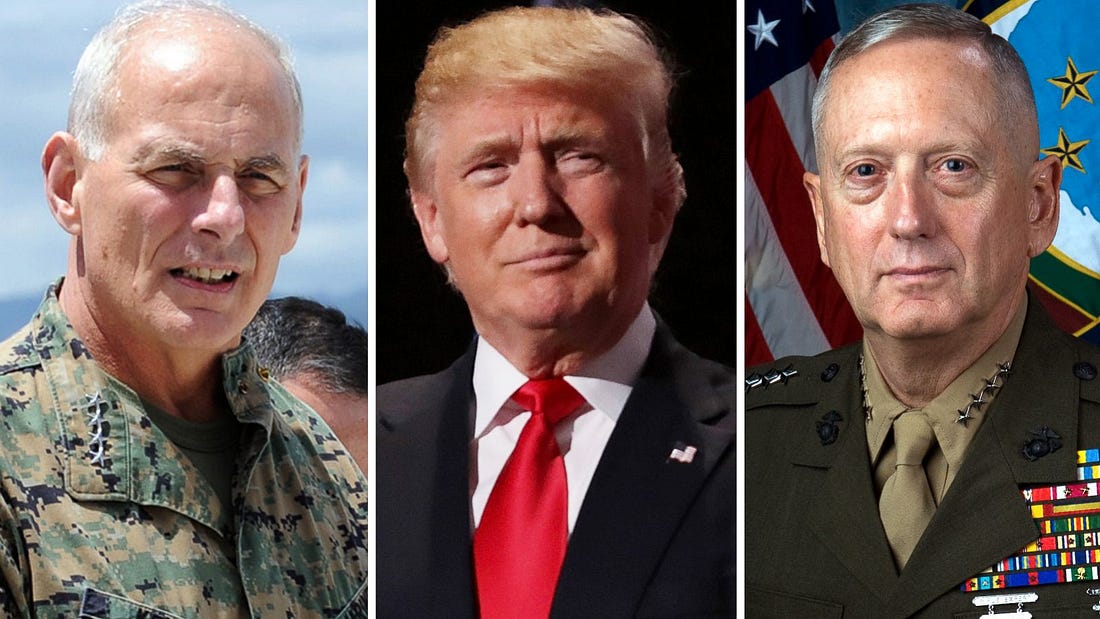 |
Trump with two of the former generals – John Kelly and James Mattis – who left his first administration over policy disputes
What could go wrong?
To be sure there are many, many dangers in another war in the Middle East and much that can – and probably will – go wrong, including a region-wide nuclear arms race.
In an interview Sunday with The Atlantic’s Michael Scherer Trump said he’s ready to talk to the Iranians. But given Trump’s serial lying it’s impossible to know what he really has in mind beyond capturing another news cycle.
Here’s a portion of Scherer’s reporting:
Soon after our conversation, U.S. military officials announced that three U.S. service members were killed in the operation and five more were seriously wounded—the first known American casualties of the campaign. Trump told me he expects the attack on Iran will not disrupt Republican efforts before this fall’s midterm elections to convince voters that his administration is focused on delivering economic benefits for the country. “We have the greatest economy we’ve ever had,” he told me. “The word isn’t out because people like you don’t write about it properly. But the economy is ready to go through the roof. And it already is in many cases.”
Later on Sunday Trump told The Daily Mail that the war will go on and he said to expect more U.S. deaths:
“It’s always been a four-week process. We figured it will be four weeks or so. It’s always been about a four-week process so – as strong as it is, it’s a big country, it’ll take four weeks – or less,” the President explained.
In a social media post he also said:
“Combat operations continue at this time in full force, and they will continue until all of our objectives are achieved. We have very strong objectives.”
Very strong objectives that he can’t explain.
An unbalanced commander-in-chief
Trump may also be intoxicated with how well, if not how illegally, his capture of Venezuelan president Nicholas Maduro came down. But a critical factor regarding a war of choice in the Middle East centers on Trump’s profoundly damaged personality, his hubris and his increasing mental decline.
Trump’s massive ego coupled with his constant desire to disrupt and deflect from other news that is bad for him, and his faith in his own sociopathic brain make him impulsive, reckless and virtually devoid of any ability to absorb the many, many voices counseling caution.
And all of this – the risk of a wide regional war, the chance that more nations will seek to develop nuclear weapons as the only guarantee of security and the very real possibly of additional American casualties – is playing out with absolutely no congressional involvement from majority Republicans.
No hearings, no authorization for hostilities, no critical questions asked. No nothing.
And, of course, Trump has made virtually no effort to justify military action beyond vague statements about “regime change” and an Iranian nuclear threat, a threat he claimed was totally “obliterated” in June 2025.
“As Trump readies a US armada for a Middle Eastern war whose aims he cannot articulate,” Edward Luce wrote in the Financial Times last week:
“ … an honest reckoning of geopolitical risks would place his wayward psychology high up. That Trump often lies is, in itself, not proof of irrationality. That he is encouraged to believe his own lies is more serious. . . . Whether foreign or American, people who tell him what he wants to hear, not what he needs to know, are playing a dangerous game. The road to Trumpian recklessness is paved with flattery …”
Flattery, and I’ll add, foolishness from a foolish man with foolish “advisors.”
Saturday night after ordering up a war, as The New York Times reported, “the president capped an extraordinary day of U.S. aggression abroad by attending a glitzy fund-raising dinner at his club.”
Sources: