

“Politics has become so expensive that it takes a lot of money even to be defeated.” – Will Rogers
By Marc C. Johnson
Susan Collins, the Republican senator from Maine, announced her re-election campaign this week. If the GOP can hold on to her seat they can almost certainly hold on to Senate control.The New York Times referred to “her brand of political centrism” in reporting on the Collins announcement, but also said:
Her frequent statements of concern and regret that follow many of President Trump’s actions have been mocked by her opponents because she has, with some notable exceptions, been a reliable vote for the Republican agenda during Mr. Trump’s presidencies.
A centrist that is a reliable vote for Donald Trump. Hum …Collins infamously said that Trump had learned his lesson after he tried to shakedown the Ukrainian president to get dirt on Joe Biden and was impeached. Collins voted against convicting Trump.When Trump was impeached a second time after the January 6 insurrection Collins voted to convict him.”This impeachment trial is not about any single word uttered by President Trump on Jan. 6, 2021,” she said. “It is instead about President Trump’s failure to obey the oath he swore on January 20, 2017. His actions to interfere with the peaceful transition of power — the hallmark of our Constitution and our American democracy — were an abuse of power and constitute grounds for conviction.”
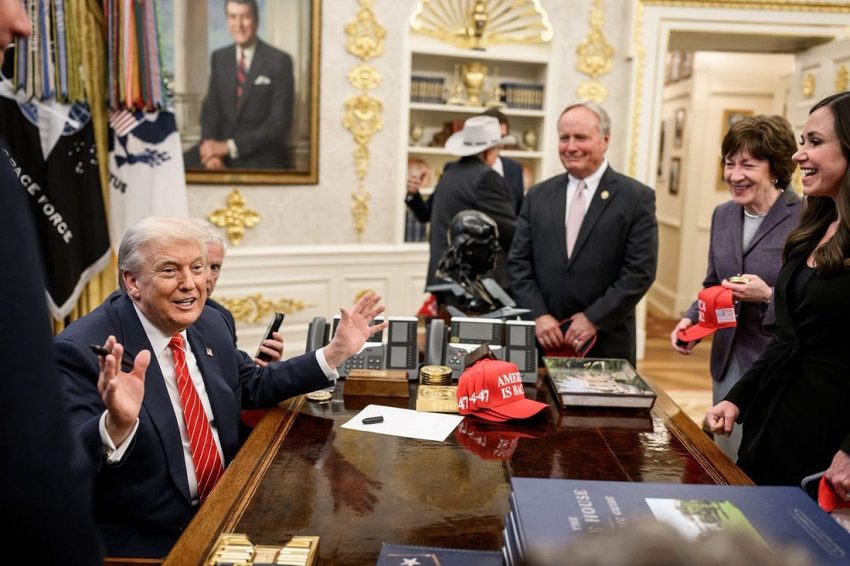
She also recently showed up with a MAGA hat in the Oval Office for a press availability with Trump.
Life in Trumpworld. So, pass the lobster, I guess, she obviously needs the job at age 73.But the most interesting thing in the recent Times story about Collins running again was not her obvious need to not piss off Donald Trump – Trump said recently “should never be elected to office again” – but what her campaign says about our political money system.Campaigns are now just a constant, unrelenting, grubby grab for money. And that, my friends, is what is wrong with our politics.It’s difficult to be an optimist in today’s world and I’m not all that optimistic, but I do try to focus on realism and populate my writing with solid sourcing and not just opinion. I also write these pieces to offer a perspective based on history and particularly American political history since 1900.
Here’s the end of the Times piece on Susan Collins:Political organizations either supporting and opposing Ms. Collins have for months been running advertising about her, with spending on the race expected to eclipse the record $200 million that was spent on the 2020 race. ¹
Ms. Collins herself appeared prepared in recent days for her campaign announcement.
Last week, an unlisted YouTube link appeared with eight minutes of footage of the senator that was ready-made to be dropped into supportive ads from friendly outside groups. The clips show her doing Maine things — picking blueberries, helping with a lobster haul, tossing a Frisbee to her black Labrador retriever.
Pause over that for a moment.Collins’ campaign has a YouTube site with eight minutes of “B” roll of her sitting at a conference table with some young staffers, standing outside a Maine fire station, etc.The sole purpose of that site is to provide video that Collins-aligned political action committees can use to make ads. After all, as all you fans of Buckley v. Valeo know, candidates cannot legally communicate or coordinate with PAC’s who are lavishing money on them.No prohibition, however, for providing those PAC’s with easy access to insipid video footage. And every competitive Senate campaign in the country will feature something similar this year.None of this is, really, about Susan Collins, a mediocre senator who by gift of seniority has risen to chair the Senate Appropriations Committee.Nope. This is about the “system” we have that pumps literally billions of dollars into campaigns for high public office and, I would argue, profoundly corrupts not just politics but everyone who has a stake in this squalid game.Collins is a particular magnet for political money because she’s an appropriator who has a lot to say about how Congress handles federal spending.Collins has $8 million in her campaign account and the Super PAC supporting her – they’ll be using some of that cheesy B roll – has nearly $6 million in hand. And we’re more than eight months from the election.And, of course, Collins’ Democratic challengers are raising big money, too.The money is truly staggering.
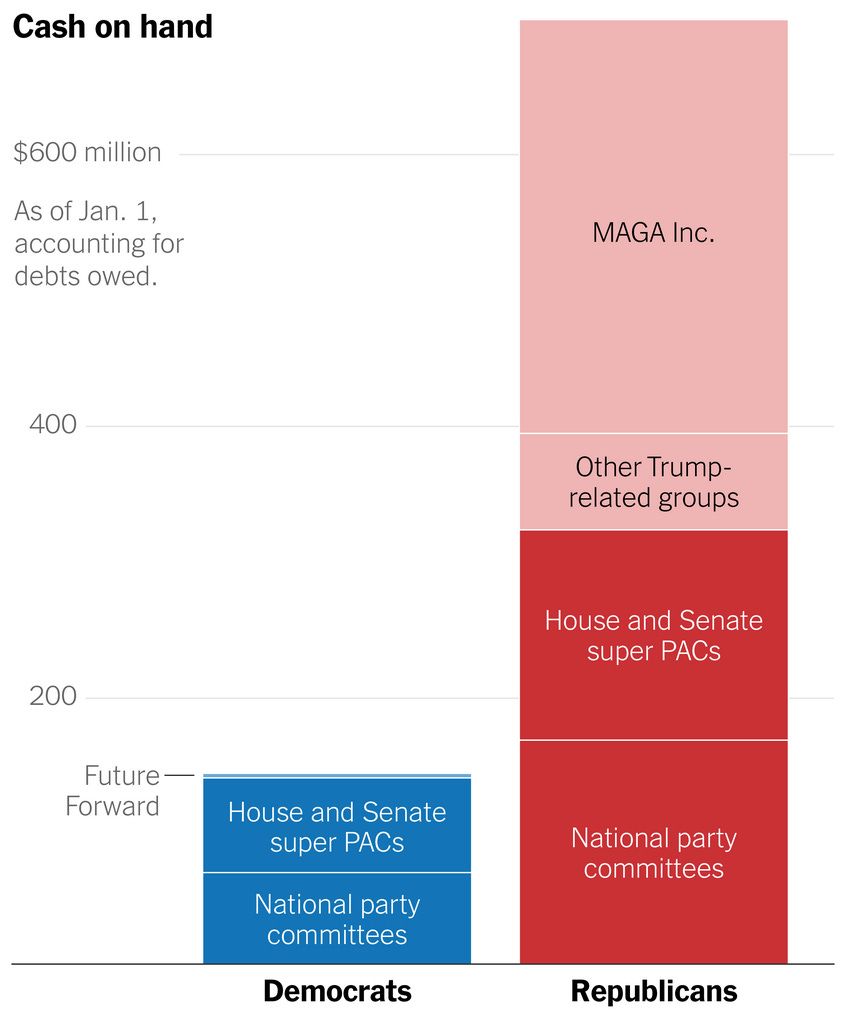 |
New York Times chart of the money raised as of January for PAC’s supporting the two major parties. Obviously, Republicans are very good at this game
Our “system,” if we can even call it one, is so completely corrupt that it has become almost impossible to track where all the money is coming from and how it is being spent.Federal law requires some disclosure for various types of political money, but the vast “dark money” universe, a product of the Supreme Court’s Citizens United decision – allows ultra-wealthy people to entirely avoid disclosure.Yet, we know this. The reporting is from the Times:The Republican National Committee began this year with nearly $100 million more than the Democratic National Committee.
The Supreme Court is widely expected to loosen restrictions on party funds in the coming months in a way that could help Republicans take fuller advantage of their fund-raising edge.
President Trump is sitting atop a super PAC with more than $304 million — a huge sum for which there is no Democratic counterweight.
The world’s richest man, Elon Musk, has re-engaged with the Republican Party after his blowup with Mr. Trump last year, donating tens of millions of dollars in the last two months and attending the recent wedding of a top Trump aide at Mar-a-Lago. And Democrats worry that well-funded super PACs tied to the cryptocurrency and artificial intelligence industries, which have cozied up to Mr. Trump, could further fuel a Republican financial edge.
So, Republicans are really good at raising this kind of money, while Democrats have generally been better at appealing to grassroots voters who usually contribute smaller amounts. Big surprise, the Supreme Court is poised to again help the cash spigot open even wider benefiting – drum roll – Republicans.… the pending Supreme Court decision is widely expected to water down Democrats’ years long advantage in grass-roots donations. That is because under federal law, candidates can buy television ads at the cheapest rates, while super PACs often pay much more — sometimes five to 10 times as much.
The court case could open the floodgates for political parties to leverage big-money donations to pay those cheaper rates for the first time.
Republicans said the Supreme Court decision — depending on its scope — could remake the financial playing field. Some operatives drew parallels between its possible impact and the effect of a seemingly obscure decision by the Federal Election Commission in 2024 that quietly opened the door for super PACs to pay for a candidate’s field operation — a ruling that Republicans exploited far more effectively and quickly than Democrats.
It’s the corruption, stupidYet beyond the vast amounts of money involved and regardless of which party plays the “system” better, the issue I want to highlight is the corrupting impact of this gusher of money.Here’s a recent headline in The Times.Hundreds of Big Post-Election Donors Have Benefited From Trump’s Return to OfficeThe president’s team has created a highly unusual fund-raising apparatus for causes he favors. The Times analyzed more than half a billion dollars in contributions from 346 donors. Some have received pardons, jobs, access to the president and other valuable gains.
To shed light on what has been a largely opaque fund-raising apparatus, The New York Times conducted a comprehensive investigation. It relied on previously unreported documents and public campaign finance filings, as well as interviews with dozens of people who are familiar with the solicitations or are involved in the fund-raising. It traced a large portion of the funds raised — more than half a billion dollars’ worth — back to 346 donors who each gave at least $250,000. It also found that more than half of them have benefited, or are involved in an industry that has benefited, from the actions or statements of Mr. Trump, the White House or federal agencies.
This is “pay to play” on steroids. You have a few billion, need access to the White House (or the right congressional committee) you open your checkbook. Want a government job or contract. Write the check. Need a pardon. Write the check.Presto.The Times analysis literally reeks of corruption.One $2.5 million contribution to MAGA Inc. was given by a South Florida woman whose father months later received an unusually lenient deal from top Justice Department officials to settle charges that he bribed Puerto Rico’s then-governor in 2020.
Another $2.5 million pledged donation — this one to Mr. Trump’s White House ballroom project — came from Parsons Corporation, an engineering firm that has won government contracts for years, including under Mr. Trump, and is jockeying for some of the more than $1 trillion in contracts that could be awarded to build a missile defense system proposed by the president called the “Golden Dome.” Also giving at least $2.5 million to the ballroom project was the chief executive of Roblox, a popular online video game company that has applauded a Trump executive order and other initiatives involving children’s use of artificial intelligence.
A couple who donated $1 million to Mr. Trump’s inaugural committee and $500,000 to MAGA Inc., as well as an undisclosed amount to the ballroom fund, saw Mr. Trump nominate their son to be U.S. ambassador to Finland.
And a company that was accused last year by the Justice Department of colluding over ticket prices donated $250,000 to Mr. Trump’s inauguration. The president pardoned the company’s co-founder in a separate case this month.
Need a bridge stopped?You may have seen the story in the last day or two about Trump threatening to disrupt the opening of the new Gordie Howe International Bridge linking Detroit to Windsor, Ontario and scheduled to open next year.A wealthy Michigan guy, Matthew Moroun, big Republican donor, owns a rival bridge, the Ambassador Bridge, and currently has a near monopoly on truck traffic across the border.Apparently Moroun leveraged his contributions to the GOP to meet with Commerce Secretary Howard Lutnick who then talked to Trump who then issued the bridge threat.Here’s the Windsor Star newspaper on this almost certain quid pro quo at play here:The Moroun family, who are major Republican donors, spent millions of dollars and launched dozens of lawsuits trying to stop progress on the Gordie Howe bridge. In 2012, they spent about US$30 million on a failed Michigan ballot proposal to block its construction.
“They lost every last one of them,” said [James] Blanchard, [a former Michigan governor and ambassador to Canada]. “The reality is the Ambassador Bridge is going to make money one way or the other. Yeah, they’ll make less because they’ll have a modern infrastructure a mile and a half away, but they’ll still make money.”
Dark MoneyThe proliferation of dark money is a pox on all their houses story, involving Democrats and Republicans and groups with ideological agendas that dare not be exposed.The Republican Lt. Governor of Georgia is running for governor and not having much fun as dark money attacks mount against him:New campaign finance data shows the shadowy group Georgians for Integrity has poured millions of dollars into a relentless advertising campaign attacking Lt. Gov. Burt Jones, focusing on allegations of self-enrichment during his time in public office. The ads have become nearly unavoidable on television screens across the state, fueling deepening fractures within the Republican field.
The spending spike comes as questions intensify over who is actually behind the ads — and why.
Who is behind the ads – and why. Good question.
Can states act?There is virtually nothing happening at the federal level to address the swamp of money and the stench of corruption, but some states are trying to do something, including Montana, a state with a legacy of corporate dominance of politics.A bipartisan group, including former Republican Governor Marc Racicot and former Democratic Senator Jon Tester, are pushing a ballot measure to outlaw corporate spending in Montana elections.The architect of the Montana effort is Jeff Mangan, a former commission of political practices.Mangan said the idea wasn’t to try out a new system for election spending in Montana but to restore the old one, which banned corporate cash and was in place until a U.S. Supreme Court ruling nullified it in 2010.
“We forgot,” Mangan said. “People think it must have been years and years and years— decades. No. It’s only been since 2010 that this has happened. We can get back to the system in Montana that we were proud of and that we had before.”
And here’s the blunt spoken Tester:“You might ask yourself, ‘Well why does money in politics keep people from having town hall meetings or meetings eyeball to eyeball?” Tester said. “‘They still need to do that.’ Well, they really don’t. And the reason is — is if you’ve got enough money, you can buy your advertisements, you can buy the interviews, you can buy what’s going to be said in a town hall meeting. And then as the candidate or person, you control the message entirely and you don’t have to field difficult questions because you don’t know what’s coming. By the way — which is part of what democracy’s about.” ²
It will be an uphill climb, I suspect, but as the former GOP governor said:“Frankly, if we get this done, it’s going to spill over and be an example for every other state in the nation,” Racicot said.
By one account dark money groups spent $1.4 billion on various federal races in 2024.
Voters see the corruptionThe uber-rich, corporations, dark money groups, the Koch Family, Donald Trump, labor unions and many others are fine with the runaway political spending and out of control corruption. ³Little wonder The Searchlight Institute finds that most voters think all politicians are crooks. As Matthew Yglesias writes:Searchlight Institute polling on this shows that voters just have an incredibly low estimate of the baseline level of integrity of politicians. Seventy-one percent say the “typical politician” is corrupt. Typical Republican? Sixty-eight percent. Typical Democrat? Sixty-one percent. Seventy-two percent say that “long-term elected officials” are probably corrupt.
There is a lot wrong with our rotting politics, but our corrupt political money system is at the heart of the rot.
It is necessary that laws should be passed to prohibit the use of corporate funds directly or indirectly for political purposes; it is still more necessary that such laws should be thoroughly enforced. Corporate expenditures for political purposes, and especially such expenditures by public-service corporations, have supplied one of the principal sources of corruption in our political affairs.
Theodore Roosevelt, 1910
1 – If the 2026 Collins race matches spending in her last race, and it almost certainly will exceed $200 million, then every person in Maine (population 1.4 million) will see about $143 dollars per person spent to influence the election outcome.
2 – Upwards of $250 million was spent in Tester’s 2024 race that he lost to Republican Tim Sheehy.
3 – The Koch network spent about $550 million influencing elections and policy in 2024.