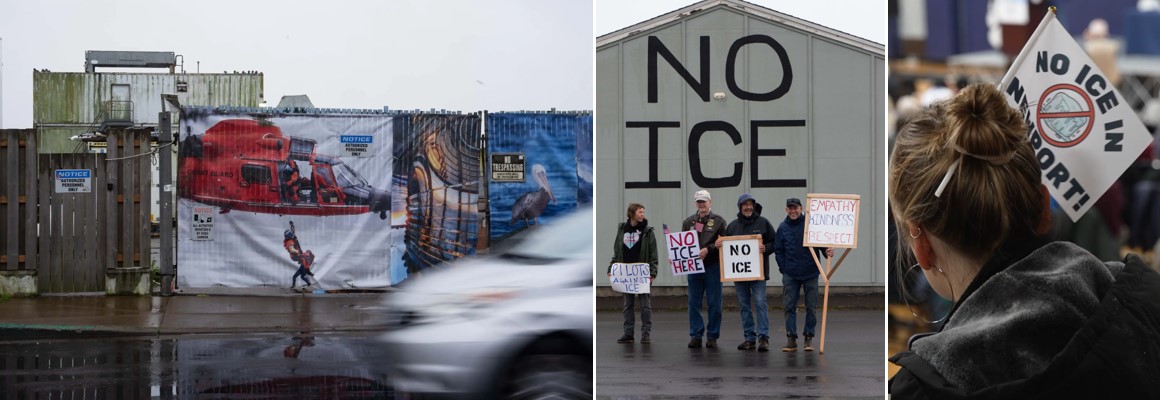
| The situation in Newport with the status of the Coast Guard air rescue operation and the possibility of an ICE detention center continues to evolve.
Tuesday, I shared news that U.S. District Judge Ann Aiken found that the sudden relocation of the helicopter last month could imperil lives as crabbing season gets underway, and that the Coast Guard had not provided the legally required notice before moving the aircraft nearly 100 miles south to North Bend.
Translation: The Department of Homeland Security (DHS) violated the law in removing the helicopter and put lives at risk. You can read the order here.
The U.S. Coast Guard must immediately return a rescue helicopter to the city of Newport as a court case challenging the aircraft’s removal gets underway. The order remains in effect for 14 days, though Aiken will also consider a permanent injunction barring the removal of the helicopter. Read more on OPB, the Lincoln Chronicle, or the Oregonian.
Between 2014 and 2025, the U.S. Coast Guard rescue helicopter based in Newport was responsible for the rescue of approximately 500 people, including 30 commercial fishermen whose lives were saved at sea, according to court records. In 2015, I passed an Oregon resolution supporting air rescue in Newport. Concerns persist that relocating to North Bend will increase response times and put lives further at risk.
The temporary ruling is good news and a great relief to our coastal communities. Fishermen will be safer – at least temporarily. I look forward to the final decision in these lawsuits.
The Coast Guard is in the Courts, and the ICE facility is in the shadows.
A federal contractor representing U.S. Immigration and Customs Enforcement told Oregon officials last week that they are preparing an analysis of an unspecified project that could have environmental ramifications for the coastal city of Newport. The message offers the clearest indication yet that an immigration detention center could be coming to Lincoln County.
Under federal law dating back to 1972, whenever a federal agency wants to act in a coastal zone in Oregon, it must wait at least 90 days before the project can break ground. During that time, Oregon’s Department of Land Conservation and Development (DLCD) conducts a 60-day review to determine how that activity would impact the coast, as well as a 30-day public comment period. Notable recent uses of the program have been offshore wind energy and the canceled Jordan Cove Energy Project, which would have added a liquified natural gas export facility near Coos Bay.
Inquiries from the media, local government, and legislators have gone unanswered. I told the Capital Chronicle, “All we know is that they are making inquiries about a proposed action in Newport and making sure it’s consistent with Coastal Zone Management Act requirements. I just take that as one more piece of evidence that this proposed action is far from over.”
At the same time, motels along the central coast are being contacted by a federal housing contractor seeking prices and availability for up to 200 rooms for a year to “accommodate personnel” beginning as soon as December 15.
We’ve seen similar inquiries for the delivery of large volumes of drinking water, the disposal of thousands of gallons of human waste daily, and online ads for detention agents, bus drivers, and medical personnel with ICE experience – all to be employed in Newport. I remained troubled that honest and transparent details have not been forthcoming. Good government does not hide in the shadows.
I have been pleased to help bring our local story to a national audience – first on MS Now and last week in the New York Times.
As I said, the situation and the almost universal resistance to an ICE facility here continue to evolve. |