Tillamook County Pioneer

News & People of Tillamook County. Every Day.

Menu
  • Home
  • Feature
    • Breaking News
    • Arts
    • Astrology
    • Business
    • Community
    • Employment
    • Event Stories
    • From the Pioneer
    • Government
    • Letters to the Editor
    • Non Profit News
    • Obituary
    • Public Safety
    • Podcast Interview Articles
    • Pioneer Pulse Podcast: Politics, Palette, and Planet – the Playlist
  • Guest Column
    • Perspectives
    • Don Backman Photos
    • Ardent Gourmet
    • Kitchen Maven
    • I’ve been thinking
    • Jim Heffernan
    • The Littoral Life
    • Neal Lemery
    • View From Here
    • Virginia Carrell Prowell
    • Words of Wisdom
    • Chuck McLaughlin – 1928 to 2025
  • Weather
  • Post Submission
  • Things to do
    • Calendar
    • Tillamook County Parks
    • Tillamook County Hikes
    • Whale Watching
    • Tillamook County Library
    • SOS Community Calendar
  • About
    • Contribute
    • Advertise
    • Subscribe
    • Opt-out preferences
  • Search...
Menu

NEWS UPDATE FROM STATE REPRESENTATIVE DAVID GOMBERG: Student Success, Population Changes, and Taxes

Posted on January 13, 2026 by Editor

By Representative David Gomberg, House District 10

Late last week, I spent several hours at Taft High School meeting with seniors who had prepared background research and proposals to address some of Oregon’s most pressing problems. They talked about housing and homelessness, food insecurity, and the scourge of sexual abuse. The presentations were thoughtful, well-examined, data-supported, and constructive. It was a hard few hours delving into difficult questions. But time spent with these kids gave me hope and inspiration. And their youthful energy almost wore me out!

I am mindful that Oregon has one of the shortest school years in the nation and suffers one of the highest absentee rates. Cumulatively, we are graduating students and sending them out into the world with a year less time in the classroom than neighboring states. Is it any wonder they struggle to compete?

And now we have new evidence that fewer students are even showing up.

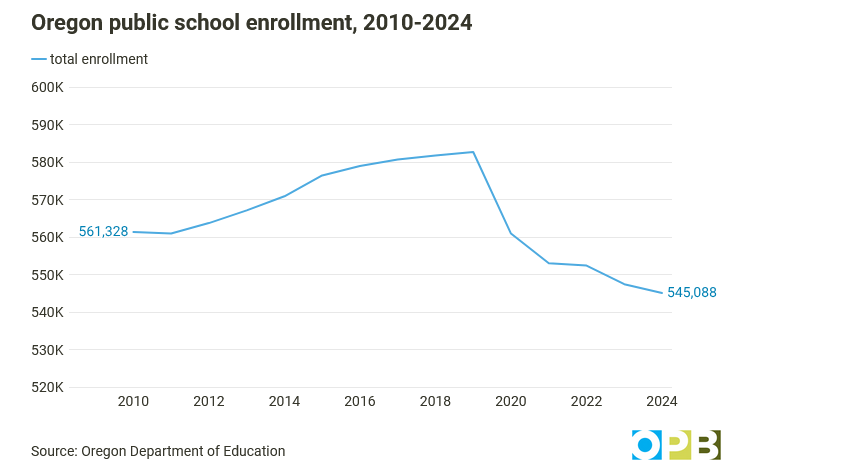
According to Jefferson Public Radio and OPB, Oregon’s public school enrollment continues to decline in the years after COVID-19, but it’s not clear where students are going.

For the better part of a decade — from 2012 through 2019 — Oregon’s public school enrollment had been increasing. But schools saw a sharp, steep decline in 2020-2021: 21,744 fewer students. The next year, another drop of almost 8,000 students. And even with COVID behind us, that trend continues.

While declining birth rates in the state were already affecting school enrollment trends, the sharp drop in students raises questions about where once-enrolled students have gone, especially without statewide enrollment tracking for students in other settings, like some homeschool or private schools. A recent Brookings report found 12% of Oregon school-aged children “unaccounted for.” That means they were living in the state, but they didn’t show up on public or private enrollment rolls. School options are one thing; unschooled young people are another.

The inference is that these young people left school to pursue work or other interests, or to address personal challenges. In Lincoln County, one out of every five students is listed as homeless, and there is increasing concern for students of color avoiding school in response to enhanced local ICE activity.

For public school leaders, the consequences of declining enrollment are real, and something districts across the country are dealing with. Having fewer students can result in less funding to affected districts, which in turn can lead districts to close schools — both of which can make it harder to serve the students still enrolled.

Read more details here.

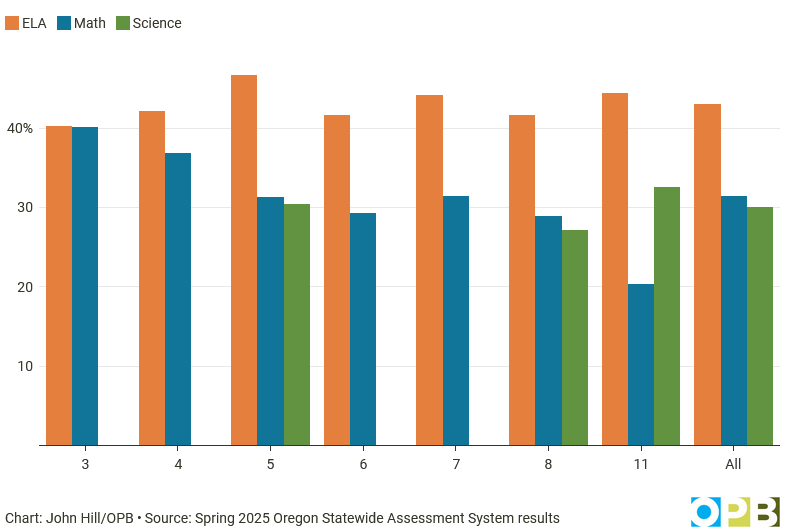
The results from Oregon’s state tests in English, math and science were released late last year. And for the first time since COVID closures, things are looking up. The share of students proficient in math, English, and science is up for the first time since the pandemic – but passing rates remain well below pre-pandemic levels.

Each spring, Oregon tests students in three subjects from elementary to high school. Students in grades 3-8 and 11 take math and English language arts assessments, while students in grades 5, 8, and 11 also take science tests. These results, from tests administered this past spring, show improvements in all three subjects. Based on test performance, students are rated on proficiency from levels one to four, with levels three and four considered proficient.

Oregon public school test scores in 2025 show the percentage of students in each grade level marked proficient in English language arts, math, and science. Note: Students are only tested in grades 5, 8, and 11 in science.

The results of these tests are skewed by the fact that many students or their parents opt out of taking them. Participation is still below federal requirements – especially in high school.

For 2025, 89% of students participated in English tests, with 88% participating in math. However, 11th-grade participation in state tests remains lower than in other grades, a consistent pattern since the COVID-19 pandemic. Oregon officials say students who score “proficient” are on track for success in college and career. But without an adequate percentage of high school students taking the test, the state tests don’t provide a very complete picture of college and career readiness in Oregon.

Read more on OPB.

Loss of population is of concern to school administrators, employers, and state economists. Population growth is core to Oregon’s economic health. A low birth rate and aging population mean Oregon leans on its working-age residents to shop, pay taxes, and bolster the state’s labor force.

But the state’s population has been on edge since the pandemic, as the tsunami of young professionals who flooded into Oregon during the 2010s slowed. We saw many people leaving Oregon, especially from the Portland metro area, suggesting a complex migration pattern driven by high costs, remote work, and a search for better opportunities or lifestyle changes. Key factors for people leaving include housing costs, homelessness, wildfire impacts, and taxes, with Washington, California, and Arizona being common destinations.

But now some good news. Oregon experienced the highest percentage of inbound movers in the nation last year, a sign that the state’s population slowdown may be coming to an end.

Interstate hauler United Van Lines released its annual moving survey that shows migration patterns across the U.S. Oregon topped the list for share of inbound movers, with 64.5% of those who moved coming into the state and 35.5% moving out. A company spokesperson noted that 22% of respondents who moved into Oregon arrived from California. Other big sources of in-migrants were Washington and Colorado.

U-Haul’s 2025 migration report echoed those findings. The report found that of the states that saw migration growth in 2025, Oregon ranks 11th, with U-Haul customers making up 50.3% of all one-way traffic in and out of the state. This is also the first time since 2022 that Oregon registers as a net-gain state with more U-Haul customers coming into the state rather than leaving, according to U-Haul.

“We are seeing a boom in the technology sector throughout the state, and there has been more of a recent push by state leadership to have clean energy and a cleaner state. The people who move to and live in Oregon love the outdoors. We have the Pacific Ocean and the mountains. We have all four seasons here and a lot of people appreciate and enjoy that.”

The U-Haul report says notable cities seeing growth include Beaverton, Bend, Corvallis, Happy Valley, McMinnville, St. Helens, Tigard, Florence and Woodburn. According to the report, the top 10 growth states are Texas, Florida, North Carolina, Tennessee, South Carolina, Washington, Arizona, Idaho, Alabama and Georgia – in that order.

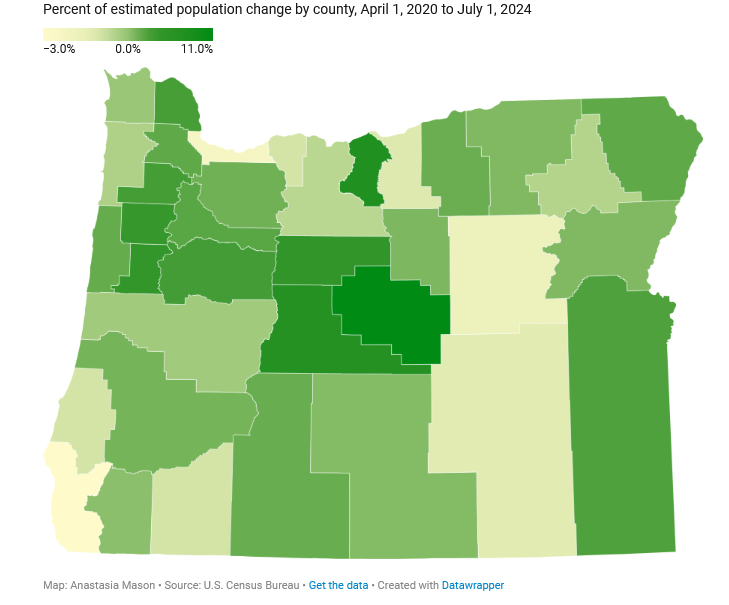
Check this interactive map to see population trends in each Oregon county.

The Census Bureau still contends Oregon lost population from 2021 to 2022. But in 2024, its data shows Oregon gained just over 18,700 residents for a total population of 4.27 million. While Oregon’s population seems to be inching back, new data shows Lincoln County’s dipped last year to at least a seven-year low.

Lincoln County’s decline from 2024 to 2025 came mainly in its unincorporated areas, with 242 of the losses coming outside of the county’s seven incorporated cities. And while Newport did register a population decline of 213 residents from 2024 to 2025, the county’s six other cities and towns added a total of 103 residents during that same one-year period. Lincoln City led the way in population growth last year with 55 new residents. Following were Depoe Bay with 19, Waldport with 18, Siletz with seven, and Yachats with four. Toledo’s population of 3,654 in 2024 remained identical in 2025.

Aside from the sheer interest in population growth or loss, these numbers are important for other reasons, as well. Chief among those is that they can be determinative in deciding how much, or little, any community might be in line to receive from five state of Oregon shared revenue programs.

Together, those five programs – the state highway trust fund, liquor revenues, marijuana taxes, cigarettes taxes, and 9-1-1 taxes – passed along a total of $310 million to Oregon cities in 2023-2024.

The 2030 Census will also determine whether Oregon keeps the sixth congressional seat it won in 2020. Stagnant population growth here could see other states with faster growth pick up the seat.

Budget writers like me in Salem worry about the taxes we will receive to pay for needed programs. People like you worry about the taxes they will pay. And this year, that will be more complicated than usual.

The IRS says opening day of the federal tax filing season will be Monday, January 26. Oregon will start accepting state tax returns the same day the federal government does. The average taxpayer may receive a refund that’s between $300 to $1,000 more than the previous year’s, according to the Tax Foundation, a nonpartisan think tank in Washington, D.C.

For many taxpayers, the bonus money may be a result of the new legislation calling for no taxes on tips, overtime, or car loan interest, as well as greater deductions for state and local taxes paid, parents, and people 65 and older.

While the average taxpayer will see a larger refund, the tax breaks also will have repercussions for the national deficit, causing it to increase over a decade, according to the Congressional Budget Office. The One Big Beautiful Bill Act also comes with enormous benefits for big business and the wealthy. Meanwhile, it slashes health care for poor and older Americans and cuts food aid to the Supplemental Nutrition Assistance Program (SNAP), formerly known as food stamps.

Oregon is expected to lose significant tax income because, in general, Oregon automatically copies the tax cuts the federal government offers.

The rules are complicated and peppered with exceptions. And before you get any money, there’s one new thing you’ll definitely need to do: Fill out a new Schedule 1-A form, which isn’t available yet.

With few exceptions, you won’t get your money by paper check. So make sure you have a bank account and your account’s routing information so you can get your refund through direct deposit. If you don’t, you may experience delays in getting your money.

Here are a few of the changes:

  • Standard deduction: This is the set amount that taxpayers can deduct from their taxable income. The standard deduction for the 2025 tax year will rise by $750 to $15,750 for single filers or married people filing separately. It’ll increase by $1,500 for married couples filing jointly, to $31,500.
  • No taxes on tips: Waiters, bartenders, or others who “customarily and regularly” receive tips can avoid paying taxes on up to $25,000 of them. This tax break is designated for single filers with modified adjusted gross incomes of less than $150,000 per year or joint filers at less than $300,000 per year. Make more than that and the deduction starts to phase out.
  • No taxes on overtime: Single filers can avoid paying taxes on up to $12,500 in overtime income, while joint filers can deduct up to $25,000 of their overtime pay. The deductions start phasing out for single filers with modified adjusted gross incomes of more than $150,000, or $300,000 for joint filers.
  • No taxes on auto loan interest: Taxpayers who bought a new car, minivan, van, SUV, pickup truck or motorcycle for personal use can deduct up to $10,000 in auto loan interest per year, if their modified adjusted gross incomes are less than $100,000 per year for single filers, or $200,000 for joint filers. To qualify, the car must have undergone final assembly in the U.S.
  • Deduct state and local taxes: Changes will allow taxpayers a much larger SALT (State and Local Taxes) deduction — up to $40,000 instead of up to $10,000. That means a taxpayer who itemizes their deductions can prevent up to $40,000 of the income that they paid in state and local taxes, such as property and income tax, from being taxed federally. This mostly benefits wealthier taxpayers because they are more likely to pay higher amounts of income tax and own property that accumulates larger tax bills.
  • Child Tax Credit: This tax credit increases by $200 year over year, to $2,200 per child for the 2025 tax year. It applies to single filers with annual incomes up to $200,000, or $400,000 for joint filers. Above those thresholds, parents may be able to claim a partial credit.
  • Older taxpayers: Many people 65 and older can claim a new, additional $6,000 deduction for single filers or $12,000 per married couple. The benefit starts phasing out for those with modified adjusted gross incomes over $75,000 or more than $150,000 for joint filers per year.


Most of this report was synthesized from a larger story in the Oregonian.

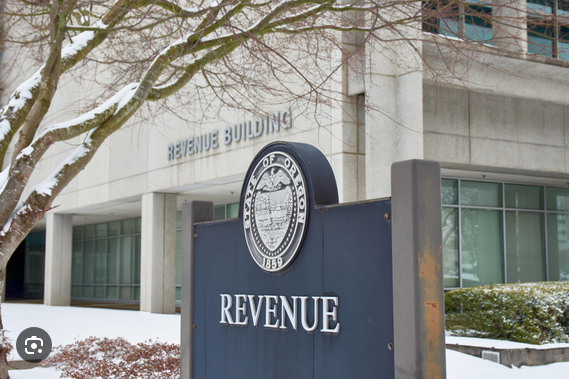
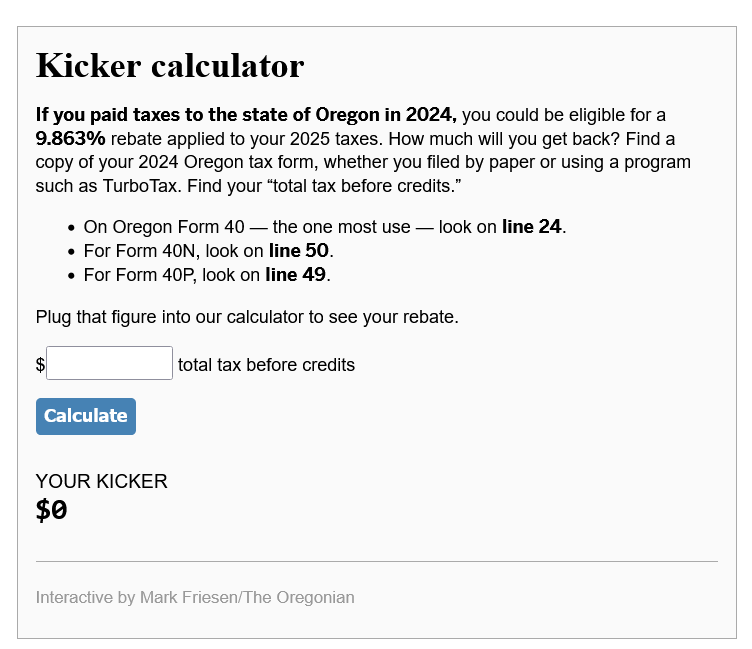
The other major tax issue is the Oregon kicker refund. Aside from the federal government’s tax refunds, Oregon is sending taxpayers the fourth-largest kicker in state history. The kicker returns state money to taxpayers when revenue is much higher than projected.

But you won’t get any cash from the kicker until you file your 2025 state taxes. You also must have filed a 2024 state tax return. You can find out precisely how much you’re due here on OregonLive.

Calculate your kicker here.

But wait — the state of Oregon is warning taxpayers who file their income tax returns by paper that they could face a two-month delay in receiving their state kicker refund. On the other hand, the Oregon Department of Revenue announced that taxpayers who submit their state tax returns electronically could receive their kicker cash in less than three weeks.

Taxpayers who mail in paper returns starting January 26 won’t receive any refunds possibly until around April 15, the Department of Revenue said. In 2016, 86% of Oregon taxpayers filed electronically. That grew to 90% in 2020. Last year, almost 95% of personal tax returns were e-filed in Oregon.

As I detailed last week, I’m off to Salem tomorrow for discussions and committee meetings to prepare for the February short session. In particular, I’ll be focused on how we reduce spending in the Department of Transportation to cover a $250 million revenue shortfall, and how we further shift funds to pay for road safety like snow removal, fog lines, potholes, and slides. Any proposals for revenue changes have been put on hold until January of 2027.

Big things are going on in Philomath.

While in Salem, of course, I won’t be out as much across our district. But I did want to close with mention that I braved dark and wet, windblown roads to attend the Philomath State of the City address with my friend, Mayor Christopher McMorran. Big things are going on in this little town and you can read more here in the Philomath News.

I’ll be back next Monday with news I trust you find helpful.

email: Rep.DavidGomberg@oregonlegislature.gov

phone: 503-986-1410

address: 900 Court St NE, H-480, Salem, OR, 97301

website: http://www.oregonlegislature.gov/gomberg

Slide Slide Slide Slide Slide Slide Slide Slide Subscribe Contribute

Ads

Featured Video

Tillamook Weather

Tides

Tillamook Church Search

Cloverdale Baptist Church
Nestucca Valley Presbyterian
Tillamook Ecumenical Service

Tillamook County Pioneer Podcast Series

Archives

  • Home
  • EULA Privacy Policy
  • Contact
  • Opt-out preferences
  • Search...
Share on facebook
Facebook
Share on pinterest
Pinterest
Share on twitter
Twitter
Share on linkedin
Linkedin
Catherine

Recent Posts

  • BOOK REVIEW: The Secret History of Wonder Woman by Jill Lepore

    January 13, 2026
  • NEWS UPDATE FROM STATE REPRESENTATIVE DAVID GOMBERG: Student Success, Population Changes, and Taxes

    January 13, 2026
  • TILLAMOOK COUNTY EMERGENCY MANAGEMENT ADVISORY: Dense Fog Advisory from 10:00PM Tonight Tuesday 1/13 until 12:00PM Wednesday 1/14

    January 13, 2026
©2026 Tillamook County Pioneer | Theme by SuperbThemes

Manage Cookie Consent
To provide the best experiences, we use technologies like cookies to store and/or access device information. Consenting to these technologies will allow us to process data such as browsing behavior or unique IDs on this site. Not consenting or withdrawing consent, may adversely affect certain features and functions.
Functional Always active
The technical storage or access is strictly necessary for the legitimate purpose of enabling the use of a specific service explicitly requested by the subscriber or user, or for the sole purpose of carrying out the transmission of a communication over an electronic communications network.
Preferences
The technical storage or access is necessary for the legitimate purpose of storing preferences that are not requested by the subscriber or user.
Statistics
The technical storage or access that is used exclusively for statistical purposes. The technical storage or access that is used exclusively for anonymous statistical purposes. Without a subpoena, voluntary compliance on the part of your Internet Service Provider, or additional records from a third party, information stored or retrieved for this purpose alone cannot usually be used to identify you.
Marketing
The technical storage or access is required to create user profiles to send advertising, or to track the user on a website or across several websites for similar marketing purposes.
  • Manage options
  • Manage services
  • Manage {vendor_count} vendors
  • Read more about these purposes
View preferences
  • {title}
  • {title}
  • {title}