
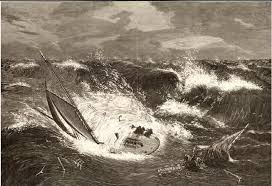

On January 3rd in Tillamook County history, the significant event was the 1881 wreck of the British sailing ship Lupata off Tillamook Head, causing 23 deaths in thick fog and rough seas, while earlier, Lewis & Clark’s expedition recorded Clatsop Indians trading blubber from a beached whale near the Tillamook area in 1805.
Key Events on January 3rd in Tillamook History:
•1881: The British ship Lupata wrecked near Tillamook Head during a foggy, stormy day, resulting in the loss of all 23 lives aboard.
•1805: Members of the Lewis & Clark Expedition noted Clatsop people trading blubber from a recently deceased whale, obtained from the Tillamook (Cal la mox) people, highlighting early interactions and resources of the region.
These events showcase both maritime dangers and early cultural exchanges in the Tillamook area’s past.
The 1881 wreck of the Lupata (often spelled Lupatia) off Tillamook Head was primarily caused by a combination of severe winter weather, limited visibility, and unfortunate navigational errors just weeks before the nearby Tillamook Rock Lighthouse was operational.
Key factors contributing to the disaster include:
•Extreme Weather Conditions: On the night of January 3, 1881, the ship was caught in a “terrific gale” with high seas and a thick, heavy fog that obscured the coastline.
•Navigational Mistake: Under the command of the first mate, B.H. Raven—the captain having died earlier in the voyage—the ship was hugging the coast too closely while heading toward the Columbia River. In the darkness and fog, the crew mistakenly steered the vessel directly toward the dangerous reefs jutting out from Tillamook Rock.
•Incomplete Lighthouse: The Tillamook Rock Lighthouse was only 18 days away from completion. Although construction workers on the rock heard the crew’s cries and attempted to warn them by lighting lanterns and a large bonfire, the ship was already too close to the rocks to escape.
•The Outcome: The 1,200-ton British bark was torn apart and sank rapidly. All 16 crew members perished; the only survivor was the ship’s dog, an Australian shepherd puppy, which was found whimpering on the shore the following morning.
The tragedy highlighted the desperate need for the lighthouse, which was officially lit on January 21, 1881, to prevent future disasters in the area known as the “Graveyard of the Pacific”.
The Lupatia is one of those unlucky ships famous primarily for sinking. Accounts of the tragedy vary, but the oldest likely comes from Lewis and Dryden’s Marine History of the Pacific Northwest, published just four years later.
The Lupatia was a British bark, a type of square-rigged ship, bound for Portland after making the long crossing from Hiogo, Japan. The crew had lost their captain early in the voyage, and command had fallen to the ship’s mate, B.H. Raven. On January 3, 1881, they were making their way north to the mouth of the Columbia River, hugging the coast. A strong southwesterly wind blew that night, and a heavy fog lay upon the water.
On Tillamook Rock, a small crew was finishing construction on the lighthouse. Around 8 p.m., the workers heard voices on the wind, and spotted the red light of a ship. They hurried to kindle lanterns and a signal fire. Through the fog they could just make out the Lupatia struggling in the wind, dangerously close to the rock. They must have held their breaths as the ship drifted back into the darkness, and the light and the voices faded.
Daylight dashed any hopes they may have had that the ship had escaped. The next morning, the bodies of 12 men lay washed up on the beach. Four members of the crew were never found. Of the Lupatia itself, little remained but flotsam, scattered among the rocks where it likely broke apart in the storm.