
EDITOR’S NOTE: The Pioneer is lucky to have a group of dedicated writers and contributors – blessed really by so many talented individuals that are willing to share their writing with our readers. Mike Randall has been a consistent presence here for several years, and over the last year providing commentary about the current state of government. Mike likes to say that he’s the “crumudgeon” in the group, the grumpy old man to Neal Lemery’s lyrical, uplifting kindness muse. When I hadn’t seen something from him for awhile, I reached out to make sure he was okay, and he said he wasn’t writing like that anymore — he was writing haiku! I love haiku, and asked if he’d share some with about the style of poetry. So here’s some haiku with information about the poetry form. How about you? Let’s fill the Pioneer with haiku and poetry – what are you doing creatively to cope with the mental barrage of negativity? Please share with Pioneer readers, send to editor@tillamookcountypioneer.net.
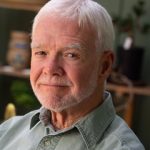 By Michael Randall
I have been writing about Trump since his first presidency: his self-serving motives and ill-considered actions, his delight in humiliating other people, his cruelties, his ignorance, his felonies. But suffering as severely as one can with “TDS” (Trump Derangement Syndrome), I am as done with Trump as one can be in a country descending into tyranny at the hands of a growing criminal organization led by a creature who is about 15% of a man (in line with his latest 15% tariffs).
As an 82 year-old TDS sufferer, I want to regather the remaining shreds of my emotional and mental health. Consequently, I am dumping Trump and returning to the writing of “haiku” poems, which I have written on and off during difficult times for over six decades.
Haiku originated in Japan in the sixteenth century, but now is popular all over the world. Haiku poems are short, and traditionally total 17 syllables in length. They are written in three lines with a “five syllable, seven syllable, five syllable” form. However, some of my three-liners range between 15 and 20 syllables, and that is OK. No apologies to humorless purists out there; please relax. Haiku creation is lots cheaper than paying therapists.
Many people struggle to write poetry but give up, feeling their attempts to be inadequate. Everyone should try haiku. Haiku’s essence is brief and precise, and its form is forgiving. Most important is the moment wherein you feel suddenly moved in your heart and head by some unusual insight or observation in your surroundings, maybe something spiritual or something very small.
That upwelling of emotion often comes in an instant: noticing how a fly preens and cleans its wings, or looking out at your garden at night, or struggling to keep rats out of your bird feeder.
Noticing such small things, you feel sudden insight and an emotional lift. Writing about those experiences in haiku’s brief form will make you start to notice other small, but truly momentous things. You start to build a habit of seeing the world more deeply and with a sense of wonder and awe. Below are several of my own haiku poems, followed by a comment about what inspired each one, and what each one “means.”
Gazing into the dark,
There in the night garden
My small lantern still flickers.
I am an old man, no longer considered useful, and now looking ahead into unknowable darkness, but my lamp still casts a sputtering glow, as do the lights of all the living.
The mirror finds it
Flattering: all who pass by
Give it loving looks.
Mirrors are innocent. They misinterpret what is merely the face of our vanity or, more likely, our means of reassuring ourselves.
With its legs this fly
Cleans its wings and body,
And I lay my swatter down.
Flies are despised as filthy and we kill them. But we look closer as they clean themselves, and our sympathy is aroused. Also, when people to whom we feel superior do something that makes us see their humanity, we suddenly feel humble.
The hurt dove stood wobbly
Last evening in my twilit garden.
At dawn just bloody feathers.
As Alfred Tennyson once wrote, the world is “red in tooth and claw,” and what can we do about that? Very little, even in our own backyards.
I tack wire mesh
Around my bird feeder,
But the rats change their tactics.
Those that are alive in this world must adapt when their circumstances change, if they want to keep on keeping on.
In my garden of plenty,
This blood-gorged mosquito
Cannot let go.
For some of us, there is never enough money or power or comfort to cure us of wanting and seeking more. We do not even remotely consider the possibility of change.
I leave my heart
To that glowing dahlia,
This last day of my journey.
As our lives approach their end, we each go through a transformation. Our egos shrink and weaken; our self-absorption starts to erode away. We understand more about the astonishing richness of our brief life in this ancient (but not eternal) world. We begin to see beauty in so many small things that we never noticed in our younger drama-driven years, and we want to bow toward them, as toward that glowing dahlia.
Pick up a copy of Nick Virgilio’s “A Life in Haiku.” As with a number of his poems, the following haiku was his attempt to deal with the death of his younger brother, Lawrence, a Marine killed in Vietnam.
Deep in rank grass,
Through a bullet-riddled helmet:
An unknown flower.
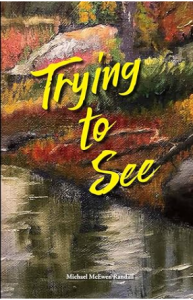 Mike Randall has written freelance opinion columns for several newspapers here and in the Midwest. He is author of the non-fiction book, “Becoming Human: A Servant of the Map,” and a novel, “Into the Unknown Country.” He recently published his book, “Trying to See.” All three books are available for purchase on Amazon.