











By Jim Heffernan
I first read this book when I haunted the bookstore at Metro State College in Denver 50 years ago, give or take. I was reminded of it during the recent scuffle between Department of War lackey Hegseth and AI (Artificial or Alien Intelligence) firm Anthropic. Anthropic wanted to put limits on its software by weakly observing the spirit of Asimov’s “three laws of robotics.” AI frightens me because I think it might harm humans by taking our jobs.
Asimov formulated the 3 laws in a short story, “Runaround” that was published in the magazine, “Astounding Science Fiction” in 1942.
They are:
1. A robot may not injure a human being or, through inaction, allow a human being to come to harm.
2. A robot must obey the orders given it by human beings except where such orders would conflict with the First Law.
3. A robot must protect its own existence as long as such protection does not conflict with the First or Second Law.
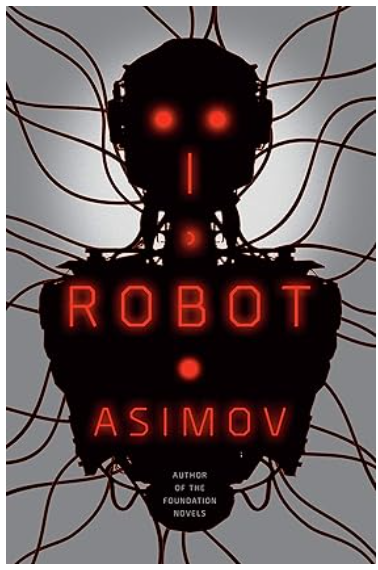
In 1950, “Runaround’ and eight other short stories/novelettes Asimov wrote for magazines between 1940 and 1950 were combined into the “fixup” book, “I, Robot”. Asimov wrote a framing narrative to tie the stories together. It’s set in the year 2057 when Susan Calvin, the head robopsycholgist for U.S. Robotics and Mechanical Men is interviewed by a young reporter. She is 75 and has been with the company for 50 years. The 9 chapters are her stories about how robots were sometimes confusing and confounding. Their “positronic” brains never violated the robotic laws, but they were sometimes quirky in how they reasoned out their tasks.
Fifty years later, I can’t say I remember the book, but I did thoroughly enjoy re-reading it this week. Asimov’s writing is clear and direct. In 1980 he described his style, “I have an informal style, which means I tend to use short words and simple sentence structure, to say nothing of occasional colloquialisms. This grates on people who like things that are poetic, weighty, complex, and, above all, obscure. On the other hand, the informal style pleases people who enjoy the sensation of reading an essay without being aware that they are reading and of feeling that ideas are flowing from the writer’s brain into their own without mental friction.”
He wrote over 470 books about a wide variety of subjects. He would sit at his electric typewriter and write at 90 words per minute. He was his own typist, secretary, proofreader, and literary agent. He died of AIDS when he was infected by blood products he received during 1983 triple bypass surgery.
Here’s an excerpt where Susan is talking to a young reporter who is interviewing her, “Then you don’t remember a world without robots. There was a time when humanity faced the universe alone and without a friend. Now he has creatures to help him; stronger creatures than himself, more faithful, more useful, and absolutely devoted to him. Mankind is no longer alone. Have you ever thought of it that way?” “I’m afraid I haven’t. May I quote you?” “You may. To you, a robot is a robot. Gears and metal; electricity and positrons.—Mind and iron! Human-made! If necessary, human-destroyed! But you haven’t worked with them, so you don’t know them. They’re a cleaner better breed than we are.”
Book is available at Cloud and Leaf Bookstore, Manzanita and Tillamook County Library
As always, discussion welcome at codger817@gmail.com
