
EDITOR’S NOTE: The haiku journey continues and the reaching deep into creativity … what art is moving you now? Spring and nature are my focus and blooms and birds fill my photo gallery. Share your haiku or photography with the Pioneer – editor@tillamookcountypioneer.net.
By Michael Randall
Here are eight haiku broken in two sections — one dark and one light. They don’t always adhere fully to the 5-7-5 syllable form. (All perfectionists, please gnash your teeth.)
First, here are four pointedly dark haiku after four weeks of the Trump “whim-war’s” savagery. These need no commentary or explanation, but please be patient with my attempts to point out a couple of the human consequences of Trump’s presidency. Trumpers must be very proud of their “great leader.”
Laughing children play,
Each one innocent in joy.
Soon to be soldiers.
Agony is policy
Amid bombing, flames, gunfire,
Burning children run screaming.
Soldiers’ smoldering bodies
Cooling in twisted wreckage.
Black kites circle and land, strut closer.
Insane ghoul prances
Amid corpses he sent to war,
Shouting “A Great Victory!”
Several more haiku, more satisfying to write than the foregoing, touch me in a wholly different way. Each one is followed by comments about its inspiration.
This sudden spring breeze
Brings a dusty scent of rain.
Pup hops ‘round, barking.
That pleasant, dusty scent ahead of a spring shower makes a pup happy, too.
Grove of lilacs
Surround this limestone marker.
Unknown infant’s grave.
Hiking in a remote area of the northern plains twenty-five years ago, I saw a small stand of lilacs growing on a nearby hilltop, so climbed the hill to look closer. Parting the plants with my hands and looking within, I was surprised to see a small tombstone worn to near illegibility by more than a century of sun, rain, and winter’s blizzards.
Still visible on the stone was the raised outline of a cherub that told me of its role: guardian to a tiny child’s soul on its way to heaven. Someone had planted a lilac beside this stone back then, and a small forest had grown up all around the baby’s grave.
Worn sandstone doorsill,
Entry to ancient ruins. Here
Children once grew old.
Hiking one morning in northern Arizona many years ago, I visited Wupatki Ruin. This place was built around 1,100 years ago, then abandoned around 1,300 CE. In that morning stillness now long past, I gazed at the sandstone doorsill, reflecting on the lives that had been born, had grown and lived, then passed away after their feet wore such a deep concavity into that stone.
Ancient Chinese script
Found scratched on tortoise shells, just
8,000 year old bills of lading.
As reported in a recent issue of Archaeology Magazine, archaeologists in China’s Henan Province have discovered 8,000 year-old tortoise shells upon which ancient people had inscribed a form of proto-Chinese early writing.
Years ago, while living on the northern plains, I volunteered at a few archaeological digging sites: a 6,500 year old buffalo jump, an old dwelling site where ancient camp fires had burned, a newly eroded river bend where stone and bone tools had been cached and left, then lost long ago.
One enters these sites and this work with a sense of wonder and more than a touch of anticipation. “What will we find?”
At the “buffalo jump” site, another volunteer found the broken part of a buffalo thighbone (femur) with stone hack marks on it. Nearby, she uncovered the other part, also with hack marks. Around 6,500 years ago, another human, hungry like us, had hacked open that femur to suck out the bone marrow. She said that, “Holding those two pieces together in my hands made me feel that other person’s presence, and our human connection, though they had been in this place more than 65 centuries ago.”
Sometimes a “digger” finds nothing, but only receives black fly bites on his sunburned neck. Or, as some “archs” recently found etched on clay slabs in the Middle East: the earliest examples (5,000 years old) of Mesopotamian writing. Nothing dramatic, just administrative records and business bills of lading. Still, a communication with humans from long ago.
They, just like us, had found a way to survive and work and live in this world. Keeping records provided proof of work and goods sold, created mutual trust between seller and buyer, just like us: trying to do right, or at least avoid courtrooms.
May we have better times ahead, and may we learn more, better how to get along with each other.
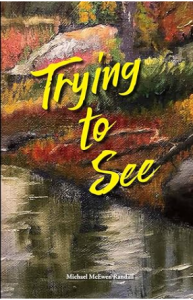 Mike Randall has written freelance articles and opinion columns for several newspapers here and in the Midwest. He is author of the non-fiction book, “Becoming Human: A Servant of the Map,” and a novel, “Into the Unknown Country.” He recently published his book, “Trying to See.” All three books are available for purchase on Amazon.
