











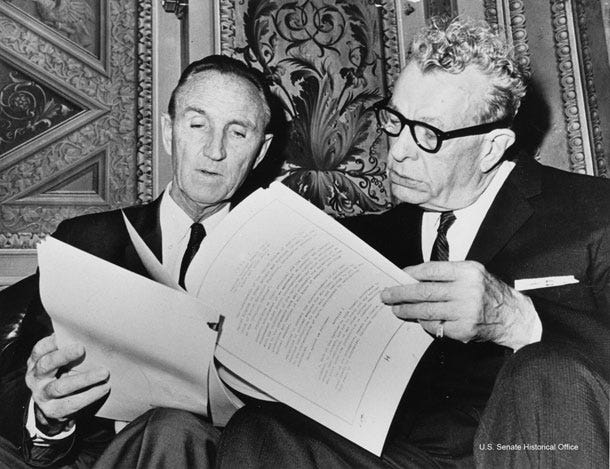
“Stronger than all the armies is an idea whose time has come.” – Senator Everett McKinley Dirksen debating the Civil Rights Act in 1964
By Marc C. Johnson
Today, June 19, 2026, marks the 62nd anniversary of the passage of the Civil Rights Act of 1964, a monumental achievement by the leaders of the great Civil Rights coalition, the American Congress, President Lyndon Johnson and two historically important leaders of the United States Senate – Democratic majority leader Mike Mansfield of Montana and Republican minority leader Everett Dirksen of Illinois.
Working together as genuine colleagues and friends – think about that in the context of John Thune and Chuck Schumer in today’s Senate – Mansfield and Dirksen (with lots of help) drafted the civil rights legislation, whipped the votes, humored the president, defeated what is still the longest filibuster in Senate history and changed the nation.
As I wrote in my study of the Senate leadership of Mansfield and Dirksen in the 1960’s:
When the Civil Rights Act arrived in the Senate on February 17, 1964, having passed the House a week before, Mansfield was ready. Despite his frequent claim that he was no expert in the Senate’s complicated, often arcane rules, Mansfield had meticulously worked out his strategy to advance the civil rights legislation, knowing full well that Dick Russell, the wily leader of the segregationist bloc of southern Democrats was also ready. From his earliest days in the Senate in the 1930’s, Russell had been an expert parliamentarian. As his biographer wrote, Russell “believed that knowledge was power and set out to learn the minutest details about the Senate’s rules, procedures, and traditions.” Additionally, Russell’s principal southern allies, including James Eastland and John Stennis of Mississippi, Lister Hill of Alabama, and Allen Ellender of Louisiana, were skilled in the ways of the Senate, and particularly in the use of the filibuster. As Clay Risen has noted, “like the Confederacy during the Civil War” Russell and his troops “did not have to defeat their opponents outright, they just needed to draw out the fight long enough that the other side gave up.” Mansfield and his allies, eventually including Dirksen, had to meet and overcome this powerful combination of Senate experience and intransigence, and because of Mansfield’s commitment to openness and candor, do so without tricks, subterfuge, or misdirection. Success would require the skills of a juggler, the patience of a saint, and the stamina of a long-distance runner.[i]
It’s possible today to view Mansfield’s approach to political leadership as hopelessly antiquated as a Model T Ford in the age of the drone.
But I think of his approach to leadership as not only brilliant, but in the context of how the United States Senate is structured, as being absolutely necessary.
By displaying the character of a servant leader, facilitating, encouraging, insisting upon fair play and candor, Mansfield made the Senate – and senators – better than they were.
And it came with some major pushback that sounds all too familiar:
Mansfield was … hearing from his voters. A Eureka, Montana, constituent wrote, “It is my firm conviction that the Civil Rights Bill is a radical, unconstitutional and thoroughly unacceptable proposal, in that it will destroy the basic rights of all individuals through federal intervention.” A couple from Billings told Mansfield, “Individual freedoms cannot be removed, either collectively or one at a time, without leading us along the road to socialism which will enslave us all, black and white alike.” In what was clearly a coordinated lobbying effort, several letters to Mansfield in early 1964 used the same language: “The Civil Rights Bill before the Senate now, is 10% civil rights and 90% take-over of all activities of life.”
Always attuned to home-state sensibilities, Mansfield prepared a summary of the bill, “The Civil Rights Bill and Montana.” Not altogether correctly, this summary dismissed the legislation’s impact on Montana “because in the first instance there is no problem of discrimination in Montana.”
Seemingly immune to criticism of his strategy and undeterred by the widespread skepticism about the likelihood of success, Mansfield pressed on, systematically clearing the Senate calendar of pending business. Ignoring advice from President Johnson that he immediately take up the civil rights bill, he kept everyone talking about the path forward, encouraging and facilitating working groups that included attorney general Robert Kennedy and his staff, Republicans, and [Hubert] Humphrey and his team. He maintained a laser-like focus on Dirksen and those Republicans the minority leader could influence, knowing that without Dirksen’s eventual active engagement he could not create a sufficiently large bipartisan coalition to defeat a filibuster; and he refused Johnson’s advice to keep the Senate in round-the-clock session as a tactic to wear down Russell and his troops.
“I am not going to turn the Senate into a circus,” Mansfield said when challenged about his rejection of all-night or even late-night sessions. The dignity and respectability of the Senate would be tarnished by news accounts of elderly, unshaven senators padding about in bedroom slippers, napping on cots in the cloakroom, or answering quorum calls in their pajamas. “He just thought it was senseless to do it,” Charles Ferris [a top Mansfield aide] remembered of the demand for around-the-clock sessions, “and ineffective in passing the legislation. There is a natural rhythm to an event of this magnitude and the all-night sessions would have worked against the passage of the strongest bill possible. It also demeaned the dignity of the Senate.”
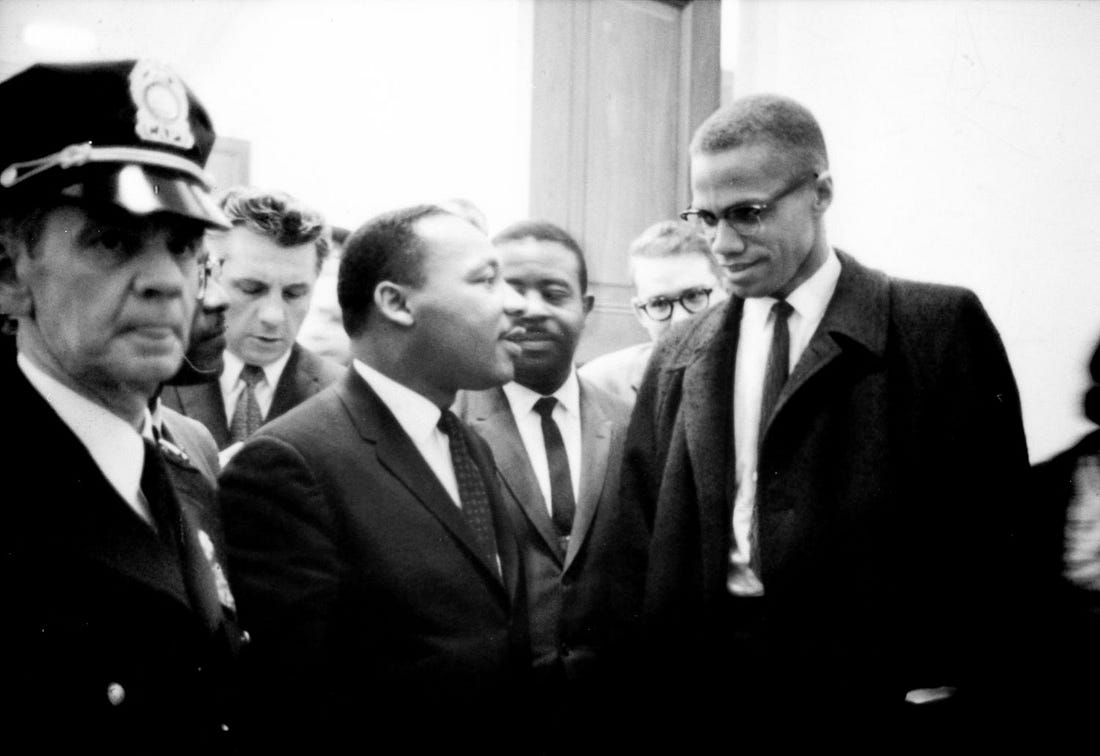 |
Dr. King and Malcolm X
I really love this little detail:
At the precise moment the Senate finally agreed to move to consideration of the civil rights bill, the nation’s two most prominent Black leaders were watching from separate parts of the gallery. Martin Luther King Jr. and Malcolm X, the activist and Muslim minister, later held separate news conferences. As the Detroit Free Press reported, “The two Negroes differed both on their goals and on the means to achieve them. About the only thing they had in common was a desire to see the civil rights bill passed.” King had words of praise for President Johnson and “courageous” senators in both parties who supported the legislation, while “Malcolm issued a thinly veiled threat to Mr. Johnson by warning that Negroes may abstain from voting in the presidential election this November” if there was no action on civil rights. The two men were captured in a photo awkwardly shaking hands, with Malcolm wisecracking to King, “now you’re going to get investigated.”
The southern filibuster of the Civil Rights Act of 1964 lasted for 60 working days, but the filibuster was finally broken on June 10 and the Senate moved to actually debating the historic legislation, eventually passing the bill nine days later – June 19, 1964:
While the praise rained down on Dirksen and columnists assessed the historic importance of the Senate action on a civil rights bill, Mansfield continued to act in a manner that he hoped his colleagues would emulate. He wrote a thank-you letter to every senator.
“We have come through a most trying period in the Senate. In retrospect, the issues were such that they might have opened schisms which would have been years in closing. That did not happen, and I want you to know how grateful I am for the help, the understanding and the cooperation which you gave to me in striving to prevent it.
“The character of the Senate’s handling of this issue, I believe, will mean a great deal to the nation. I know that it meant a great deal to me personally. Members, regardless of views on the substance of the measure, treated me with the utmost kindness and consideration and I am deeply appreciative.”
Some coincidence
The passage of the Civil Rights Act of 1964 on June 19 created a remarkably historic “coincidence,” or perhaps proof that the stars occasionally do align.
June 19 is also the date in 1862 that President Abraham Lincoln signed legislation prohibiting slavery in U.S. territories.
And June 19 is celebrated today as Juneteenth, the day:
… some 2,000 Union troops arrived in Galveston Bay, Texas [in 1865]. The army announced that the more than 250,000 enslaved black people in the state, were free by executive decree. This day came to be known as “Juneteenth,” by the newly freed people in Texas.
The long American struggle to live up to the promise of the Declaration of Independence – “that all men are created equal” – has often been a two steps forward, one back reality.
We seem to be stepping back right now, but June 19 with all of its significance should be a reminder that while genuine political and social progress is often slow, progress can come when real leaders strive greatly to do vitally important things.
We celebrate Juneteenth 1865 as a milestone ending the original American curse of slavery. The Civil Rights Act, passed 99 years later, was a political and social affirmation that the self evident truths of equality never just spontaneously happen. They are made to happen.
Thanks for reading.
My book Mansfield and Dirksen: Bipartisan Giants of the Senate will be out in paperback in late October.
About me: I am a Nebraska native, grew up in South Dakota and migrated in Idaho after college to work in broadcast journalism. In 1986, I joined the “comeback” campaign of a legendary Idaho political figure – Cecil D. Andrus – who eventually served four terms as governor and four years as Secretary of the Interior, not bad for a Democrat in a very conservative state. I had a small role in helping Cece Andrus win his last two gubernatorial terms. I did communication and crisis consulting work, and since “retiring” to the beautiful north coast of Oregon have written three books on U.S. Senate history. I’m working on a new book on another legend – this one a legend in journalism.
You can find my books here:
I write this Substack to scratch my itch to connect history with current politics. I hope, in some small way, to contribute to understanding of this perilous moment for our democracy, for free speech and facts.
