Tillamook County Pioneer

News & People of Tillamook County. Every Day.

Menu
  • Home
  • Feature
    • Breaking News
    • Arts
    • Astrology
    • Business
    • Community
    • Employment
    • Event Stories
    • From the Pioneer
    • Government
    • Letters to the Editor
    • Non Profit News
    • Obituary
    • Public Safety
    • Podcast Interview Articles
    • Pioneer Pulse Podcast: Politics, Palette, and Planet – the Playlist
  • Guest Column
    • Perspectives
    • Don Backman Photos
    • Ardent Gourmet
    • Kitchen Maven
    • I’ve been thinking
    • Jim Heffernan
    • The Littoral Life
    • Neal Lemery
    • View From Here
    • Virginia Carrell Prowell
    • Words of Wisdom
    • Chuck McLaughlin – 1928 to 2025
  • Weather
  • Post Submission
  • Things to do
    • Calendar
    • Tillamook County Parks
    • Tillamook County Hikes
    • Whale Watching
    • Tillamook County Library
    • SOS Community Calendar
  • About
    • Contribute
    • Advertise
    • Subscribe
    • Opt-out preferences
  • Search...
Menu

NEWS UPDATE FROM STATE REPRESENTATIVE DAVID GOMBERG: China Trip Review

Posted on October 26, 2026 by Editor


By Representative David Gomberg, House District 10

10/26/2026

Dear Neighbors and Friends,

Before I share the details of my China mission, I have an important message.

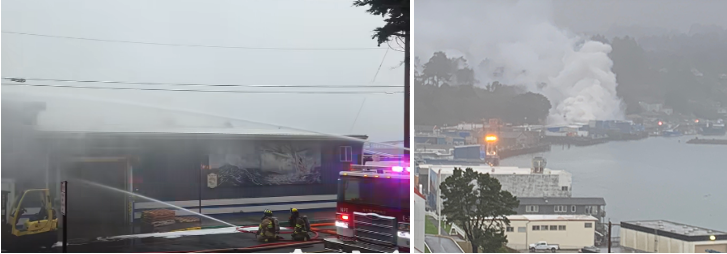
Sunday was a bad day in Newport. A dangerous day.

I usually write these reports on Sunday morning, and I was working early with jetlag messing up my internal clock. I had just finished the first draft when once again, my phone lit up.

There was an industrial fire on the bayfront with the potential to send poisonous smoke across a wide swath of Newport. Evacuation notices had been issued.

My family had been evacuated during the 2020 fires, and I know how scary “go now” can be.

I’m grateful to the first responders from around the region that worked through the day to contain the fires. I’m grateful to the hazmat teams that arrived and confirmed there was not dangerous ammonia in the smoke. I’m grateful to city leadership for their handling of this crisis. And I’m grateful to the people of Newport who reacted calmly as their Sunday was turned upside down.

I spent most of the day monitoring the fire with updates from the State Fire Marshal, talking with local leaders and the Governor’s office, and fielding calls from state and federal offices offering support and help if needed.

The fires are smoldering now, and we must look to recovery. We must look to the businesses, jobs, and lives that changed on Sunday.

It was a bad day in Newport but could have been much worse. Thank you.

And now, China…Many of you know I spent a lifetime as a hobbyist and small businessman building, flying, and selling kites. As I became more serious, I dreamed of one day traveling to the large and famous kite festival in Weifang, China, regarded as the actual birthplace of kite flying.
Among the many people I met in Shandong Province was a young family that shared my passion and business interests. We became friends and then partners. Susan and I designed and they produced. Over the following decades our small company became an industry leader and the fifth largest seller of kites in the USA.
We returned to Weifang dozens of times, led US teams to the festival, helped organize competitions there, and I was eventually named Vice-Chairman of the International Kite Federation and honorary citizen of Weifang.
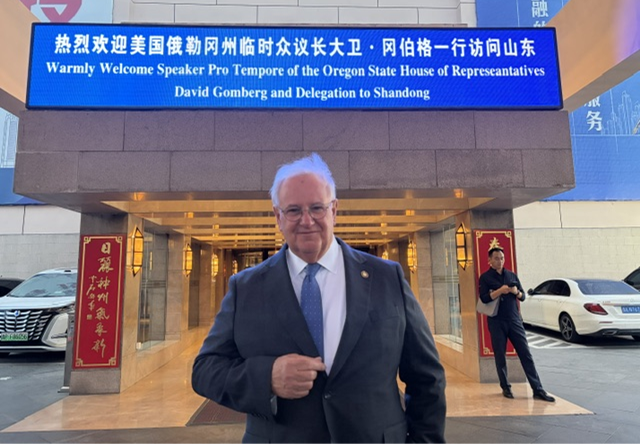
Back then, I could never have imagined that one day I would lead a legislative learning and trade mission back to a modern and sophisticated China where old friendships, historical commitments, and formal relationships still matter.

Smoke billows from Pacific Seafood’s processing plant on the Newport Bayfront early Sunday after an explosion, ammonia leak, and partial roof collapse. (Garret Jaros/Lincoln Chronicle)
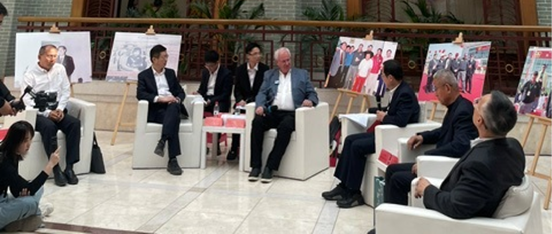
And so it was that last week I found myself at an official exchange of speeches and a private dinner with the Mayor of Weifang—a city of nine million, somewhat larger than New York. We talked over old times, what we had in common despite our many differences, and our hopes for the future.


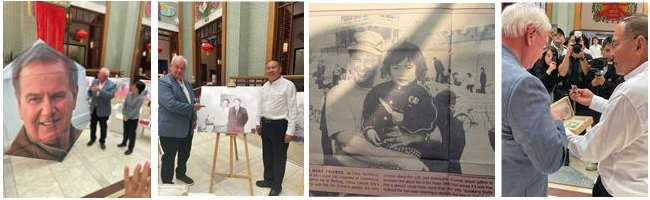
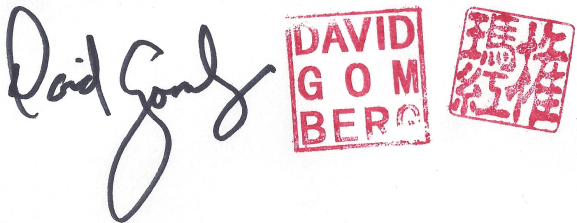
Earlier in the day, our group visited the enormous Weifang Kite Museum. Old friends had gathered to reminisce, and the atrium was filled with enlarged photos of a much younger David Gomberg at the festival. I was presented with a large kite that married old traditions with new technologies. I also received carved name stamps for Susan and myself.

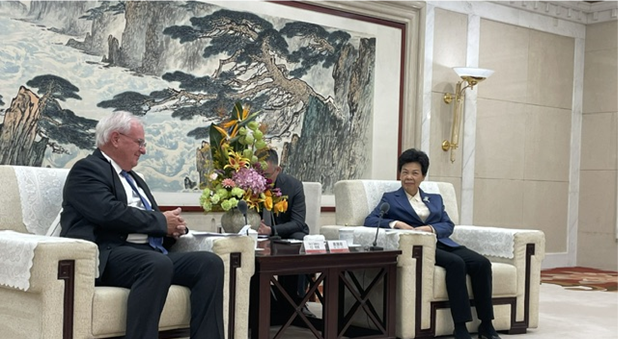
The next evening, I met with Madam Ge Huijun, Chairwoman of the Shandong Provincial Committee—essentially the Governor of this province of 100 million people. In her official remarks, she proposed specific opportunities for cooperation and exchanges.


  • First, we are ready to foster future relations. We are willing to actively promote the establishment of a state-province relationship between Shandong Province and the State of Oregon and carry out multi-level exchanges. At the state-province level, we can establish a Shandong–Oregon exchange mechanism focusing on regular exchanges and collaboration in government, economy and trade, agriculture, and other fields. At the city-county level, we support Weifang, Qingdao, Zibo, Jining and other cities and counties in strengthening ties with relevant cities and counties in Oregon.


  • Second, we are ready to deepen economic development and trade. We are willing to actively promote exchanges with Oregon in sustainable development, aerospace, high-end equipment, and other fields. We suggest that the economic, trade and commerce departments of Oregon work with the Shandong Provincial Department of Commerce and the Shandong Council for the Promotion of International Trade to organize mutual visits of enterprises in relevant fields and hold events such as industry roadshows.


  • Third, we are ready to strengthen agricultural alignment. Oregon has a developed modern agriculture industry and rich experience in wheat cultivation and marine ecological protection. Shandong is a major agricultural and fishery province in China, and there is broad space for collaboration between the two sides.


  • Fourth, we are ready to expand people-to-people exchanges. We sincerely invite Speaker Pro Tempore to attend events such as the Shandong International Friendship Cities Cooperation and Exchange Week held in our province every spring, the Weifang International Kite Festival, and the Kite Carnival held in autumn. We look forward to your help to advance people-to-people and cultural exchanges and allow the friendship across the Pacific to fly higher and higher and grow ever closer.


Shandong now has agreements with Connecticut, Georgia, and Texas. I told Madam Ge I could say with certainty that Oregon on the Pacific was much closer to Shandong than those states on the Atlantic and the Gulf. We both have universities that could benefit from student, academic, and scientific exchanges. We both are agricultural regions that could benefit from trade and sharing of ideas and advances. We both have excellent fishing fleets and could enjoy each other’s produce. We both are manufacturers of equipment, machinery and electronics. We both have ports and could benefit from more trade.


The Governor reminded me with a smile that we also both fly kites. She concluded by suggesting Oregon and Shandong consider a formal sister relationship.

Madam Ge Huijun, Chairwoman of the Shandong Provincial Committee—essentially the Governor of this province of 100 million people.
Travel to China thirty years ago could only be described as difficult. Weifang was a dusty, wind-blown, bland industrial city. Streets were filled with bicycles. Hotel rooms were dark and a thermos of boiled water was brought to the room daily for safe drinking or teeth brushing. Food was challenging. Public toilets were something to be avoided. Crowds followed us in the streets as children had never seen Westerners. And you could taste the coal dust in the air with every breath.


Susan and I first traveled from Beijing to Weifang on a slow twelve-hour overnight train. We shared a sleeping compartment with bunk beds with an older, quiet Chinese couple.


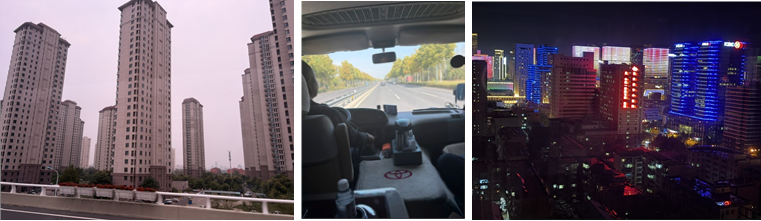
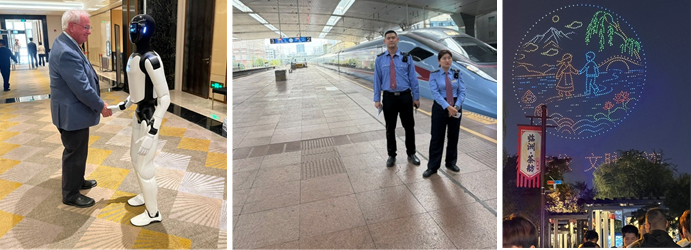
This time, our group zipped from Beijing to Weifang on a 90-minute bullet train, and I found myself wishing we had high-speed rail at home as well. Five-star hotels were the norm where robotic hotel carts delivered luggage to rooms and meals were exquisite. We passed forests of 30-story apartment complexes, gleaming skyscrapers that lit up at night, wide and efficient boulevards, and there were trees and flowers everywhere.

Most of the stores we saw were familiar brands from Starbucks to Cartier. I saw no trash, no graffiti, and no homelessness. On Friday night, people came out to the large pedestrian malls and a drone show filled the skies.


I learned that life expectancy had increased by five years since my last visit. Solar provides a quarter of the power and they expect that to reach 50% in ten years.


In short, what I saw was remarkable progress. And I well understand the cost of that progress.


China leads the world in renewable energy manufacturing and deployment but remains the largest annual greenhouse gas emitter and still relies heavily on coal. The U.S. has lower total annual emissions and higher industrial carbon efficiency, but a much higher per-capita carbon footprint and larger historical emissions.


That is just one example that the US and China have very different strengths and weaknesses. Our history, culture and politics are different. And despite our differences—or perhaps because of them—we have much we can learn and much we can teach or share.

New Chinese friends.
Each evening, we met with local leadership and discussed opportunities for trade, commerce, student exchanges, clean energy and science. They talked solar. I talked wave energy. I touted the Hatfield Marine Science Center. I promoted our local wine and fisheries. I detailed our hopes for a new deepwater port in Coos Bay.


(While I was gone, it was announced that the Pacific Coast Intermodal Port, or PCIP, project had received nearly $205 million for the Coos Bay Rail Line, which would carry the shipping containers from the port to market.)


Our small delegation visited six cities and four provinces, and I spoke at two major conferences. The first was the Legislators Forum for Friendly Exchanges in Tianjin. It was hosted by the Chinese People’s Association for Friendship with Foreign Countries (CPAFFC) and brought together nearly 100 legislators from 55 countries.


After the opening ceremony, CPAFFC President Yang Wanming met with our delegation. I shared that I was impressed by how modern Tianjin Port is, noted that Oregon is exploring new opportunities in port development, and expressed hope for closer exchanges on port development and trade.


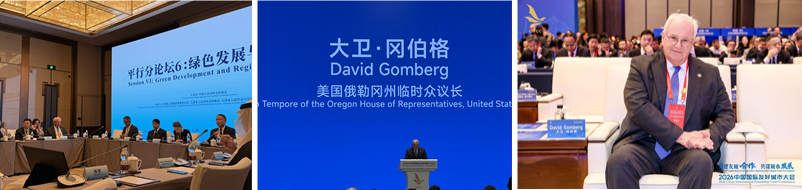
That afternoon, I addressed the forum’s session on Green Development and Regional Coordination.


Included in my remarks was this observation: “I come from Oregon, a state where our identity and our economy are closely connected to our natural environment. We are blessed with forests, rivers, mountains, farmland, and a magnificent Pacific coastline. For us, the question of how to achieve economic development while protecting the environment is not an abstract question. It is a practical responsibility to our communities and to future generations.”

Talking about balancing economics and the environment. Our work with wave energy at PacWave while coordinating with the fishing fleet is one good example.
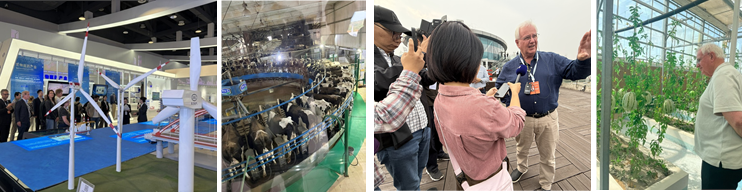
Between conferences and formal discussions, we visited factories, farms, universities, and urban renewal projects.


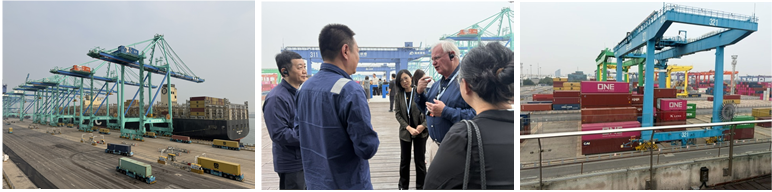
We toured Tianjin Port Smart Zero-Carbon Terminal. Tianjin is home to the largest comprehensive port in northern China and ranked eighth in the world for container traffic. Most of their core operations run without on-site staff, using AI and robotics to offload, organize and transport the big shipping boxes. All of its power comes from wind and solar, and it is described as the world’s first large container terminal with zero carbon emissions across its full operating cycle.


We visited Tiangong University’s Center for Chinese Artifact Art, which pairs university faculty with master artisans to teach new generations the traditional arts of lacquer, ceramics, embroidery, and silversmithing.


The delegation toured the Hanting District National Modern Agricultural Industrial Park and saw how Shandong uses technology to modernize farming. We saw acres of new greenhouses and the testing of melons and green radish. Shandong and Oregon are both major agricultural regions, with opportunities to work together on ag technology, water use, and workforce training.


We visited JA Solar’s Shijiazhuang manufacturing base. JA Solar is one of the world’s leading solar companies, and the group saw its automated production of solar modules first-hand.


The delegation also visited Junlebao’s dairy farm and research institute to learn about Chinese modern dairy herds, quality control, and nutrition research. Oregon, of course, has a strong dairy industry, which gives the two sides a solid basis for exchange in livestock and dairy science.

Tanjin Port operates on wind and solar, and it is described as the world’s first large container terminal with zero carbon emissions.
We visited solar and wind plants, indoor farms, and modern Chinese dairies. They produce milk, infant formula, yogurt, and butter, but no cheese.
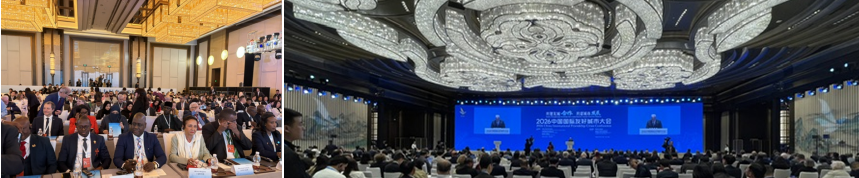
Our second conference was the 2026 China International Friendship Cities Conference in Xi’an which brought together more than 700 international participants representing 61 countries, 103 provinces and states, and 140 cities.


Our delegation attended the opening of the conference, themed “Jointly Strengthening Friendship Cities Cooperation for Common Urban Development.” CPAFFC Vice President Lu Xiangdong moderated. International speakers included former Moldovan President Igor Dodon, Rwanda Secretary General Valens Uwineza, and former Romanian Prime Minister Viorica Dăncilă.


After the opening ceremony, I was scheduled to address the conference’s main forum. It was a big room and a big crowd. In the back, translators worked in soundproof booths to simultaneously translate speeches into seven languages and attendees listened over earbuds.


I spoke about my own experiences in China and the importance of people-to-people exchanges.


Formal agreements are only the beginning, I said. A relationship becomes real when people keep showing up. Communication is easier than ever. We can video conference, email, and text. But trust evolves over a handshake, a shared meal, and genuine progress.


Documents detail our intentions. But success must be measured by real results.


I pointed to more than forty years of results since Oregon and Fujian became sister states in 1984, and Portland and Suzhou became sister cities in 1988. I cited Portland’s Lan Su Chinese Garden, built with the help of Suzhou artisans. I referenced China as Oregon’s largest trading partner—$5.4 billion in goods exports (19% of total goods exports).


China remains one of the most consequential markets for a broad range of Oregon products and services, including agricultural commodities, consumer and industrial goods, clean-technology inputs, and advanced manufactured products. Oregon’s export profile—particularly in semiconductor-related products, agriculture, and globally recognized outdoor, athletic, and consumer product ecosystems—depends on access to large-scale international markets. In that context, China is not simply another trading partner; it is a market of sufficient scale to influence production, investment planning, supply-chain stability, and the commercial confidence of Oregon businesses.


I described the Oregon-China Sister State Committee, which Oregon law establishes as a framework for turning friendship into action. And I told my own story: our first trip to Weifang in 1989, the family we met there who became friends and then business partners, and our small company’s growth into the fifth-largest seller of kite products in the U.S.


Cities everywhere face similar challenges in housing, transportation, the environment, heritage, new industries, and rural development. We should learn from each other’s successes and failures. Partnerships should be judged not by agreements signed but by what they create in education, business, and stronger communities.


I closed by saying collaboration is still about people, still built on trust, and still depends on the willingness to keep showing up. I hoped every participant would leave the conference with at least one new connection and one concrete idea to put into action.

That’s me at the front of the room (and on the large screen behind). About 700 people were in the room representing 61 nations. Translators shared the speeches in real time over earbuds.
Our China schedule was very full every day and demanded thoughtful consideration, careful planning, and the ability to speak extemporaneously to large or important groups.


Almost every day, Chinese media interviewed me about the visit. Most reports were, of course, posted in Chinese. But there were a few English stories. Check these links to hear me joking about robotic dogs, reminiscing with old kite friends, and talking about international trade and ports.

Everything went well—except our trip home. Flights were delayed and then cancelled. Travel that took weeks to book was painfully re-booked on our phone apps. Connections were missed. At close to midnight in Los Angeles, we were given hotels before our 6 am flight north. And finally—finally—Susan met me at PDX.


I think Marco Polo got home from China faster than we did!


The delegation thanks the Chinese People’s Association for Friendship with Foreign Countries for its invitation and careful planning. We thank the Oregon-China Council for their support. We also thank the governments and foreign affairs offices of Tianjin, Beijing, Hebei, Shandong and Shaanxi for their warm hospitality. Special thanks go to Mr. Li Zhe of CPAFFC’s Department of American and Oceanian Affairs, who traveled with the delegation for the entire trip.


I hope and trust our work was meaningful, and back in Oregon, I’ll be working to turn opportunities into real results.

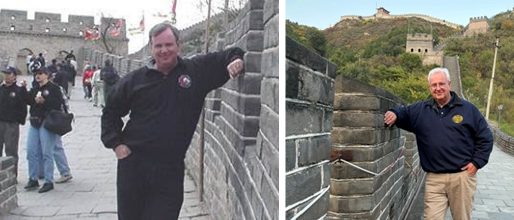
My first visit in 1989 and my recent return.
Warm Regards,
P.S If you have already voted in the November 3rd general election, thank you!

If you haven’t voted yet, Oregon Secretary of State Tobias Read recommends that you not mail your ballot and instead, take it to a county ballot drop box. You can find the closest drop box location here. If you use a post office, ask them to postmark your ballot at the counter.

To be counted, voted ballots must be received at any County elections office in Oregon or Official Ballot Drop Site location by 8:00 p.m., Tuesday, November 3, 2026, or postmarked by Tuesday, November 3, 2026.

Check to ensure your ballot has been received. Go to My Vote, check if you are registered to vote, view your voter registration information, update your voter registration, check the status of your ballot, find contact information for your county elections office, or find a ballot drop site.

Please consider supporting the Pioneer with a contribution. Independent journalism stays alive on the Coast. Click here to contribute!
Subscribe

Ads

Keep the News Free to Read

Featured Video

Tillamook Weather

Tides

Tillamook Church Search

Cloverdale Baptist Church
Nestucca Valley Presbyterian
Tillamook Ecumenical Service

Tillamook County Pioneer Podcast Series

Archives

  • Home
  • EULA Privacy Policy
  • Contact
  • Opt-out preferences
  • Search...
Share on facebook
Facebook
Share on pinterest
Pinterest
Share on twitter
Twitter
Share on linkedin
Linkedin
Catherine

Recent Posts

  • GORDON'S WEEKLY WEATHER UPDATE 10/26/26: More rain and rainshowers this week; Halloween is looking dry, but cool

    October 26, 2026
  • NEWS UPDATE FROM STATE REPRESENTATIVE DAVID GOMBERG: China Trip Review

    October 26, 2026
  • TILLAMOOK PEOPLE’S UTILITY DISTRICT November 2026 Meetings

    October 26, 2026
©2026 Tillamook County Pioneer | Theme by SuperbThemes
Manage Cookie Consent
To provide the best experiences, we use technologies like cookies to store and/or access device information. Consenting to these technologies will allow us to process data such as browsing behavior or unique IDs on this site. Not consenting or withdrawing consent, may adversely affect certain features and functions.
Functional Always active
The technical storage or access is strictly necessary for the legitimate purpose of enabling the use of a specific service explicitly requested by the subscriber or user, or for the sole purpose of carrying out the transmission of a communication over an electronic communications network.
Preferences
The technical storage or access is necessary for the legitimate purpose of storing preferences that are not requested by the subscriber or user.
Statistics
The technical storage or access that is used exclusively for statistical purposes. The technical storage or access that is used exclusively for anonymous statistical purposes. Without a subpoena, voluntary compliance on the part of your Internet Service Provider, or additional records from a third party, information stored or retrieved for this purpose alone cannot usually be used to identify you.
Marketing
The technical storage or access is required to create user profiles to send advertising, or to track the user on a website or across several websites for similar marketing purposes.
  • Manage options
  • Manage services
  • Manage {vendor_count} vendors
  • Read more about these purposes
View preferences
  • {title}
  • {title}
  • {title}