









 EDITOR’S NOTE: Here’s an installment from Tillamook County’s State Representative Cyrus Javadi’s Substack blog, “A Point of Personal Privilege.” Oregon legislator and local dentist, representing District 32, a focus on practical policies and community well-being. This space offers insights on state issues, reflections on leadership, and stories from the Oregon coast, fostering thoughtful dialogue. Posted on Substack, 5/16/26
Housing is Not Everything. But Without It, Everything Else Gets Harder.
By State Representative Cyrus Javadi
I’ve never been homeless. At least not the kind of homeless that we all think about.
I’ve slept in tents while camping. I’ve had to spend the night on a row of chairs in an airport because of flight delays. And in 2008, I spent the night in a moving truck because a traffic jam on I-5 didn’t clear for more than 12 hours.
No joke.
At the time, one of my kids was three weeks old. She was probably the most comfortable person in the truck, which is one of those small injustices of parenting. The baby gets the deluxe accommodations. The adult get a steering wheel, a stiff neck, and the quiet spiritual crisis that comes from wondering whether the Columbia Sportswear fleece bunched under your head technically counts as a pillow.
But that kind of “homeless” is not what we mean when we talk about homelessness.
Or at least, it is not all we mean.
The Homelessness We See, and the Homelessness We Don’t
When most of us hear the word, we picture the most visible version: tents under bridges, tarps along sidewalks, people sleeping in doorways, RVs that have become permanent because the “recreational” part left the situation a long time ago.
That is real. It is painful. It is public. And it is often the part of homelessness that makes communities angry, afraid, frustrated, and sometimes ashamed.
But it is only part of the story.
The federal government’s annual Point-in-Time count tries to measure people who are in shelters, transitional housing, safe havens, or sleeping in places not meant for human habitation: cars, parks, abandoned buildings, bus stations, airports, campgrounds, and the like. It does not include people temporarily staying with family or friends, the people we often describe as doubled-up or couch-surfing. HUD is explicit about that. Those people may be housing unstable. They may be one bad week from sleeping in a car. But they are not included in the main PIT count.
That matters, because the official numbers are already grim.
On a single night in January 2024, HUD counted 771,480 people experiencing homelessness in the United States. That was the highest number ever recorded. About 497,256 were sheltered. About 274,224 were unsheltered. The total was up 18.1 percent from 2023. Nearly 150,000 children were counted as homeless that night. People in families with children increased by 39 percent in just one year.
And again: that does not count the family in the cousin’s spare room. It does not count the teenager sleeping on a friend’s couch. It does not count the divorced dad living in a garage while trying to keep his kids in the same school district. It does not count the family that looks “fine” because they are not under a bridge, but are still one awkward conversation away from being told, “Hey, we love you, but this can’t go on forever.”
Close Enough to See the Edge
I know something about that version.
A few years after my parents divorced, my mom loaded up a U-Haul and drove us from Utah to Massachusetts. My mom and the four of us kids were all packed into the front of the truck for three long days. Mom drove. One kid got the bench seat. One kid sat in the footwell. One kid wedged into the space behind the seat, which sounds illegal now because it probably was then too.
When we finally got to my grandparents’ house in Amherst, we lived in their basement for four months. Comfy. But also, my grandparents thought they were done raising kids, and were relieved to see us move out.
Years later, as an adult with a small family of my own, we moved from Utah to Idaho after college. I had a job lined up, but it had not started yet. Paychecks, as a general rule, are more useful after they exist. So we stayed with family in a spare bedroom for a couple of months while we waited to get on our feet.
And then, after I moved to Oregon in 2012, it happened again in a different form.
I was a dentist. I had multiple degrees. I was the new owner of a dental practice. I had every outward sign of being a responsible adult, or at least a reasonably convincing impersonation of one.
But what I didn’t have was a place to live.
I simply could not find a place to rent or buy. Banks would not lend to me because I was self-employed and needed two years of income history from the new practice. And as anyone who has tried to live on the coast knows, rental homes are nearly as rare as dinosaurs. Possibly rarer, depending on the month.
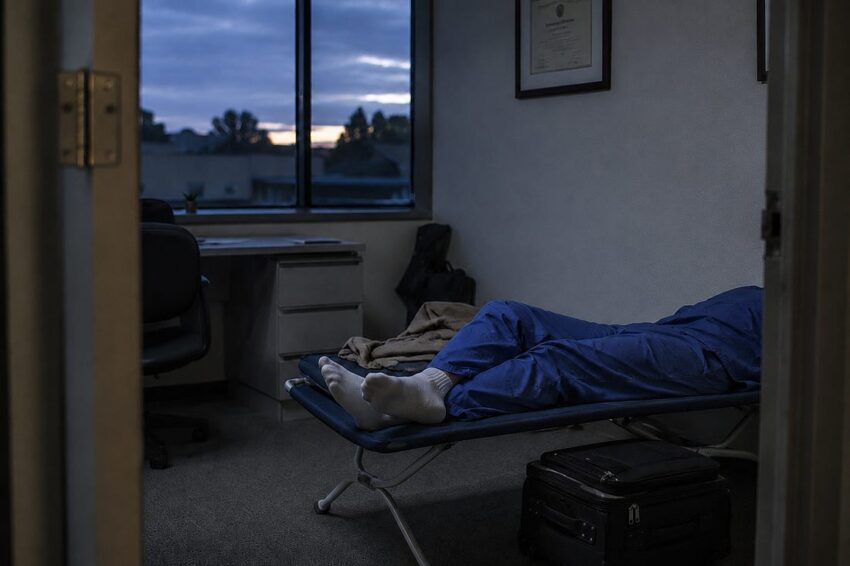
So I lived in my office on a cot I bought at Fred Meyer.
That is not the story people usually picture when they hear the word homelessness. But it is much closer to the real line than most of us like to admit.
I also had a friend with a college degree who had been the principal of several schools. After separating from his wife, he lived for months in the back of his pickup truck on an inflatable mattress. He showered at the school or the YMCA. He warmed up his food in the teacher’s lounge.
That was not because he lacked discipline. It was not because he lacked education. It was not because he had failed to become “productive.” He was not addicted to drugs. He did not drink alcohol. He didn’t have a mental health diagnosis.
He had a job. He had a résumé. He had a life. What he did not have, for that stretch of time, was a home.
Now, I know what some people are thinking. That is not homelessness. And in the legal HUD-counting sense, fair enough.
But it was not exactly stable housing either. It was one missed paycheck, one failed credit check, one landlord saying no, one car repair, one medical bill, one “sorry, we rented it to someone else” away from a much harder story.
I was lucky. My friend was lucky. We had work. We had people. We had enough social capital to keep the floor from completely giving way.
But millions of people do not. For millions of people, the ladder is missing rungs. For some, it is missing the wall entirely.
The Story We Tell Ourselves
This is why we need to be careful about the story we tell ourselves about homelessness.
The easy story is that homelessness is mainly about addiction or mental illness. That story has the virtue of being partly true, which is the most dangerous kind of wrong.
Addiction matters. Mental illness matters. Trauma matters. Family breakdown matters. Domestic violence matters. Bad choices matter. Bad luck matters. All of it matters.
But if homelessness were simply an addiction problem, the map would look very different. If it were simply a mental health problem, the highest rates would show up wherever mental illness is highest. If it were simply a poverty problem, the poorest places in America would have the worst homelessness.
Yet that is not what we see.
The best evidence points to something more basic and, frankly, more annoying for those of us who prefer complicated moral lectures: homelessness is deeply tied to housing costs and housing scarcity.
Gregg Colburn and Clayton Page Aldern make this point in Homelessness Is a Housing Problem: places with high rents and low rental vacancy rates tend to have much higher homelessness, while common explanations like drug use, mental illness, poverty, or local politics do not explain the regional variation nearly as well.
That does not mean addiction and mental illness are irrelevant. It means they are sometimes the spark, not the dry Oregon forest.
The Spark and the Dry Forest
A person with untreated schizophrenia in a cheap housing market may still have a fighting chance at staying housed. A person with depression, a divorce, a low-wage job, and a $900 apartment in may bend without breaking. But put that same person in a market where rent eats half the paycheck (or more), vacancy rates are microscopic, and every apartment has twenty applicants, and suddenly “coping” becomes “camping.”
This is the brutal math.
When housing is scarce, landlords can be picky. Rents rise. Deposits rise. Credit checks become walls. Pet fees become walls. Income requirements become walls. A prior eviction becomes a wall. A criminal record becomes a wall. A disability becomes a wall. A child becomes a wall if the only affordable unit is too small. A fixed income becomes a wall when the rent jumps faster than Social Security.
Eventually, people stop falling through the cracks because the floor doesn’t exist anymore.
Oregon Knows This Story
Oregon knows this story too well.
In 2024, HUD counted 22,875 people experiencing homelessness in Oregon. That was 54 people per 10,000 residents, more than double the national rate of about 23 per 10,000. Of those counted in Oregon, 14,191, or 62 percent, were unsheltered. Oregon also had 3,952 people in families with children counted as homeless, and 56 percent of those families were unsheltered, the highest share in the nation.
Now stop. And sit with that last number for a second.
Families. Children.
That’s right. Not just the guy yelling at a mailbox downtown. Not just the tent that makes people mutter, “Why doesn’t someone do something?” Families. Children. People trying to keep backpacks dry and homework uncrumpled while living in a car or a motel or a campsite that was never meant to become a childhood memory.
That is not a policy failure in the abstract. It’s much more. It’s a moral bruise.
And yes, some of those families may be dealing with addiction, mental health struggles, domestic violence, job loss, or trauma. But the common denominator is still brutally simple: they do not have a home they can afford.
The Annoying, Boring, Necessary Answer
This is where the conversation usually gets both more important and less fun.
Because once we admit homelessness is, in large part, a housing problem, we have to talk about building housing.
Not just “affordable housing” in the way politicians say it at press conferences while pointing at architectural renderings of buildings that will open in 2031 after seventeen stakeholder meetings and a ceremonial shovel photo.
Actual housing. More housing. Housing of different types.
Apartments. Duplexes. Townhomes. Starter homes. Accessory dwelling units. Manufactured homes. Small homes. Supportive housing. Workforce housing. Senior housing. Housing near jobs. Housing near schools. Housing in places where people already live and places where they could live if we had the roads, water, sewer, and power to support it.
We need more land where housing is legal. We need infrastructure that can support growth. We need permitting that does not treat every new home like a suspected war crime. We need building codes that protect safety without turning modest housing into a luxury product. We need financing tools that work in small towns, rural counties, and coastal communities where construction costs are high and wages often are not.
Services Matter. But Services Are Not a Home.
And yes, we need services.
We need mental health care. We need addiction treatment. We need shelters that are safe and clean. We need case management. We need veteran services. We need domestic violence services. We need youth outreach. We need help for people who cannot simply be handed a lease and wished good luck, like a reality show contestant being released into the wild.
But services without housing are just a very expensive waiting room.
A shelter bed can save a life. A housing voucher can stabilize a family. A treatment bed can help someone get sober. But if there is nowhere affordable to go afterward, we are not solving homelessness. We are moving people from one line to another line and calling it a system.
Everyone Supports Housing Until It Has an Address
This is the part where we need to be honest with ourselves.
Building housing is hard.
It is hard because land is expensive. Labor is expensive. Materials are expensive. Interest rates matter. Sewer capacity matters. Water systems matter. Roads matter. Wetlands matter. Fire safety matters. Neighborhood opposition matters. Local government budgets matter. State land use laws matter. Federal rules matter. The price of a two-by-four apparently has its own emotional journey now.
And every community wants housing in theory.
In practice, everyone supports affordable housing until the affordable housing becomes an actual building near an actual street with actual neighbors who suddenly develop a deep and principled concern for “neighborhood character.”
Neighborhood character is a wonderful thing. So is having neighbors.
The hard truth is that we cannot demand lower rents while blocking more homes. We cannot say we care about teachers, nurses, dental assistants, line cooks, seniors, veterans, and young families while designing a housing system that treats them like they are trying to sneak into a country club.
And we cannot say we care about homelessness while pretending emergency shelters are a substitute for a functioning housing market.
Housing Is the Platform
A house is not a luxury item. It is the platform on which almost every other part of life is built.
Yes, you can get sober without housing, but it is harder. Yes, you can hold a job without housing, but it is harder. Yes, you can go to school without housing, but it is harder. Yes, you can raise children without housing, but it is harder. And, yes, you can heal from trauma without housing, but it is harder.
Housing is not everything. But without it, everything else gets harder.
That is why homelessness should not be treated as someone else’s failure. It is not just “those people.” It is us, on a bad enough day, in a tight enough market, with one fewer relative, one fewer paycheck, one fewer lucky break.
That last part matters.
Because until we truly believe that “we” are “those people,” we will not have the resolve we need to meaningfully solve the homelessness crisis. Emergency. Epidemic. Or however you want to label it.
Because what we call it less important than what it is. It’s real people, who need real help. It’s you. It’s me. It’s all of us.
Less Home
So, yes, I was never homeless in the way we usually mean it. But I have been close enough to see the edge.
And I have lived long enough to know that a lot of people standing far from the edge are mostly just lucky they have not had to measure the distance.
So let’s stop pretending this is only about addiction. Let’s stop pretending it is only about mental health. Let’s stop pretending it is only about personal choices. Those things matter. Of course they matter.
But the center of the problem is right there in the word.
Homelessness.
Less home. So build more homes.
Make them legal. Make them possible. Make them less expensive. Put them near roads, water, sewer, schools, work, and community. Help the people who need services. Protect public spaces. Keep families together. Get kids indoors. And treat housing not as a partisan trophy, but as basic civic infrastructure.
Because the opposite of homelessness is not a program. It is not a policy. It is not partisan talking point.
It is a home.
Subscribe
Oregon has big problems to solve. Housing is one of them. Homelessness is one of them. And if we’re going to make real progress, we need more people willing to look at the facts, tell the truth, and stay in the conversation after the easy answers run out.
So subscribe, share this with someone who cares about Oregon’s future, and stick around.
 Subscribe
Donate
If this piece resonated with you, I hope you’ll consider supporting my re-election campaign.
I’m running because Oregon needs leaders willing to tell the truth about hard problems, not just repeat whatever slogan happens to fit on a yard sign. Homelessness, housing, affordability, public safety, schools, and healthcare all require the same thing: honest work, practical solutions, and the patience to stay at the table when the easy answers fall apart.
That is the kind of leadership I’m trying to bring to Salem.
Campaigns are not powered by good intentions alone, unfortunately. Yard signs, mailers, ads, voter outreach, and all the other glamorous machinery of democracy cost real money. Apparently, the printer does not accept “thoughtful moderation” as legal tender.
Rude, but here we are.
So if you believe Oregon needs more problem-solvers and fewer performers, I’d be grateful for your support.
A Point of Personal Privilege is free.
|
|||

