











On books, belonging, and the increasingly lonely business of thinking for yourself.
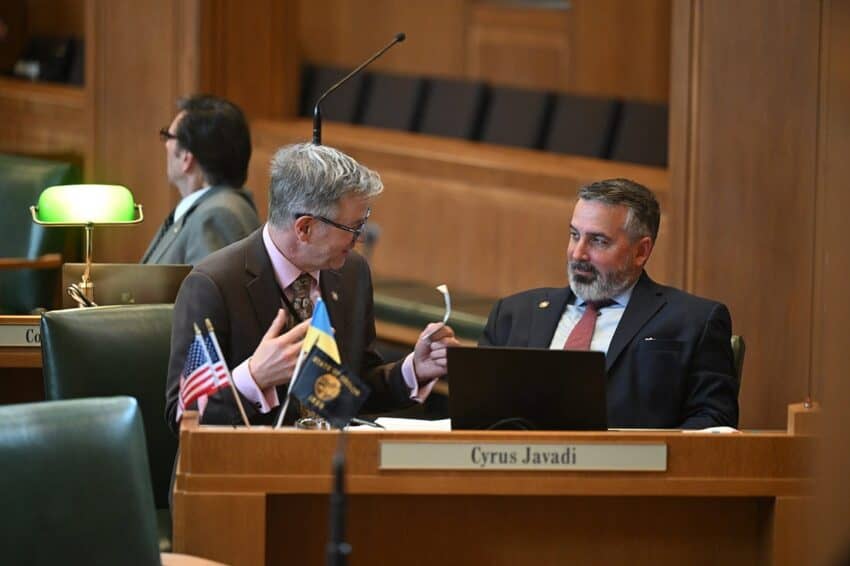
 EDITOR’S NOTE: Here’s an installment from Tillamook County’s State Representative Cyrus Javadi’s Substack blog, “A Point of Personal Privilege” Oregon legislator and local dentist. Representing District 32, a focus on practical policies and community well-being. This space offers insights on state issues, reflections on leadership, and stories from the Oregon coast, fostering thoughtful dialogue. Posted on Substack, 10/11/26.
By State Representative Cyrus Javadi
I’ve been asked a lot why I left the Republican Party.
It’s a fair question. After all, I was first elected to the Oregon State Legislature as a Republican in 2022.
And then, in September of 2025, I became a Democrat.
Naturally, this has led some people to conclude that I must have undergone some great ideological transformation. Perhaps I woke up one morning, looked in the mirror, and discovered that I suddenly believed healthcare is a human right, reproductive freedom, and the radical proposition that gay people should be allowed to live their lives.
Except I already believed those things.
I believe people should have access to healthcare. I believe women should make their own reproductive decisions. I believe LGBTQ+ people deserve the same rights as everyone else. I believe in due process, protecting our environment, good schools, decent roads, and government that remembers it’s supposed to serve the public.
None of this strikes me as particularly revolutionary. Indeed, I once thought most of it was pretty conservative.
So what changed?
Well, pull up a chair.
A Funny Thing Happened in the Caucus Room
Let me take you inside the Oregon Capitol for a moment.
Every morning during the legislative session, House Republicans would gather in our caucus room to discuss the bills coming up for a vote. We’d spend an hour or so going through legislation, hearing reports from committee members, and deciding where everyone stood.
In theory, this was an opportunity for thoughtful debate and the exchange of ideas.
In practice, it sometimes resembled a high school lunch table with better suits and considerably more expensive consequences.
Members would explain why they liked or hated a bill. Sometimes someone would make a joke at a Democratic sponsor’s expense. Sometimes there would be a little chest-thumping about who was the most loyal Republican, the most committed conservative, or the most enthusiastic supporter of the president.
To be fair, there were also serious discussions. I served with Republicans who cared deeply about their communities and worked hard to represent them.
But there was an unmistakable pressure in that room. There were certain positions a good Republican was simply expected to take. Certain things you were expected to say. And, increasingly, certain questions you weren’t supposed to ask.
Let me give you an example.
One morning in the Spring of 2025, a bill about books in public schools came up.
It was Senate Bill 1098, what would eventually become Oregon’s Freedom to Read Act.
The Republican vice-chair of the House education committee summarized the measure for us. The bill dealt with when schools could remove books from their libraries.
That sounds boring enough. Most legislation does. Democracy rarely comes with a particularly exciting table of contents.
Then one of my colleagues, a reliably outspoken member of the party’s right flank, announced that this bill was really about allowing something sinister—it would keep pornography in school libraries.
Another colleague, who would later run for governor, agreed. It was a terrible bill. No good Republican could support it.
The minority leader agreed that we needed to oppose it.
Well, that seemed to settle things.
There was just one small problem.
I had actually read the bill, and it didn’t say that at all.
The Dangerous Business of Reading
Now, I realize that reading the legislation before voting on it is an eccentric habit in modern politics. But I recommend it. Sometimes the words on the page bear a surprising resemblance to what the law would actually do.
And this bill was not especially complicated.
It said that schools couldn’t remove or reject books simply because they were written by, or told the stories of, people belonging to certain protected groups.
A book by a gay author? That alone wasn’t grounds for removing it.
A story about a Muslim family? Same thing.
A book featuring a Jewish child, a Black teenager, or a transgender character? You couldn’t pull it simply because you objected to the identity of the person writing it or the people appearing in it.
That was the issue. Pretty straightforward.
It wasn’t a requirement that schools stock pornography. It wasn’t a mandate that every child read every book. And it didn’t eliminate the ability of schools to review materials for legitimate concerns about age appropriateness.
It was about making sure that a school library couldn’t be turned into a political sorting machine, where books were acceptable or unacceptable based on whose lives they described.
Now, reasonable people can disagree about what belongs in a school library. I’m a parent, and I understand perfectly well why parents care about what their kids are reading.
But there’s a world of difference between saying a particular book isn’t appropriate for a ten-year-old and saying a book shouldn’t be available because the author is gay.
One is a judgment about content and age.
The other is discrimination.
I thought conservatives, of all people, ought to appreciate the distinction.
So I raised my hand.
I pointed out that the bill didn’t actually do what most of the caucus was claiming. In fact, it seemed to me like a pretty reasonable protection against discrimination.
Let’s just say I wasn’t greeted with a standing ovation.
The mood in the room made something very clear: I wasn’t supposed to be making that argument.
I was supposed to be a good Republican.
Which is when I found myself wondering something I’d been wondering with increasing frequency:
When did being a good Republican become more important than doing the right thing? When did it become more important than looking out for every person we represent, not just those we agree with?
The Loyalty Test
That caucus meeting wasn’t the reason I changed parties. But it was one of those moments that helped me understand why I eventually would.
Because the books weren’t really the problem.
The problem was a political culture in which loyalty increasingly mattered more than judgment.
I kept finding myself at odds with Republican leadership. On healthcare. On reproductive freedom. On education. On the rights of LGBTQ+ Oregonians. On whether government should be making intimate personal decisions for people who never asked for its opinion or judgment.
And too often, the argument seemed to begin and end with the question of whether Democrats supported something.
If they did, we were supposed to oppose it.
Never mind whether the idea was good. Never mind whether it would help people. Never mind whether it made life a little better in Astoria, Tillamook, Seaside, or Clatskanie.
Apparently, the gravest sin in politics isn’t getting something wrong. It’s accidentally agreeing with the other team.
I’ve never understood that.
I know Democrats can be wrong. Spectacularly wrong, in fact. I’ve sat through enough legislative hearings to know that bad ideas are an equal-opportunity employer.
And, of course, Republicans can be right.
The question ought to be whether something works, whether it’s fair, whether it protects people’s freedoms, and whether it helps the people we’re supposed to represent.
That’s governing.
Everything else is theater. And the taxpayers are paying an awful lot for the tickets.
The Part That Was Harder Than I Expected
I don’t want to pretend that leaving the Republican Party was easy.
It wasn’t.
I’d spent years building relationships with people in that party. Some were good friends. Some still are. We had worked on legislation together, shared meals, traded stories, and tried to solve problems for our communities.
I didn’t suddenly stop caring about those people because I changed my registration.
And I didn’t enjoy disappointing people who had supported me.
There’s something genuinely uncomfortable about realizing that the political home you’ve occupied for years no longer feels like home.
You wonder whether you’re the one who’s changed. You wonder whether you’re being unfair. You wonder whether there’s still room to disagree without being treated as disloyal.
I asked myself those questions.
More than once.
And I stayed longer than some people thought I should, partly because I believed there was value in being a Republican willing to say no to Republicans.
Sometimes I was the only one.
For example, I was one of two Republicans in the House to support legislation protecting Oregonians from having medical debt reported to credit bureaus.
I didn’t do that because a Democrat told me to. I did it because I thought it was right.
I’ve never believed that someone who gets cancer, has a heart attack, or ends up in an emergency room should have their financial future wrecked because they couldn’t afford to get sick.
That seemed like common sense to me.
But as time went on, I began to see a difference between occasionally disagreeing with my party and belonging to a party that increasingly regarded disagreement itself as the problem.
And eventually, I had to ask myself a more personal question.
What was I actually staying for?
The friendships? Those didn’t have to end.
The values? I wasn’t abandoning them.
The label?
Well, labels are useful on soup cans. I’m less convinced they should determine a person’s conscience.
Kids and a Little Perspective
Here’s something having children teaches you: People can grow up in the same family, eat at the same dinner table, and somehow develop completely different opinions about nearly everything.
And that’s before somebody brings up politics.
You learn that loving someone doesn’t require agreeing with them. You learn that listening is not surrender. And you learn, sometimes through considerable trial and error, that winning every argument is a lousy substitute for maintaining a relationship.
I wish our politics had a little more of that wisdom.
Most people I meet aren’t waking up in the morning eager to advance the Republican or Democratic platform.
They’re wondering how they’re going to pay the mortgage.
Whether their kids are getting a decent education.
Whether Mom can get in to see a doctor.
Whether the business they’ve spent twenty years building is going to survive another year.
Whether the roads will be fixed before the potholes develop their own ZIP codes.
They want a little stability, some opportunity, and the freedom to build a life that means something to them.
Their hopes and fears are remarkably similar, even when their political beliefs aren’t.
And I think we’ve gotten so wrapped up in our differences that we’ve forgotten something important.
We aren’t supposed to be identical. We’re supposed to be free.
Free to worship differently. Free to love differently. Free to raise our families differently. Free to read different books, hold different opinions, and disagree with our elected officials without being treated as enemies.
Freedom doesn’t mean much if it only applies to people who agree with you.
In fact, that’s when freedom matters least.
The real test is whether you’re willing to defend someone else’s freedom when you don’t particularly like what they’re doing with it.
The Letter Next to My Name
Which brings me back to the original question.
Why did I become a Democrat?
Because I came to believe that the Republican Party’s direction was increasingly at odds with the principles that brought me into public service in the first place.
Because I wasn’t willing to treat my neighbors’ rights as bargaining chips in a national culture war.
Because I believe healthcare, education, infrastructure, and personal freedom are more important than winning the next round of partisan applause.
And because I was tired of being told that representing my district sometimes had to take a back seat to representing my party.
But I want to be clear about something.
Becoming a Democrat doesn’t mean I’ve signed up to be a Democratic soldier instead.
I didn’t trade one set of marching orders for another.
I will work with the party when they’re right. I’ll disagree with them when they’re wrong. And when the opposition party brings forward good ideas for the North Coast, I’ll work with them, too.
That’s not a threat to either party. That’s what voters should expect from everyone they send to Salem.
I understand why some people are skeptical of my decision. They have every right to be. Changing parties is a big deal, and people deserve an explanation that amounts to more than a new bumper sticker.
So don’t judge me by the letter next to my name.
Judge me by the votes I’ve cast. The fights I’ve taken on. The times I’ve stood up to my own party. And the things I’ve actually accomplished for the people who live here.
I didn’t run for office because I wanted to be a Republican.
I ran because I wanted to make life better for the people of the North Coast.
That hasn’t changed.
And if there’s one thing I hope people understand about my decision, it’s this:
I don’t need a political party to give me permission to do what’s right.
I never did.
The Republican Party wanted something different from me.
So I left.
My principles didn’t change. My party did.
Politics has become a place where everyone is expected to pick a side, repeat the talking points, and treat disagreement like a character flaw. I think we deserve better.
That’s why I write this newsletter.
I want to take you beyond the headlines and political theater. Into the decisions being made in Salem, the arguments happening behind closed doors, and the real-world consequences for the people who live here. I want to explain not just what I believe, but why I believe it, what I’ve gotten wrong, and what I’m still trying to figure out.
Because good government requires more than politicians asking for your trust. It requires giving you enough information to decide whether we’ve earned it.
If you want a more honest look at politics, from someone actually in the room, subscribe to my Substack. You’ll get the stories, the context, and the occasional uncomfortable truth that don’t fit into a campaign ad or a 30-second sound bite.
It’s free. You don’t have to agree with me. And I promise not to make you sit through a caucus meeting.
The North Coast deserves a representative who answers to the people who live here—not the people running a political party.
That’s what I’ve tried to do in Salem. It hasn’t always been easy. Standing up to your own party rarely is. But I didn’t run for office to win a popularity contest in the Capitol. I ran to get things done for the people back home.
And now I’m asking for your help.
This is one of the closest legislative races in Oregon. The stakes are real. The decisions made in Salem will affect our schools, our hospitals, our roads, our freedoms, and the future of the communities we love.
I can’t promise I’ll always agree with you. I can’t promise I’ll get every decision right. But I can promise that I’ll keep showing up, telling you what I think, listening when we disagree, and putting the North Coast first.
If that’s the kind of representation you believe in, I’m asking you to invest in it.
Your contribution helps us reach more voters, knock on more doors, and make sure the people of the North Coast—not political insiders—have the final say about who represents them.
Because independence in Salem starts with people willing to stand behind it.
