









By Jim Heffernan
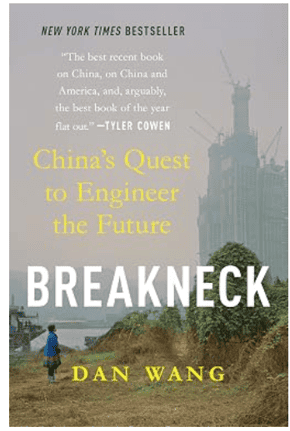
This excellent book was written by a native born Chinese man who emigrated to Canada in 1999 at age 7. His family moved to the United States when he was in high school. He spent 6 years in China (2017-2023) working as a financial consultant. He has keen insights into how China and the US share similarities and deep differences. He has written a very good book. It’s 260 pages and 25 of those are notes and acknowledgments. It is available at Cloud and Leaf Bookstore, Manzanita and Tillamook County Library.
The main premise of the book is that China is run by engineers and the United States is run by lawyers.
High speed rail is a good example of something engineers do very well and lawyers just make a mess of things. In 2008, both China and California decided to build an 800 mile high speed rail network.
China’s project was to connect Beijing and Shanghai. California’s goal was to connect San Francisco, Sacramento, Los Angeles and San Diego.
China spent $36 billion to complete its project by 2011. The line is used by millions and in 2024 generated $2 billion in profits. Since then, China’s high speed rail network has grown to over 30,000 miles in length.
Beijing to Shanghai is equivalent to the distance between Washington D.C. and St. Louis, MO. The trip costs about $100 and takes 4 hours and 18 minutes.
California’s story is much sadder. 18 years and $131 billion later, a 104 mile line between Merced and Sacramento might open next year.
Where engineers fail is in their treatment of people. Big projects don’t happen without “little people” being stepped. China’s one child policy that was pursued for a decade and was filled with cruelty and mistreatment. Restrictions for Covid were very strict and rigidly enforced.
I see a parallel between the outsize power of China’s engineering class and the heavy influence of our economic elite. Our treatment of immigrants is very like what the Chinese do to Uyghurs.
Here is an excerpt from introduction:
“The starkest contrast between the two countries is the competition that will define the twenty-first century: an American elite, made up of mostly lawyers, excelling at obstruction, versus a Chinese technocratic class, made up of mostly engineers, that excels at construction. That’s the big idea behind this book. It’s time for a new lens to understand the two superpowers: China is an engineering state, building big at breakneck speed, in contrast to the United States’ lawyerly society, blocking everything it can, good and bad.”
Here is an excerpt from page 232
“That commitment to transformation is an ideology that both the United States and China share. The United States has a distinctly ideological character as a nation, founded on values and principles rather than heritage; modern China is intent on proving that its historical heritage is glorious. Both countries have an ethos of self-transformation that have become deformed in various ways. For both countries to develop the potential of its people, they have to figure out how to fully express their transformational urge.”
It wasn’t in the book, but I think part of the difference between China and us is our view of the “trapped assets” of the Petro-Chemical empire. Petroleum in the ground is a “trapped asset” that is only as valuable as the demand for it. We own big chunks of it and what else explains the current leadership’s disdain for electric vehicles and solar and wind power. China does not have much oil and seems dedicated to down-grading the value of those “trapped assets” by making itself a world leader in solar and wind power and electric vehicles.
As always, discussion welcome at codger817@gmail.com
