











By Jim Heffernan
I read this 2019 book in June of 2026. I’d like to blame the time-lag for the review on simple writer’s block, but I think there’s something else involved. The book revealed that maybe I’m not the good listener I thought I was and I was shy about admitting it
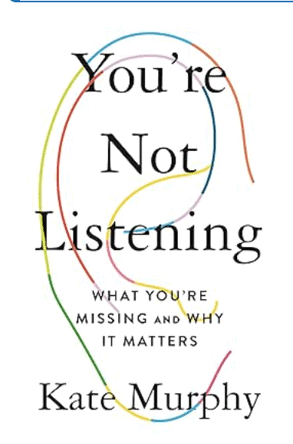
You’re Not Listening is Kate Murphy’s first book. It made several best-seller lists and was translated into 35 languages. Some schools use it as part of their curriculum. No surprise, a large part of the book comes from her interviews with a wide range of experts.
The worst thing I do that hampers my listening is my tendency to respond in conversations with a “shift” response. A ‘shift” response is when you shift the conversation back to yourself. I usually want to be “Mr. Fix-It” and offer a remedy.
I should use a “support” response more often. A “support” response is very often a question or sympathy that encourages the speaker to elaborate on their feelings. Sometimes silence does the same thing.
I found it a very good book and I find myself re-reading sections just to burnish its lessons into my mind.
I’ll close with some excerpts.
But listening is no easy task. Our magnificent brains race along faster than others can speak, making us easily distracted. We overestimate what we already know and, mired in our arrogance, remain unaware of all we misunderstand. We also fear that if we listen too carefully, we might discover that our thinking is flawed or that another person’s emotions might be too much to bear. And so we retreat into our own heads, talk over one another, or reach for our phones. Page 222
Listening is often regarded as talking’s meek counterpart, but it is actually the more powerful position in communication. You learn when you listen. It’s how you divine truth and detect deception. And though listening requires that you let people have their say, it doesn’t mean you remain forever silent. In fact, how one responds is the measure of a good listener and, arguably, the measure of a good person. Page 224
In our fast-paced and frenetic culture, listening is seen as a drag. Conversations unfold slowly and may need to be revisited. Listening takes effort. Understanding and intimacy must be earned. While people often say, “I can’t talk right now,” what they really mean is “I can’t listen right now.” And for many, it seems they never get around to it. This, despite what we all want most in life—to understand and be understood—only happens when we slow down and take the time to listen. Page 223
“People in long-term relationships tend to lose their curiosity for each other. Not necessarily in an unkind way; they just become convinced they know each other better than they do. They don’t listen because they think they already know what the other person will say.”. Page 148
Book is available at Cloud and Leaf Bookstore, Manzanita and Tillamook County Library.
As always, discussion is welcome at codger817@gmail.com
