


By Butch Freedman
I recently had reason to drive into the city, into Portland. I wasn’t looking forward to the journey, or to being in the city I once called home. I’m no longer accustomed to the noise and traffic and feared that the drive, once we were into the busy suburbs would spike my heart rate and my sense of security. Maybe I’m spoiled. No, definitely I am. Now, if I pass three or four cars on the winding country road that leads into our small coastal village, I become alarmed. “What’s going on?” I ask my wife, as we slow down to gaze at the egrets, and the soaring eagles.
And the excursion lived up to my expectations, as did our brief time in the city. What we once loved, now seemed foreign—even hostile. And Portland is a pretty copacetic city, as big cities go. We still have a lot of friends there who righteously love the place and are thriving and happy.
So, each to his own. If not for some fortuitous turns of fate and tips from friends, we might still be hanging out in one of the cozier, Portland neighborhoods. But we didn’t want that anymore. I mean, I was ready and it didn’t take too much convincing to get Beverly to share my dream of moving to the Coast. The relocation didn’t happen all at once—first, we rented for a weekend, then for longer, all in the same small town where the heavy summer traffic passes us by on their way to more exciting coastal vacation spots. It wasn’t long before we began seriously looking for a house of our own, and after a lot of searching found the right one, and at a very reasonable price, though we didn’t realize that at the time, didn’t know how quickly properties here would soar in value. We didn’t move here full-time for another couple years. I came first, as I had some medical issues that required me to give up my full-time gig(s). There was nothing holding me back in the city and, I was weary of it. Beverly was still hammering away in one of the many important positions she held over her years in P.town. But the siren call of the Pacific soon had her packing her bags also. We both agree it was the best move we ever made, and now, thirteen years later, we’re happily established as “full-timers.” And, fortunately, there are not too many of us. By now we know all our neighbors, and they us. A true community.
But back to that Portland drive, the one that made me half-looney (I’m normally only a quarter.) We took care of the business we had to do, blood pressure rising after each near collision. I don’t now recall even what brought us in there—likely something medical related. There is that downside to living in a rural area—lack of access to complete health care options. Come to think of it, that is what city living provides that small towns don’t—access to not only health care, but also to good restaurants, especially ethnic ones; and museums, and theater, and sports venues, and so on. I do sometimes miss all that. But, frankly not a whole bunch.
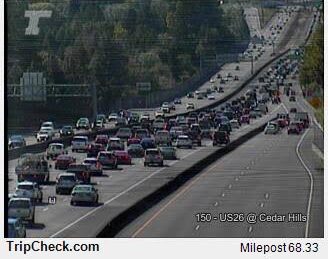
The halt-and-speed nature of Portland traffic reminded me of an incident back when I was a single guy and always busily hurrying from one place to the next. On this occasion, to my utter horror, as I drove home after work, a large dog raced out in front of my vehicle. I slammed on the brakes, but it was too late, and the sickening thud, tumbled the dog, a German shepherd, to the curb. I stopped and ran over to the animal, but it was too late. The owner rushed out of his house, and sprinted over from across the street, visibly upset and angry, accusing me of speeding even before tending to his pet. I said, “I’m really sorry this happened, but I was not speeding.” Before it went any further, a policeman arrived. He took me aside and told me, “Don’t engage with him. The dog was running loose. He’s at fault. You should leave.” And I did, though completely shaken. And feeling guilty, even though I knew I couldn’t have done anything about the collision. My girlfriend at the time, tried to console me and said she would “smudge” the car. I didn’t know what she meant. I rarely did with her. She was a tarot card reader. That’s actually what she did for a living. So she took a bundle of sage, lit it, and waved the smoke over the front of my car. I had no words. But in my head , I thought, this is wrong, all of it. Maybe I don’t belong here.
After taking care of our business we didn’t even stop for bagels at Bernstein’s or lunch at Marco’s, or visit the new wing of the Art Museum, which we had planned to do. We wanted only to get back home, out of the city, out of the traffic, away from the noise. And so we navigated out on to the Sunset Highway. I breathed a little easier then. But my full release did not return till we turned on to Highway 6, and the open landscapes and farm land returned; traffic thinned. We passed by the still small-town of Banks, where I had my first Oregon teaching job, one I remember with fondness. My pulse returned to a slow beat and I smiled. At least it felt like I was smiling. Beverly says I don’t smile nearly enough. She’s probably right. Another hour would bring us back to the Coast. And we’d be safe and snug till the city called again. But hopefully not for a long time.
