









In his recent State of the City message, Rockaway Beach Mayor Charles McNeilly was direct: the city’s first responders are tired. Call volumes and complexity continue to rise, yet current revenues can sustain existing services but not expand them. Additional firefighters and a new station outside the tsunami inundation zone remain out of reach without new funding. The Fire Department is preparing a SWOT analysis that will feed into this fall’s Five-Year Strategic Plan update, opening a community conversation about service levels and how to pay for them.
Tillamook County Pioneer reporting has tracked ambulance staffing and response-time concerns for years. In 2021 the Tillamook Fire Defense Board publicly described the system as “in crisis,” citing frequent staffing shortfalls, response times that often exceeded 20 minutes (sometimes reaching 40), and occasions when no ambulance was available inside the county. Fire chiefs reported delayed arrivals on time-critical calls for chest pain and possible strokes. By 2023 the county had lengthened the formal response-time standard from 15 to 20 minutes — a change fire chiefs opposed. Critics noted that average response times could mask limited staging of ambulances outside the central Tillamook area.
Throughout, local fire departments have filled the gap. When an ambulance is delayed or unavailable, firefighters are often the first on scene for heart attacks, falls, strokes, and other medical emergencies. Many of these departments rely heavily on volunteers who leave jobs, families, and sleep to answer calls. That model is under increasing strain as the volunteer pool ages and recruitment grows harder.
Rockaway Beach Fire & Rescue illustrates the pattern. Medical calls are the most frequent type of response. The department has responded by training more EMTs and Advanced EMTs — often through partnerships with Tillamook Bay Community College — precisely because of rising medical demand. Still, the core of the force remains volunteer.
Tillamook County’s demographics intensify the pressure. The median age is roughly 49, and about 27–30 percent of residents are 65 or older, well above the statewide average. An older population generates more falls, cardiac events, and complex medical needs. At the same time, summer tourism can swell the local population several times over, doubling call volumes in peak months and stretching both paid and volunteer responders.
This pattern is common across rural Oregon. Roughly two-thirds of the state’s EMS agencies serve rural or frontier areas and depend heavily on volunteers or limited paid staff. Paramedic and EMT shortages are widespread. Pay often lags urban departments, training access is harder, and call volumes keep climbing. Fire departments routinely provide the rapid medical first response while the transport ambulance follows. Nationally, medical calls make up 65–80 percent of responses for many fire agencies as improved fire prevention has reduced structure fires.
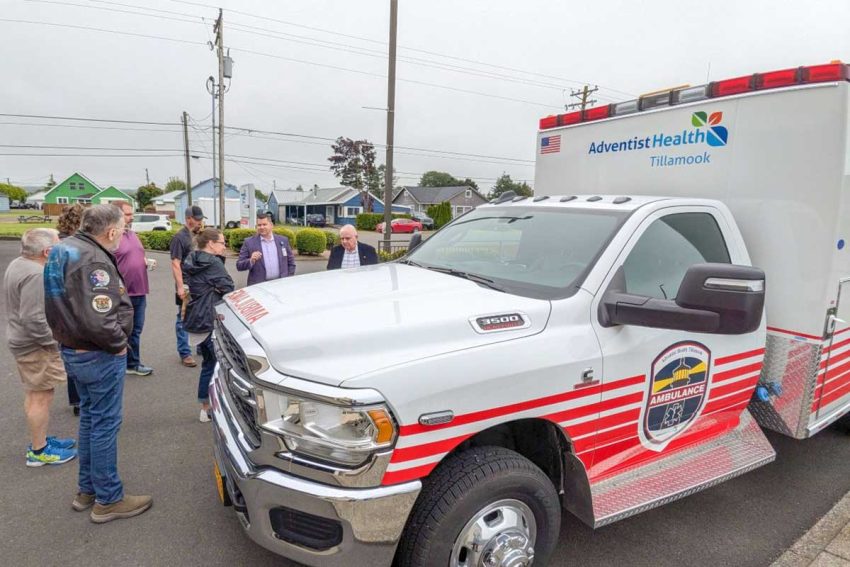
Adventist Health Tillamook remains the primary ambulance provider, operating from multiple stations with EMTs and paramedics. The agency reported roughly 4,845 ambulance responses in 2025. Recent private donations, including support from the Loren E. Parks Trust, have helped fund new ambulances — critical equipment that can accumulate 200,000 miles a year on rural roads. Hospital leadership has prioritized provider recruitment and maintains a membership program (T.E.A.M.) that reduces patient out-of-pocket costs. No major structural expansion that would substantially reduce the medical first-response burden on local fire departments has been publicly announced.
The pressure is felt at both ends of the 911 system. Dispatchers and responders nationwide report high rates of burnout driven by rising volumes, overtime, and the emotional weight of the work. Some Oregon centers, including pilots in Lincoln County and Portland, are testing AI tools to handle non-emergency calls, provide transcription and language support, and free human dispatchers for true emergencies. These tools can ease the communications layer, but they do not put more paramedics on rural roads or shorten the distance an ambulance must travel.
An aging year-round population, heavy seasonal tourism, geography, and limited paid staffing keep the system under pressure. Volunteer-heavy fire departments have become the reliable backstop for medical emergencies.The coming Strategic Plan update in Rockaway Beach — and parallel discussions across the county — offers a chance to confront the numbers honestly: what level of emergency response the community expects, what it costs, and how volunteer fire departments can be sustained as medical demand grows. The people answering the calls already know the system is stretched. The next step is deciding, together, what comes next.
