











A conversation with Sidra Pierson of the Rural Organizing Project on Oregon Sanctuary Laws recorded on Thursday, October 1, 2026
Editor’s Note: This Q&A is based on an interview by Shaena Peterson with Sidra Pierson of the Rural Organizing Project. Listen to the full interview – see links below.
Q1: What is the mission and focus of the Rural Organizing Project?
Sidra: The Rural Organizing Project (ROP) in Oregon works to build and support a statewide movement which serves immigrant, new arrival, and refugee families who are directly impacted by detention, deportation, and family separation. We have community centers in Cottage Grove and Hood River and work with rural and small town Oregonians who make up a network of self-directed volunteer groups called human dignity groups.
Q2: Oregon was the first state to pass a sanctuary law in 1987. Why was this law conceived, and how does it work? How does the 2021 Sanctuary Promise Act update it?
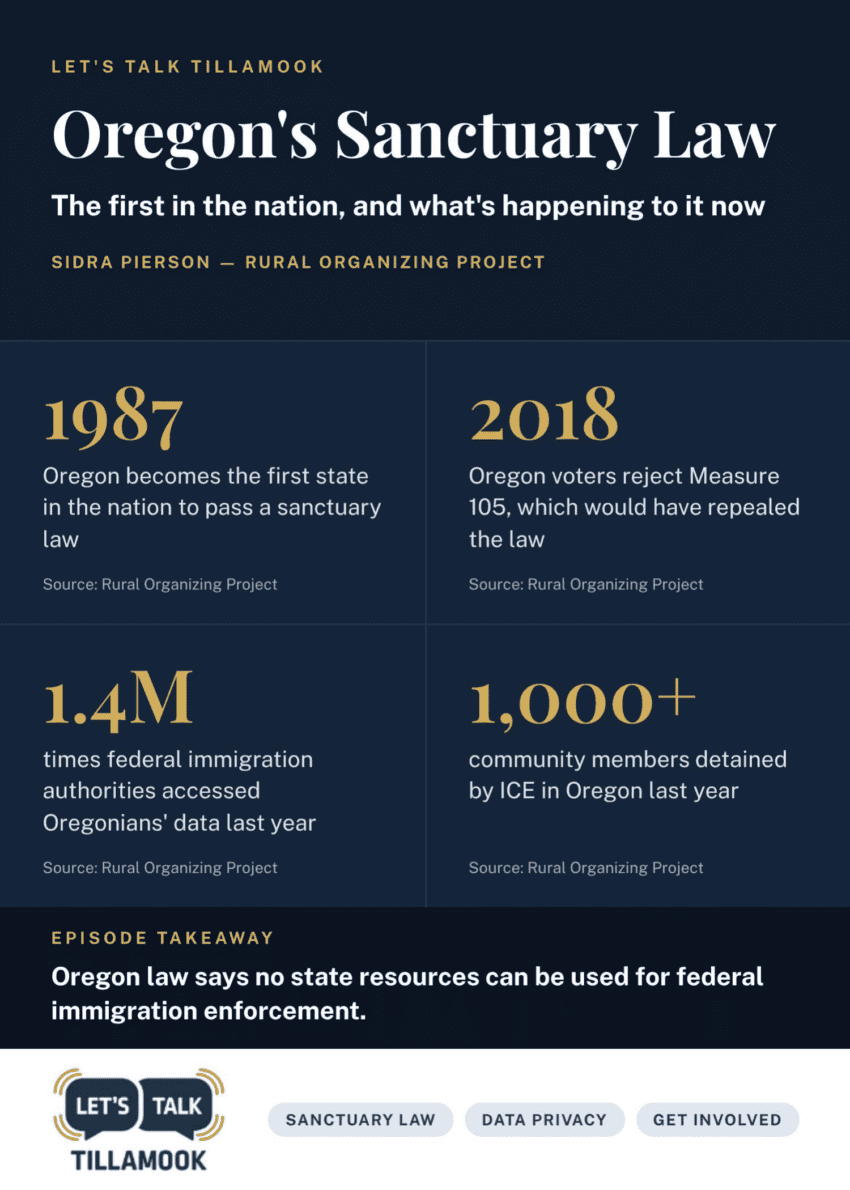
Sidra: Oregon Sanctuary Law prevents local law enforcement and other state agencies from using public resources to aid ICE. Other states and cities adopted similar legislation because when police collaborate with ICE, immigrants become too afraid to report crimes, bear witness, and access police protection. Separating law enforcement from ICE keeps our community safer and protects local resources for local issues. Despite our original sanctuary law, law enforcement continued to cooperate with ICE. The Northern Oregon Regional Correctional Facility (Norcor) and two local jails continued ICE contracts to detain people showing up for routine appointments inside of courthouses or after release from serving a prison sentence. ROP identified those patterns of violations and organized with other groups to pass the Sanctuary Promise Act in 2021. It expanded to cover any public agency and closed loopholes that enabled ICE to use local resources.
Q3: In 2018, opponents put Measure 105 on the ballot to repeal Oregon’s sanctuary law. Why did Oregonians vote to keep the law?
Sidra: Trust in local law enforcement erodes when they assist ICE. Oregonians see how communities and families are ripped apart. The sanctuary law aligns with our shared values of safe and welcoming communities for all.
Q4: Trump federalized U.S. marshals as ICE officers. How does that affect Oregon families?
Sidra: The current administration intensifies its attacks on immigrants by updating its tactics. Some Oregon counties have contracts with the U.S. Marshal Service to house people awaiting trial. ROP settled a lawsuit in Columbia County resulting in the county agreeing not to hold individuals if they’re only facing federal immigration charges, a violation of our sanctuary law.
Q5: In May 2026, ROP filed suit against Oregon State Police for sharing personal data with ICE.
Sidra: The Oregon Law Center represents ROP in this and all recent sanctuary cases. Oregon State Police (OSP) allows ICE to access Oregon drivers’ data and law enforcement records. ICE accessed Oregonians’ data 1.4 million times last year and detained over 1000 Oregonians. How many of our neighbors were turned over because OSP shared information with ICE? We want OSP to immediately and permanently stop sharing Oregonians’ personal information with ICE.
Q6: The Trump administration threatened to cut off funding to states with sanctuary laws. Why do you think our sanctuary law is worth defending?
Sidra: The Trump administration has weaponized ICE and other agencies to target immigrant Oregonians. Cruel and arbitrary arrest quotas force ICE to storm into our communities, targeting people based on how they look or talk. Oregon’s sanctuary laws have always been decisively upheld, proving that most Oregonians think they are important and worth defending. Oregonians stand together in opposing federal efforts to detain or deport our neighbors. Our elected leaders must be accountable to Oregonians. Oregon’s law states that no state resources can be used for federal immigration enforcement.
Q7: How do people support and get involved in this work?
Sidra: If you observe violations of the Sanctuary Promise Act, contact an attorney or the Oregon Department of Justice’s dedicated Sanctuary Promise Act hotline, 1-844-924-7829. If you see ICE or if a loved one is detained, call the PIRC hotline, 1-888-622-1510. To get involved, contact ROP at office@rop.org.
Spotify: https://open.spotify.com/episode/5YoPK51EqBWhLoHbYP5IRK?si=QX6gUxW5QLCRMDIX4twDPA
YouTube: https://youtu.be/Ict78vLaI5g?si=G9Z2DwiKUKnjFefs
 Let’s Talk Tillamook is an independent community project led by experienced broadcasters and journalists dedicated to providing accurate, factual information and thoughtful conversations for the people of Tillamook County and the Oregon Coast.
