








A conversation with Oregon Secretary of State, Tobias Read on Voting Rights & the SAVE Act
This Q&A is based on an interview by Shaena Peterson with Oregon Secretary of State, Tobias Read on August 18, 2026.
See links below for full interview.
Q1: Oregon has voted by mail for more than 25 years. How does it work and why is Oregon’s system considered a model for the country?
Our system makes voting convenient and secure for eligible people to participate. When you register, you verify your identity and prove your eligibility. Every ballot has a barcode on the envelope. If you lose your ballot, you can get a second one with a barcode that invalidates the first one, so no one votes more than once. With ballot signature problems, the voter is notified and fixes it. Then it’s examined and verified, or “cured.” Next the ballot comes out of the envelope, maintaining confidentiality. A team from different political parties reviews the ballot and agrees on the voter’s intent. The ballots are then counted by machines that are never connected to the internet and tested publicly for accuracy. Paper ballots are retained and recounted if necessary. People can have confidence in this system. County Clerk, Christy Nysseth can show you exactly what happens.
Q2: The President claims voter fraud is rampant and millions of ineligible people cast ballots. Is this true?
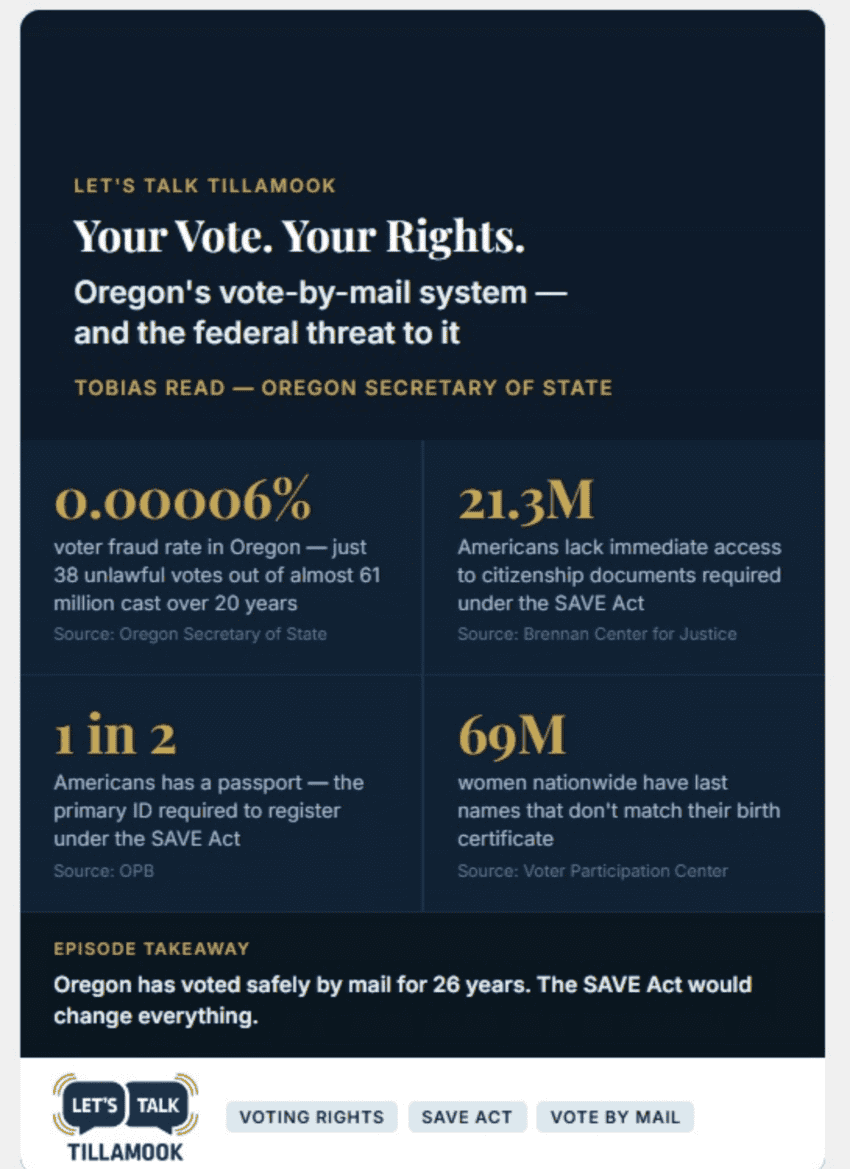
No, the Legislative Fiscal Office looked at 20 years of ballots, or 60.9 million ballots. They found 38 cases of improper voting. This doesn’t justify policies that make it harder for eligible citizens to vote. Tens of thousands of eligible Kansans were prevented from voting just because they didn’t have certain documents. Is the administration pushing this agenda because elections will hold them accountable? They know that their policies are unpopular so they try to cast doubt on election results they don’t like. But the Constitution is clear: states run elections, not presidents. Our system is safe, accurate, and fair, and will continue to be so.
Q3: Who stands to lose their vote if the federal government changes or kills mail-in voting? What can they do now to protect it?
Rural voters, seniors, low-income voters – 69 million Americans – who are unable to get to a polling station at a specific time are at risk. People, particularly women whose names don’t match their birth certificates, will have a greater risk. The best thing to do is prepare to vote and vote early. When your voters’ pamphlet arrives, do your research and consider your choices so you’re ready to vote quickly. Fill in your ballot, sign your ballot envelope, and get it to a drop box. Drop boxes can be found in Cloverdale, Pacific City, Bay City, Garibaldi, Rockaway Beach, Manzanita, and Tillamook.*
If you need to mail your ballot, do that at least a week before election day. After October 27th, ask the post office to manually postmark it. Talk to friends and family to make sure they’ve got a plan to vote and get their ballot returned. We defend our system by generating high turnout.
Q4: There are 800,000 people on Oregon’s inactive voter list. What is your plan to remove them in accordance with federal law?
When an election official mails a ballot and it is returned as undeliverable, the voter becomes inactive and will not get another ballot until they are in contact with their local elections office with a new address or to explain what happened. The elections office should notify the voter that they are on the inactive list and their record should be deleted in two to four years if the election office is not contacted. This way, the person can re-register and the voter list stays current.
One of my predecessors stopped following through on that specific federal requirement. It is important to emphasize that if you are an inactive voter, you are not getting a ballot. Therefore, you are not voting and you are not affecting any election outcome. Now we do the routine maintenance that is required.
Q5: The Supreme Court has now sided with the president on restricting mail-in voting, though it noted that doesn’t mean every measure will be lawful. Add the SAVE Act, pressure on states to hand over voter data to Homeland Security, and statements that the election will be stolen — what does all of this mean for Oregon voters heading into November, and is there a backup plan?
We will have safe, accurate, and fair elections that reflect the will of Oregon voters. We expect everyone to follow those lawful results. Oregon voters should be confident that the 36 county clerks do a good job. We won’t bow down to a federal government that exceeds their authority and makes it more difficult for eligible voters to vote. This is how we hold politicians and the federal government accountable. People ought to be confident about that.
*Ballot drop box locations:
Tillamook County
https://www.tillamookcounty.gov/sites/default/files/fileattachments/clerk039s_office/page/8346/dropsite.mediasites.schedule.pdf
Clatsop County
https://www.clatsopcounty.gov/1015/Ballot-Drop-Site-Locations
Lincoln County
https://www.co.lincoln.or.us/617/Local-Drop-Site-Locations
Coos County
https://co.coos.or.us/drop-site-locations
Curry County
https://www.currycountyor.gov/government/county_clerk/drop-site_locations.php
 Let’s Talk Tillamook is an independent community project led by experienced broadcasters and journalists dedicated to providing accurate, factual information and thoughtful conversations for the people of Tillamook County and the Oregon Coast.
Listen to the full interview at:
Spotify – https://open.spotify.com/episode/2lC76VgZXYwqMIQoMX1nzT?si=n64Rr8QAR3-lDccCh_YhJw
YouTube – https://youtu.be/-ReqMRstL8U
