








 By Denise Donohue, M Ed
The first time I ever felt anxiety was long before I knew what it was. I was an emergency medical technician working on an ambulance. I remember coming back to the bay after what was probably a horrific call. Oddly enough, I can’t remember the call that caused my first anxiety attack, but that’s probably because it wasn’t really the call that caused it. It was the immense pressure of being a woman in what other people, at the time, would consider a man’s field. I know there’s more to that story, so I’ll bookmark that for another essay. But what I remember most clearly isn’t what happened before the anxiety. It’s what happened when it arrived.
We were back at the bay, sitting on our very uncomfortable futon and getting ready for bed. This wasn’t just any uncomfortable futon either. It was heavily adorned with lumps and bumps always stabbing you in the back and smelled like the body sweat of a construction worker building the latest casino in the Las Vegas heat, which, in hindsight, probably wasn’t doing my anxiety any favors. I felt my heart wanting to jump out of my chest, and at one point I’m pretty sure it skipped not one, not two, but three beats. As I lay on the futon with my hands on my chest, I could feel my breathing getting very shallow. I was nervous. I’m an overthinker with medical knowledge, so I was dangerously inside my head, and what I didn’t know at the time was that I was experiencing my very first anxiety attack. However, I thought I was having a heart attack.
I woke my partner up, a paramedic by the name of Matt. Now, I could write a whole essay on him because he was definitely an unhinged nutcase, but that night I was a little more unhinged and I’m sure he thought I was ridiculous. But he appeased me anyway by hooking me up to the heart monitor. No heart attack, he reassured me. I was fine. But I didn’t feel fine. I felt like there was something inside me screaming, wanting to get out. So I lay there the whole night, hand on my chest, feeling my heartbeat and anticipating that eventually it would stop.
It wasn’t until a few doctor’s appointments later that I found out that I was suffering from anxiety. I don’t know if I would call it crippling yet, but that’s the first word that comes to mind. Because when you first discover an anxiety attack, you really don’t know how stressful it is until you’re actually in that moment. Feeling like you can’t breathe and your heart is going to explode is not a comfortable feeling, and it definitely warrants a little bit of the adjective “crippling”.
So I was 28. I had major anxiety and absolutely no tools for how to cope with it.
Let’s fast forward a little bit to current Denise. Twenty-eight years later and still battling anxiety, but this time I come equipped with knowledge.
I think it’s fortunate that I started working on an ambulance so young because, at that point in my life, I had absolutely no direction. I wasn’t in college. I had no plans of going to college. But somewhere along the way, I started finding myself drawn to the patients experiencing mental health crises. I wanted to understand what was happening to them, probably because, on some level, I was also trying to understand what was happening to me.
Fast forward through a whole lot of life and education, and I became a licensed counselor and certified life coach. So yes, I definitely have a better understanding of anxiety and the brain that terrified 28-year-old lying on a lumpy futon with her hand on her chest.
The irony? I still have anxiety.
I’m not sure it ever completely goes away. What I do know is that understanding what my brain is actually trying to do when anxiety shows up has changed the way I experience it. Because as complicated as the human brain is, sometimes I think it helps to imagine it as something much simpler.
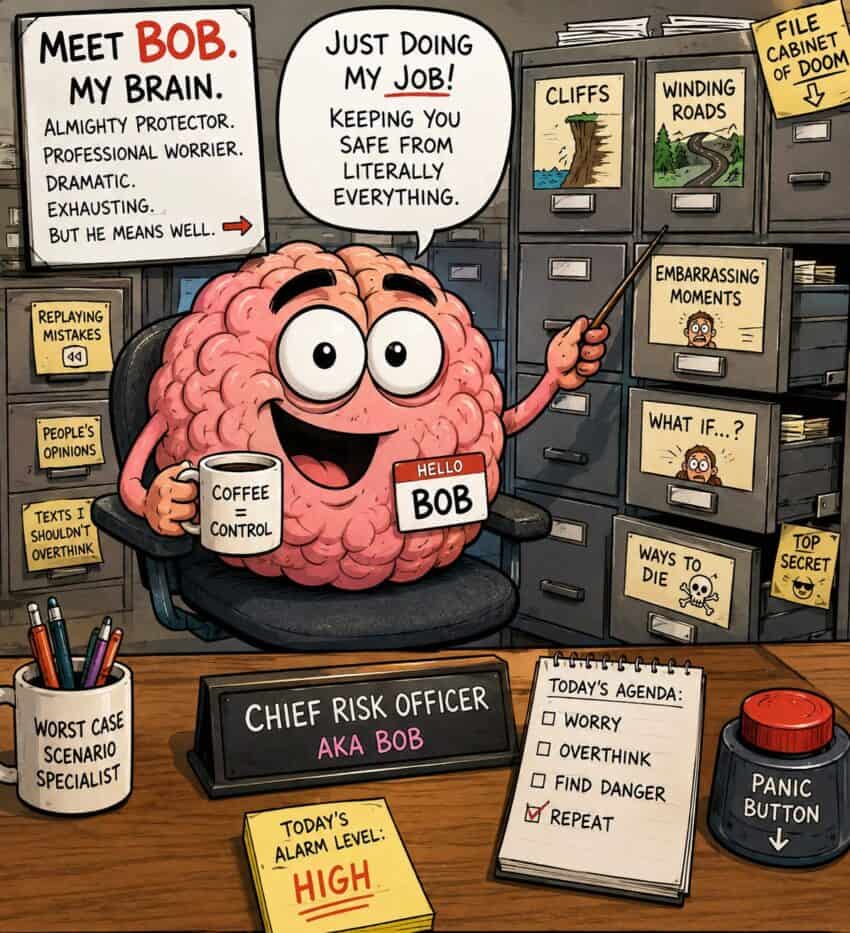
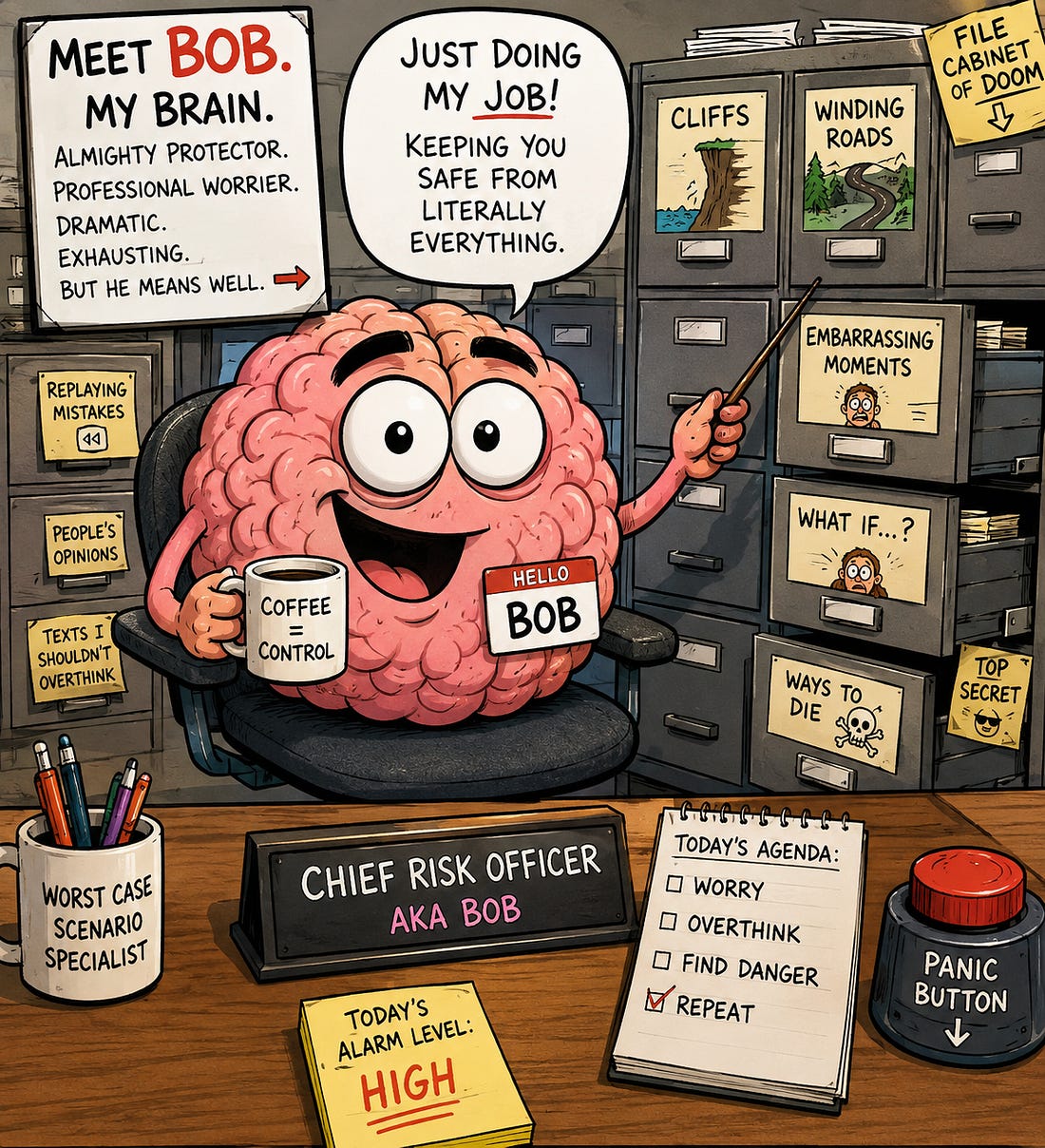 So meet Bob. The little person who lives inside my head and happens to be my brain. Bob has one job in life: keep me safe. It has something to do with our caveman days, procreating, keeping the human race alive, blah blah blah. The important part is that somewhere along the way we evolved with this pretty remarkable mechanism designed to protect us from danger. The only problem with Bob is that, in his quest to keep me safe, he has absolutely no idea how to tell the difference between real danger and something he just thinks is dangerous.
And this is where Bob gets a little overzealous with his job description. Danger to him doesn’t necessarily mean a saber-toothed tiger is chasing me or someone is standing in front of me with a knife. Bob can sound the alarm when I’m being scrutinized, when I feel like I have something to prove, when I’m anticipating criticism, feeling powerless, sitting in uncertainty, facing rejection, or losing control. Once Bob has learned that something might be threatening, he can trigger the same physiological alarm bells even when the rational part of me knows I’m not actually in danger.
So how does this actually work? Well, as you can imagine, being an EMT for as long as I was created some secondary post-traumatic stress for me. When you’ve seen that many car accidents, drunk drivers, and major traumas, your brain stores it in its memory. So that means Bob has a file cabinet full of my deepest, darkest fears, one of which would be driving. Go figure!
Everybody who knows me knows I like to drive because I like to be in control and I’m an obscenely nervous passenger. I don’t like being a passenger. I’m not a very good passenger, especially when on cliffs, abrupt edges, and winding roads. (Probably not good that I live in the Pacific Northwest because that’s pretty much all we have out here.)
So driving on one of the cliffiest, most winding roads there is, you can imagine the anxiety I have felt. Sheer panic came across me the first time I drove this road ( known as route 53) with my 10-year-old daughter. I’m pretty sure I was going 5 mph in a 35, which was probably more dangerous than the actual cliff I was on. Bob reaches into the file cabinet, pulls out at core memory from my EMT days, and alerts me: This is dangerous. He sends signals throughout my body. My heart starts beating faster and skips a few beats. I feel all the blood leave my extremities as it pools towards my heart. I feel like I can’t breathe. I’m totally inside my head, and the chest pain I feel is immense. I’m gripping the steering wheel as if I’m in the Indy 500. I literally begin to cry, and sometimes that’s what anxiety looks like for me, just a big pool of tears.
I get past the real dangerous part, and I feel like it’s safe to go up to 10 mph. Until a car is behind me. Now I have to find a place to pull over, but let’s not forget, I’m on a cliff. So this causes even more stress and anxiety. I can feel that afternoon’s lunch start to creep up my esophagus and enter the back of my throat. In my head, Bob is telling me, “We’re doomed. We’re going to die. And that’s the end of mankind.”
Yes, Bob is a little dramatic. All of our brains are. So let’s assess the situation. Let’s see where the real danger actually is. When I’m driving down the road on flat land, yellow line in the middle, white line on the right, do I ever go over the white line and end up in someone’s front yard? Do I ever drive off the road onto the sand while driving 45 mph? Do I ever ignore signs that say, “Caution, 35 mph curve ahead,” and not slow down? The answer to all of those questions is no. Never. So why would I drive off a cliff? At this point, Bob has complete control over me. I am a prisoner at his beck and call. But more realistically, I’m a prisoner of my own thoughts.
Here’s the tricky part. If I give in to Bob, guess what happens? Bob perceives that moment as an actual, viable threat. He takes a picture of it, opens up the file cabinet, and stores it in my memory. So now I’ve learned that driving on cliffs and winding roads is a threat to my nervous system and could actually kill me. Is this true? No. We’ve already determined that it’s not true. But it doesn’t matter because it’s already stored in that file cabinet, and Bob is the only one with the key.
So what do I do? I listen to Bob. I avoid Highway 53 at all costs, even if it takes me 10 minutes longer to go the opposite way. When I’m driving from Oregon to Nevada, I start rerouting to figure out how I can avoid the most mountainous roads. Before I take any road trip, I always look at the road conditions and whether I’ll be driving through the mountains. More importantly, I now insist that I always have to be the driver, which means I’m always driving. And if I am the passenger, I drive the actual driver nuts with all my gripping of the handlebar and my imaginary brake pedal on the passenger side.
Here’s the kicker. This is the part that I really want people to understand. Avoiding Highway 53, avoiding mountainous roads and cliffs, and constantly taking precautions that don’t need to be taken when driving on winding roads does not help my anxiety. Let me repeat that. It will not help the anxiety. What it does is reinforce it because I just told Bob that this is actually a danger.
So by avoiding those things, I’m actually reinforcing a fear of something that isn’t really a viable threat, and I’m creating more anxiety. Unfortunately, if I continue to let this be reinforced, driving on cliffs and winding roads can eventually turn into driving in general. Now anytime I get in the car, Bob sees it as dangerous. I retreat. I don’t go anywhere. Bob wins, and the anxiety goes away.
Except it doesn’t really go away.
It will come back because eventually and I’m going to need to leave the house.
OK, so what the hell am I going to do with Bob? Because Bob won’t learn from reasoning alone. Remember, he’s got an entire file cabinet full of all my deepest fears and anxieties. He likes to throw them out there every now and then just to give my heart a little jolt. So I can’t just tell him Highway 53 is safe. He won’t believe me.
Though Bob is my almighty protector, he is also a very good student and can be retrained. This is good news because I eventually need to leave the house. So I’ve got to give Bob new evidence. I have to show him that what he perceives as a threat really isn’t a threat.
So buckle up, Bob. We’ve got to drive the 53.
Exposure therapy is one of the most well-established, evidence-based approaches for treating anxiety. But that doesn’t mean I throw Bob into the passenger seat and take off down the 53 while he completely loses his shit. I need to expose him slowly. Little by little. Maybe I drive a quarter of the 53 and turn around. Then I drive half of it and turn around. Eventually, I drive the entire thing. And then I do it again. And again. And again. Until eventually, Bob no longer sees this as a threat and I’m able to leave my house and get groceries again.
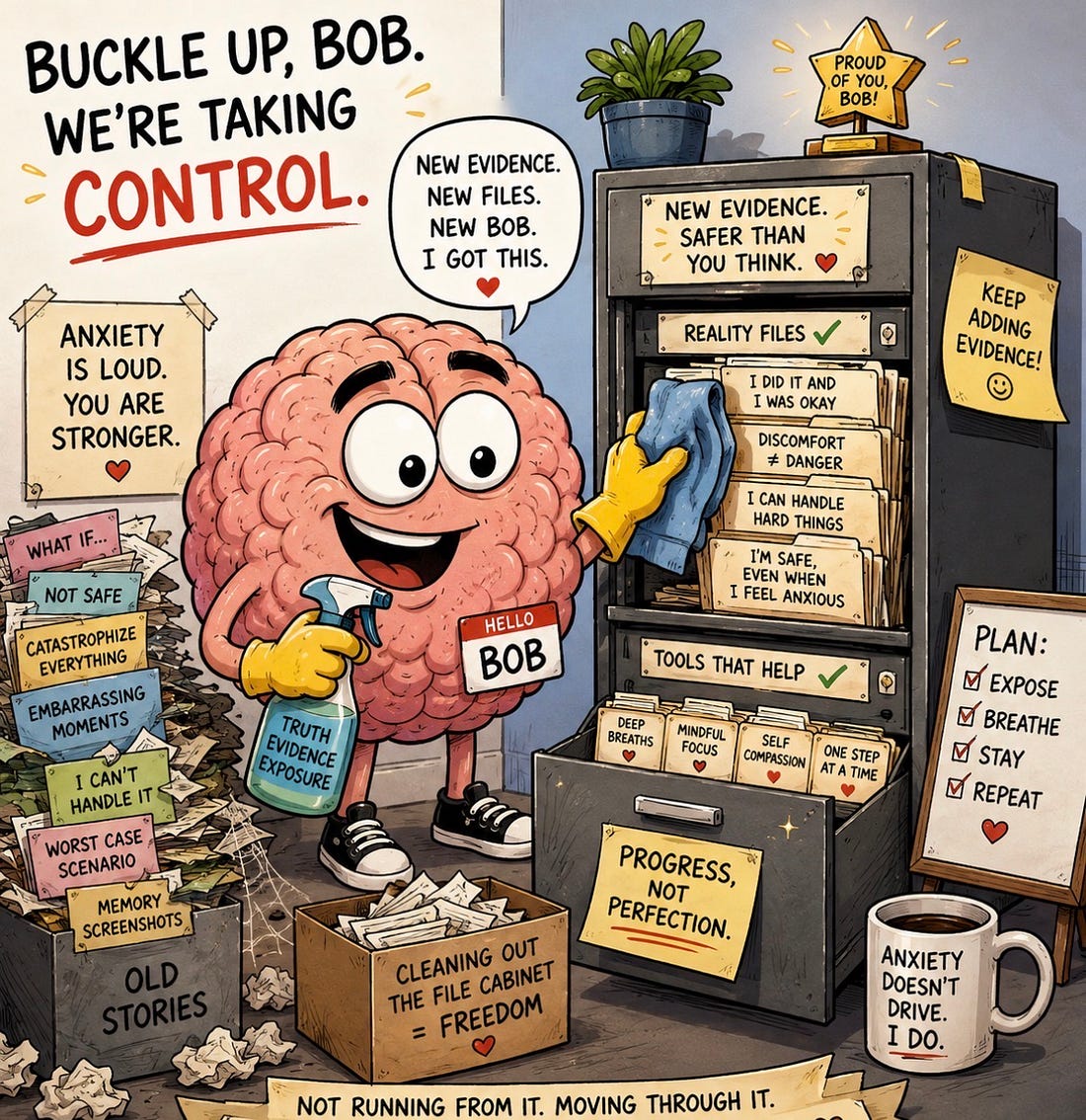 There are definitely techniques I can use to help ease some of the anxiety while I’m doing it. Deep breathing and staying mindful in the moment can help. But the bigger lesson I’m trying to teach Bob is that I can feel anxious and still be safe.
Every time I expose myself to something Bob perceives as dangerous and nothing terrible happens, I give him new evidence to put in that file cabinet. Eventually, instead of pulling out the file that says, “CLIFFS = WE’RE ALL GOING TO DIE,” maybe he starts pulling out the one that says, “We’ve done this before. We were scared. And we were OK.”(An excellent mantra to repeat in your head while facing your danger.)
Because avoiding the things we fear might make the anxiety disappear for a moment. But it also teaches our brains that running away is what kept us safe.
And sometimes the only way to teach Bob that something isn’t dangerous is to stop running from it, and move through the uncomfortable moments.
The 28-year-old me always thought the goal was to make the anxiety stop, whatever the cost. Run from it so you don’t have to feel the discomfort. Current Denise understands that the goal isn’t necessarily to stop feeling anxious. Sometimes it’s easier to accept that anxiety might simply be part of life. It’s learning that I can feel anxious without letting it control me, by slowly exposing myself to my triggers, my fears, and even my own thoughts.
So buckle up, Bob. It’s time to clean out that file cabinet.
