









“A basic rule of life for reporters is that you should spend your time talking with and learning about people who are not sending you press releases, rather than those who are.” – James Fallows
By Marc C. Johnson
Notes on a (Very Special) Guest Post
I’m giving this space over today to something very special.
A Pacific Northwest pal of mine, Eric Redman, recently spent a week traveling in Alabama and Mississippi with his friend, the journalist and author James Fallows.
Ric produced the following essay about that trip and his long friendship with Jim Fallows whose own remarkable career – presidential speechwriter, magazine editor, aviation journalist, National Book Award winner, etc. etc – is both fascinating and immensely important to the modern history of American journalism.
I’ll be back soon with more reflection on my own current travels in Europe, among other things.
But today this space belongs to Ric Redman … and Jim Fallows.
Eric Redman is a Seattle writer, lawyer, climate advocate and author of The Dance of Legislation (1973), and two Hawaiian murder mysteries, Bones of Hilo (2021) and Death in Hilo (2024).
You can read more about Ric here.
An Evening in England
One foggy English evening in 1971, James Fallows, then twenty-two, appeared unexpectedly at my flat in Oxford. He couldn’t call in advance, because the waiting list for telephones was long (Britain still struggled with post-War austerity). The “post” arrived twice daily, but we Americans couldn’t quite believe you could mail a missive in the morning and receive an answer in the afternoon.
Probably Jim’s visit was too impulsive for that anyway.
A great dilemma tormented him. He’d scored a perfect 800 on the Law School Aptitude Test (LSAT), and as a Rhodes Scholar he’d already studied law for a year at Oxford. But he found he hated it. So, he asked the key question: Did I think he could make a contribution to society if he didn’t become a lawyer?
I laughed. Who wouldn’t? Naturally I said the question was rather the reverse: could he make a contribution to society if he did become a lawyer?
Palpable relief is a cliché. But that’s exactly what Jim showed. Anguish drained from his face. I imagined him skipping home to his newly-married bride, the linguist Deborah Fallows.
A problem still faced him, however. Only twenty academic weeks remained in his last Oxford year. He needed a new field of study quickly. He chose economic development, even though he’d studied neither economics nor development previously – barely studied at all, allegedly, because as a reporter, editor, and then president of the Harvard Crimson he’d rarely left the paper’s Plympton Street offices.
Yet in remarkably short time, Jim wrote an entire thesis in this unfamiliar field. He submitted it on time and waited. Then he received an ominous summons.
The top economics professors “requested” his appearance for an oral examination on his thesis, an exam known in Oxford as a “viva,” rhyming with saliva – exactly what, suddenly dry-mouthed, one might find oneself missing in response to that communication. Because at Oxford, a compulsory viva is rarely good news. It usually foretells a sharp and thoroughly unpleasant interrogation.
In Jim’s case, however, when he entered the examination room, a semi-circle of Oxford dons in their imposing academic caps and gowns rose to their feet and began applauding him avidly. Jim had received that rarest of rare birds, a “congratulatory viva.”
What would be remarkable for others – the Crimson presidency, a perfect LSAT score, a Rhodes Scholarship from California (the most competitive state), a congratulatory viva – did not surprise anyone about Jim. His braininess always shone brightly. His improbable sprint to produce that distinguished thesis proved him a remarkably quick study – and one of the world’s fastest readers.
With those attributes and others – he’s also among the world’s nicest and most modest people – Jim left academia and began his career-long professional ultramarathon to become one of the most respected writers and perceptive observers of our time. Fellow journalists might envy those accolades, but in Jim’s case they wouldn’t dispute them.
Over six decades, Jim has written for the Crimson, the Southern Courier, the Texas Monthly, the Washington Monthly, the New York Review of Books, and most famously, cover stories and leading article after leading article for The Atlantic.
He’s also produced eleven books, including the best-selling National Book Award winner National Defense (1982); the alarmingly prophetic Breaking the News: How the Media Undermine Democracy (1996); my second-favorite book on China, China Airborne (2012) – my favorite is Deb Fallows’s Dreaming in Chinese (2010) – and together with Deb, both the national best-seller Our Towns (2018) and the HBO documentary that followed. ¹
Notably, Jim served as President Jimmy Carter’s chief speechwriter, and has interviewed every president since (other than Trump), plus a passel of other national leaders, tech titans, billionaires, military leaders, world figures, and quirky folks who just interest him. Jim also obliges the many people and media personalities who want to interview him.
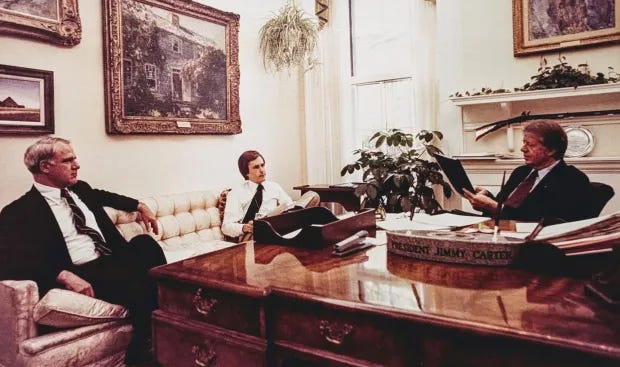 |
Jim Fallows (in shirt sleeves) with then-Energy Secretary James Schlesinger and President Jimmy Carter (Redlands Daily Facts photo)
In The Atlantic he strenuously argued against launching the Iraq War (his Iraq columns, compiled in Blind into Baghdad (2006), stand forever as for-the-record indictments). He foresaw correctly the folly, illogic, and ill-preparedness of what became, at the time, America’s greatest foreign policy mistake.
After Cassandra warnings from Jim and prescient others failed to prevent the Iraq catastrophe, Jim immediately wrote in The Atlantic – more than twenty years ago – that following up Iraq with a deceptively tempting war against Iran would make the Iraq War look brilliant by comparison. As a candidate, Barack Obama read Jim’s work. Once president, he invited Jim to the White House to consult with on China where Jim and Deb had lived.
So, given all this and more, when Jim suggested we take a road trip together, I agreed at once. I’ve long benefited from Jim’s prolific writing and admired his prose style – sometimes blunt and urgent, other times as smooth and tasty as a root beer milkshake. Yet I’d never seen him at work. This was my chance.
A Return to the Deep South
So it was that fifty-five years after that foggy English evening, Jim and I set off on a week-long journey through Alabama and Mississippi in September of this year. He wanted to return to places he’d sojourned as a youthful reporter and an investigator of corporate corruption, as well as places he and Deb had featured in Our Towns.
In seven days, we saw candidates and officeholders; survivors of the 1960s civil rights battles and bombings; octogenarians who’d been brave schoolchildren in Alabama’s landmark school desegregation case; other keepers of civil rights flames and marches; Jim’s haunts as a teenage reporter for the defiantly courageous Southern Courier; current writers who chronicle the ongoing struggles of Southern whites to retain political power and of Southern Blacks to share it – and all that was just in Alabama, before we even got to Mississippi.
Observation #1: Jim’s incredibly well-connected.
Example: As soon as we landed in Birmingham, Jim’s phone rang with calls from Doug Jones, Alabama’s former U.S. senator and now its Democratic nominee for governor, who in 2000, as a U.S. Attorney, successfully prosecuted, nearly four decades after their crime, the surviving Ku Klux Klan members who murdered four little girls by bombing a Birmingham church in 1963.
Diane McWhorter, an Alabama native who wrote Carry Me Home: Birmingham, Alabama: The Climactic Battle of the Civil Rights Revolution (2021), a Pulitzer Prize-winning account of the church bombing saga, had put Jim and Doug Jones together.
Of course, Doug Jones wanted to see Jim. He left his home near midnight just to meet Jim at an all-night burger joint. They talked candidly for nearly two hours; I was privileged to listen.
(That interview, plus a later Jones event at a Black church in Tuskegee, highlight a powerful piece Jim wrote for his Substack after our trip.)

Observation #2: people trust Jim.
Maybe it’s his reputation; maybe it’s his bedside manner. He quickly puts people at ease; his interest in them and his integrity are easily recognized as genuine. Everyone I saw Jim interview treated him as someone who could grasp their ideas, add his own, and – they hoped – convey a thoughtfully synthesized result to a sophisticated national audience.
Jim asks permission to record his interviews. He uses two identical recording devices, in case one fails. He writes notes while he listens. And he promises not to use any quotes without calling back to check first. These are professional habits that instill trust; many interviewees are more accustomed to having a microphone just jammed in their face.
Observation #3: the combination of Jim’s connections and trustworthiness yields extraordinary opportunities.
In Birmingham, thanks to McWhorter’s introduction, Mary Boehm, a key civic leader, took us to share the morning and a lunch with Barbara Shores, 82, daughter of Birmingham’s legendary Arthur Shores, the first Black lawyer allowed to argue his own cases in Alabama’s courts.
Arthur Shores brought landmark civil rights cases throughout the 1950s and 60s, including the suit that forced the University of Alabama to admit its first Black student in 1955. (Fifteen more years would pass before Alabama’s legendary coach, Paul “Bear” Bryant, managed to integrate the Crimson Tide football team.)
When Arthur Shores tried to desegregate the Birmingham public schools, his house – the one where Barbara Shores still lives and welcomed Jim to interview her – was firebombed and dynamited twice, with harrowing results. Barbara Shores described for Jim how, as a young teen, she crawled through fire and smoke to locate her wounded parents, and how she found her beloved dog blown to pieces in the backyard.
Of course, other journalists have covered the Shores story before. But it was fascinating to watch Jim re-immerse himself in the Alabama of the 1960s and the civil rights battles he’d covered as 18-year-old cub reporter for the Southern Courier in Montgomery. I knew his youthful experience would infuse (and perhaps propel) whatever he wrote about Barbara Shores.
And doors just kept opening for Jim on our trip – doors that would never have opened for me otherwise. By invitation-only, at the federal courthouse in Montgomery, we attended a ceremony honoring the surviving original plaintiffs in Alabama’s landmark school desegregation case, Lee v. Macon County School Board, filed in 1963. The plaintiffs had been children then, facing club-wielding troopers on horseback, threatened with violence and seeing it inflicted on others.
The ceremony produced many moving moments. One of the plaintiffs, now in her 80s, recalled finding courage when she looked out the bus window and saw her father, “a tall Black man,” standing in the hostile white crowd. She tore up the piece of paper telling her she couldn’t attend the school and marched bravely off the bus, even as police brutally beat the only photographer present.
Asked if she’d do it all again, she said no. Why? She explained the local Black schools in Tuskegee were better than those they tried to integrate, and once they succeeded in integrating them, the white students all left anyway. “We had our own Black Wall Street in Tuskegee,” she said, and wished the Black community had done more to focus on its own development rather than desegregation.
Which led to a second moving moment. The current senior federal judge, in whose courtroom we sat and where the 1963 drama had taken place, reminded us that although we stand on the shoulders of giants, in this instance the giants were children, kids who hadn’t wished this on themselves but who dutifully followed the directions of their parents, the real movers in the drama. There’s something shameful, the judge said, in using children to solve problems adults should be able to solve themselves.
(At the reception, I observed that Lee vs. Macon County had been filed a full nine years after the Supreme Court’s desegregation decision in Brown v. Board of Education. “Alabama had done nothing in the meantime,” I said. “Neither had Boston,” someone remarked.)
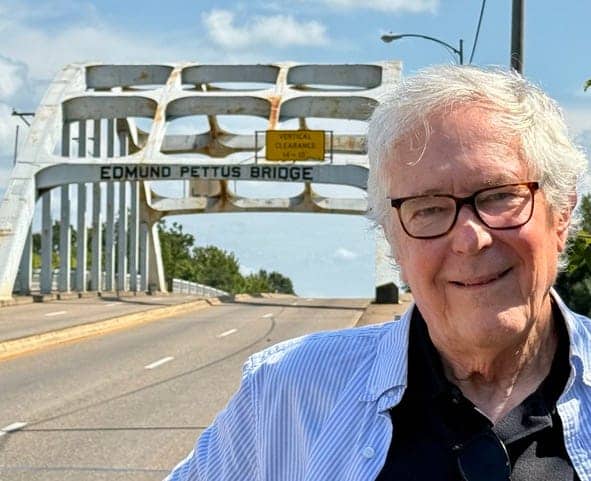
Jim’s and my trip continued like this, each day packed with enlightening events and meetings. In Selma, site of the Edmund Pettus Bridge and the famous 1965 Selma-to-Montgomery voting rights march, David Domke of the voting rights organization Common Power leapt at the opportunity to arrange interviews for Jim, including with local citizens, two Black officials from the Henry Ford Museum of American Innovation of Dearborn, Michigan and himself. (The Museum recently moved from Selma all the way to Dearborn, in two pieces, an entire house central to civil rights struggles in the 1960s.)
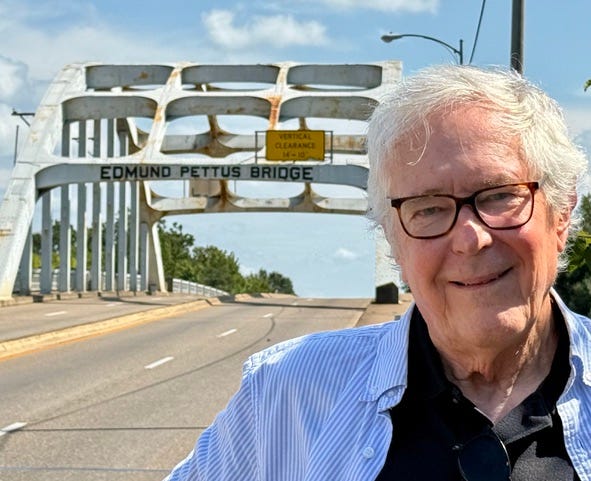 |
Jim Fallows in Selma, Alabama
Our visit to Columbus, Mississippi, was particularly memorable. Because Jim and Deb had featured Columbus in Our Towns and HBO had done the same in the Our Towns documentary, Jim was welcomed like a returning hero. A local podcaster relished having Jim as a guest (and wondered, as I did, what I was doing in the recording booth with him).
The publisher of the town’s newspaper, The Dispatch, by now an old friend of Jim’s, reveled in a relaxed reunion and sit-down with him – which again I was privileged to observe.
Our trip’s highlight – certainly the most uplifting event – was a visit to the Mississippi School for Mathematics and Science in Columbus at the invitation of Jim’s friends Thomas Easterling and Chuck Yarborough, two dedicated and energetic teachers there.
MSMS describes itself as “Mississippi’s only public, residential high school specifically designed to meet the needs of the magnolia state’s most academically gifted and talented students, with emphasis on STEM education. Created to serve the state’s brightest students, MSMS excels at providing innovative learning experiences, leadership development opportunities, and holistic residential life programs geared toward high achieving students.”
And what students! Wow.
It’s remarkable that such a public high school – and a boarding school at that – with such a diverse student body, producing amazing work product (we got to see some), can even exist. But Mississippi has been rising lately in education rankings, so perhaps I should not have been surprised.
Messrs. Easterling and Yarborough were excited to meet Jim for dinner (I was Jim’s +1) and to feature him onstage to address the entire student body and engage in Q&A with them. To watch Jim inspire these ambitious young people on matters of journalism, politics, travel abroad, and other life experiences moved me deeply; inspired they definitely were.
Reflections on the Flight Home
Observation #4: Jim’s remarkable graciousness, thoughtfulness, and magnanimity are always apparent.
It would be impossible to watch him work and not observe those qualities. He showed them to everyone he interviewed on this trip, and everyone who interviewed him. He showed them to the MSMS high school students. On the whole trip, and in fact for sixty years, he’s showed them to me as a friend, and I am sure to his other friends as well.
I wouldn’t have become a writer at all without his (and Deb’s) patient and steadfast encouragement. On this trip, I wouldn’t have been included in the events I’ve described had people not been so eager for time with Jim that they accepted his insistence on including me, generally to my embarrassment, grateful as I was.
I came away with a host of observations about Alabama and Mississippi, some depressing (the recognition that white politicians still won’t let Black people share voting rights and political power equally), some encouraging (like MSMS), some fascinating and enlightening (watching Jim work).
I also came away with a fresh dose of pleasure in getting to observe, applaud, and marvel at Jim as a person, a professional, and a friend.
But I still want to insist: he could have been one heck of a lawyer.
I hope you enjoyed Eric Redman’s Guest Post as much as I enjoyed featuring it. Thanks for reading and please share with friends and family and if you haven’t subscribed, please consider doing so.
All the best.