










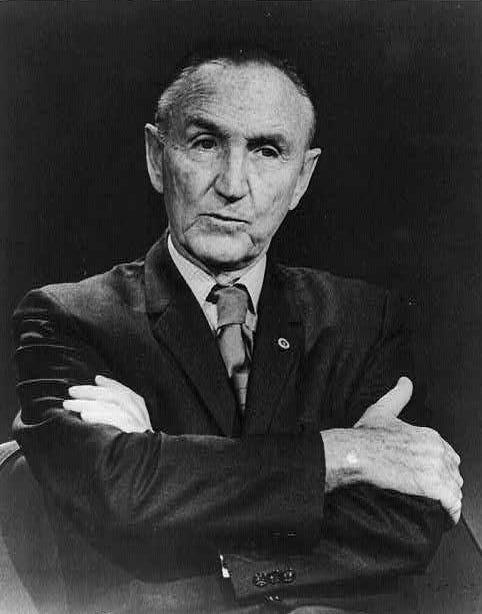
“With the nation, the Senate has come a long way. And still, there is a long way to go,” – Mike Mansfield in 1976
By Marc C. Johnson
As the new Senate majority heads into what looks like a couple of weeks of speculation, division, distraction and party infighting around the issue of Senate leadership, I’ve been thinking about the greatest majority leader in the history of the United States Senate.
I say this with complete confidence.
The greatest Senate leader ever – a politician utterly unlike anyone alive today – had once been a mucker in an underground copper mine and later a university history professor.
His name was Mike Mansfield. He was from Montana.
On March 4, 1976, Mansfield, a quiet, humble, superbly fair and ethical man, went to the Senate floor to announce that he would not seek re-election to a fifth term.
Mansfield was 72 years old. He would have easily won re-election in Montana where those old enough to remember him still revere him. He enjoyed such respect and affection in the Senate that there is no doubt he would have been selected again as majority leader, a position he had held since 1961 – still the longest tenure of any Senate majority leader. He never sought Senate leadership; it alway came looking for him. ¹
Mansfield, a political leader who often spoke of the need for personal and partisan restraint, knew when to quit.
As The New York Times wrote at the time:
Reading his statement to a hushed Senate, the tall, spare Mr. Mansfield noted that his 10 years in the House of Representatives and 24 in the Senate had encompassed “one–sixth of the nation’s history since independence” and the administrations of seven Presidents.
“There is a time to stay and a time to go,” he said. “Thirty‐four years is not a long time but it is time enough.”
Mansfield said that his age had not been a decisive factor in his decision but added:
“It seems to me that time has come to perform a final public service; to the nation, to the Senate, and to the people of Montana. A great public trust has been reposed in me in so many ways and for so many years. For whatever time remains to me I shall ever be grateful to the nation, the Senate and to my state for this confidence. I ask now that this trust be shifted to other shoulders.”
His voice began wavering as he finished reading. He sat down, wiped his nose with a handkerchief and sat with his eyes cast downward and his arms folded across his chest for the next 45 minutes as senator after senator rose to praise his fairness and integrity.
“I have never known a finer man.” said Senator [Hugh] Scott [the Republican leader] whose own voice seemed to be breaking.
“He is a Senate man and the Senate will miss Mike Mansfield when he leaves this chamber,” Mr. [Robert] Byrd said.
“I’ve not been around long Senator Mansfield, but I think it is going to be a long, long time before I meet a man of such integrity,” said Senator Joe Biden, a 33‐year‐old Delaware Democrat.
One of the great gifts of political life – or for baseball players or corporate titans for that matter – is the gift of self-reflection, the ability to tell yourself it’s time to go, time to let someone else take the lead. ²
Polling indicates a strong majority of Democratic voters are eager to see new congressional leadership, including in particular replacements for Senator Chuck Schumer of New York, and to a somewhat lesser degree Representative Hakeem Jeffries, another New Yorker.
There is a good reason for dumping Schumer, Alex Shepard wrote recently in The New Republic:
He and Jeffries were both slow to pick up on their base’s anger last year, as they largely sat back and did little while Trump and his cronies wreaked havoc. They underestimated the potential for destruction, both from Elon Musk’s “Department of Government Efficiency” and from the president’s aggressive deployment of immigration agents and the U.S. military. At the same time, the one high-stakes fight they waged—last year’s government shutdown—ended in something close to total surrender.
I don’t really have that much against Chuck Schumer. But I’m pretty sure he should step aside, and I have been thinking about an alternative reality where the five-term Democrat decides it’s time to quit leadership.
I know it won’t happen, but imagine what that might look and sound like if it did.
Schumer can justly claim a central role in the Blue Tsunami that has given Democrats at least eight – and maybe nine – new Senate seats, including in such unlikely places as South Carolina, Mississippi, Texas and Kansas.
“Why would you fire the manager when you just won the World Series?” Maine Senator Angus King, an independent who caucuses with Democrats, said recently.
“Chuck Schumer is one of the principal architects of the most successful election in modern history, and I see no reason to change the leadership that helped make that success possible.”
I get it, but the recent election also marked a generational shift in the Senate. The new senator from Texas, James Talarico is 37, Georgia’s re-elected Senator Jon Ossoff is 39, the new senator from Mississippi, Scott Colom is 44 – in addition to being the first African-American elected to the Senate from his state since the post-Civil War era.
The GOP rout also ushered in new, younger Democratic women in the Senate, including very likely two Native American women senators if Alaska’s trending vote count for Mary Peltola continues.
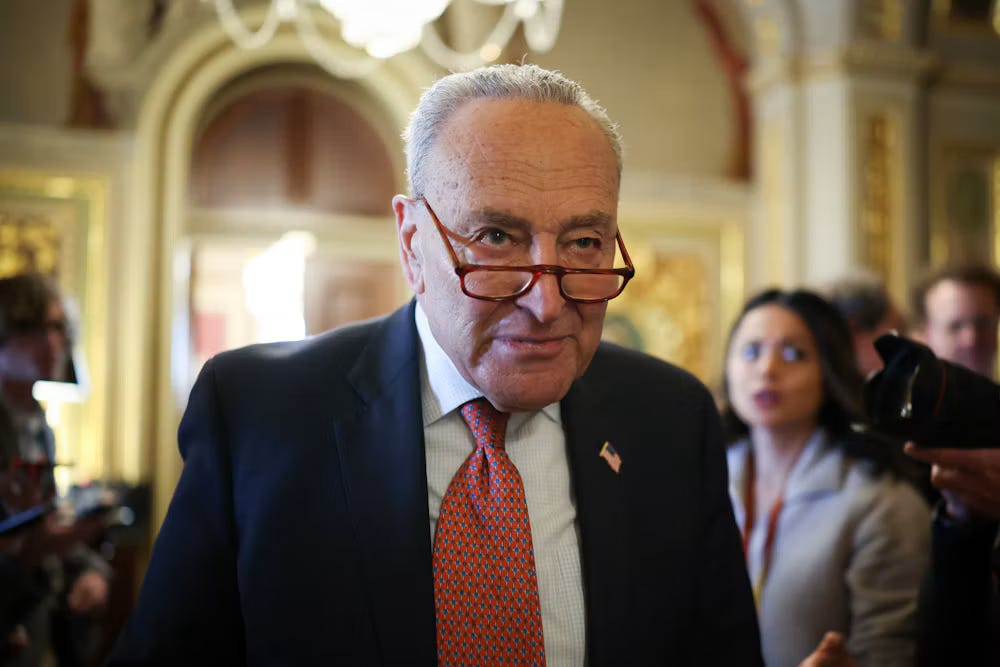 |
The once and likely future Senate majority leader
Against this background, and with a tottering, demented 80-year old in the White House showing his age and his incompetence every day, imagine Chuck Schumer saying something like this:
I am immensely proud of the new class of Democrats in the United States Senate. The American people have been signaling their desire to see a new generation assume positions of political leadership – and it has happened.
The United States Senate is a place where individual members enjoy considerable power and received considerable deference, but I truly believe the Senate’s new generation deserve to come forward to leadership – not in two years, or ten years, but right now.
The people of New York have rewarded me beyond my greatest dreams with the opportunity to serve my state and country in the United States Senate. I am forever grateful for that honor, but I also know that change is good, indeed it is absolutely necessary.
I’ve had a very good and rewarding run as the Democratic leader and as the majority leader of the Senate, but the time has come to step back and let others come to the front. I will remain the senior senator from New York for the next two years, working every day for my state and the nation now that Democrats have the opportunity and solemn responsibility to address the nation’s many pressing issues.
It is not easy to assume a different role in the Senate, but it is necessary. I leave the leadership confident in those who will be the next leaders. They will have my very best wishes and my constant support as they do the critical work for the nation and the Senate.
Imagine
Oh, I know you can’t, but just imagine how such a magnanimous gesture would be received, including particularly among those who voted for Democrats on November 3 but can’t yet quite trust them to do the right thing.
The majority leaders job in all truth is largely about trying to make the Senate function. It’s about managing the schedule, working with the arcane rules, determining when and how to give committee chairs their heads, and being smart enough to keep the other side from gumming up the works.
Yet, whether they are up to it or not the new Senate majority leader and the new House Speaker will automatically become the “face” of the Democratic Party for the next 18 months, or at least until a presidential candidate is selected.
Schumer, I suspect, is just fine at the blocking and tackling of running the Senate, but he is an uninspiring leader, not gifted with a soundbite or a speech. He still uses a flip phone – a flip phone guy in an AI world – which may be all you need to know about his embrace of change.
Schumer is, of course, far from being alone in not knowing how or when to seize a moment to orchestrate an artful exit. Chuck Grassley, for goodness sakes, is 93-years old.
Grassley had been in the Senate for eight years by the time the new senator from Texas was born!
Ya think ol’ Chuck is feeling his age, racing (sort of) against father time?
“At 93 years of age, I don’t know how many more groups of Republicans like this I’m going to have a chance to talk to,” Grassley said [in September] during the GOP’s annual Reagan Dinner in West Des Moines. “But I want to take advantage of it. But one of the reasons I’m worried about who’s going to be elected governor — I don’t plan on dying in office — but if I did, I don’t want a Democrat governor choosing my successor.”
Right on cue Iowa just elected 44-year old Democrat Rob Sand as its new governor.
Senator Mitch McConnell had the good sense to step down as Republican leader two years ago, but at 84 and in obvious declining health he has clearly not been able to do his job for months. He should resign, but hasn’t.
There is a rich – read stomach turning – irony that while Democrats reap the advantages (potentially) of a generational change in leadership, 83-year old Joe Biden is out with a new book.
The Atlantic headlined its assessment of the book with “Biden: I Was Right to Seek Re-election.”
The subhead reads: “In his new memoir, the 46th president is pugnacious, unrepentant, and unreflective.”
Grand.
As Matt Viser writes:
“Today there is no shortage of people who think I blindly raced to run again. Driven by ambition. Selfishness. Unaware of the concerns about my age,” [Biden] states, accurately. “I knew better than anyone how old I was. I knew what I was—and wasn’t—capable of doing. I carefully monitored how I was meeting the demands of the job. And there is not a single example of me failing to handle my responsibilities.”
Self awareness is an amazing thing. Or not.
Back to the greatest
In September 1976 just before the Senate adjourned that year, Mike Mansfield, the modest man from Montana spoke his last words on the Senate floor, but not before senators unanimously voted to name Room 207 of the Senate – the Mansfield Room.
“I do not leave this place in sadness,” Mansfield said. “I leave as one who has lived as a part of it and loved it deeply. I leave personally fulfilled and contented to have been one senator of the over 1,700 men and women who have served their states and the Republic in the Senate of the United States.”
After thanking a number of people, including as always his wife Maureen, Mansfield, as his biographer Don Oberdorfer wrote:
“… gathered the papers from his desk and walked briskly up the center aisle and out of the chamber, while his colleagues stood and applauded. He did not look back.”
Self awareness is an amazing thing.
2) A great example of a baseball player knowing when to quit is Joe DiMaggio, the great Yankee centerfielder. DiMaggio was only 36 when he quit. “I feel that I have reached the stage where I can no longer produce for my ball club, my manager, my teammates and my fans the sort of baseball their loyalty to me deserves,” DiMaggio said. “If I can’t give out what I want to give out, I don’t want to play.” He later married Marilyn Monroe and sold Mr. Coffee machines. So there was life after baseball.