


“When the history of the Trump era is written, the institutional cowardice will deserve a chapter, and the courage of those that fought a chapter of their own.” – Michael Hiltzik, Los Angeles Times
Since the beginning of his second term Donald Trump has signed at least 270 Executive Orders (EO), dozen of which have been fully or partially blocked in various federal courts.
One not blocked is now helping streamline the process to make Idaho a disposal site for high level nuclear waste, or as the Department of Energy (DOE) now calls it “used” fuel.
The EO now looking the people of Idaho square in the face was signed on Trump’s first day in office – January 20, 2025.
As the law firm Holland & Knight summarizes:
All federal agency/department heads are ordered to review, revise or rescind existing regulations, orders, policies or any other agency actions that potentially burden the development or use of domestic energy resources “with particular attention to oil, natural gas, coal, hydropower, biofuels, critical mineral, and nuclear energy resources.” Agency heads in consultation with the director of the Office of Management and Budget (OMB) and National Economic Council (NEC) are instructed to develop and begin implementing action plans to suspend, revise or rescind all agency actions identified as unduly burdensome by Feb. 19, 2025.
You can draw a straight line from this Trump Executive Order, and others relating to energy policy, including gutting the Nuclear Regulatory Commission, and a document Idaho’s governor signed late last month. ¹
The bottom line for Trump’s nuclear policy: speed rules, public opinion doesn’t matter, care and deliberation are out the window.
Get ready, Idaho.
Making the state a host for high-level waste is just around the corner.
Idaho’s Nuclear Step Backward
On July 24 Governor Brad Little put his signature on one of the most significant, perhaps the most significant, state paper in the history of Idaho.
Little’s action positioning Idaho to become one of the nation’s three new sites for storage of thousands of metric tons high-level nuclear waste was done with no public announcement, in fact no statement of any kind. While the governor was expressing concern about a mass shooting in Twin Falls and mobilizing the National Guard to fight forest fires, transforming Idaho into a nuclear waste storage site never made it to his social media accounts.
There was no news conference, no celebratory ceremony, no acknowledgment that with the stroke of his slanted signature Little had dramatically and unilaterally altered decades of bipartisan public policy devoted to removing nuclear waste from Idaho.
Little wants new waste and much more waste at the Idaho National Laboratory (INL), and his plan is to fast track its acceptance before Idaho voters have a chance to understand what he’s done.
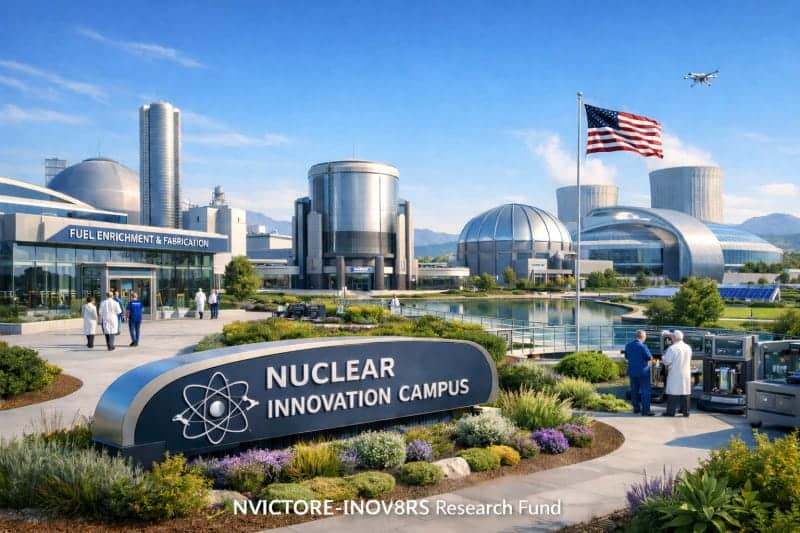
The governor’s vehicle for this profoundly cynical bit of state-level authoritarianism was a Memorandum of Understanding (MOU) with U.S. Energy Secretary Chris Wright. The MOU, committing Idaho establishing a Nuclear Lifecycle Innovation Campus (NLIC), is sweeping in scope and stunning in its commitments.
By the way, you can find many news releases on Little’s official website, but not the MOU with the Department of Energy, which was shared with me by an interested party. Not even a mention of the process.
The Governor’s Office of Energy and Mineral Resources contributed to the official state application for the NLIC designation – the director of the office was quoted in at least one news article about the application – but also contains no information about the MOU or, for that matter, about anything relating to this NLIC process.
Little’s agreement says, in part, that Idaho will negotiate a “Host” agreement with the Department of Energy (DOE) that “shall provide for the acceptance of out-of-state used nuclear fuel, spent nuclear fuel, and high-level radioactive waste, subject to section 3.6.”
Section 3.6 effectively says Idaho will modify, or more correctly, abandon the 1995 agreement – the Idaho Settlement Agreement – that was hard bargained by then-Republican Governor Phil Batt.
That agreement established legally binding milestones and guarantees that DOE would remove nuclear waste from Idaho that has been stored in the state, in some cases for decades.
The Batt agreement specifically rejected Idaho becoming a waste storage site.
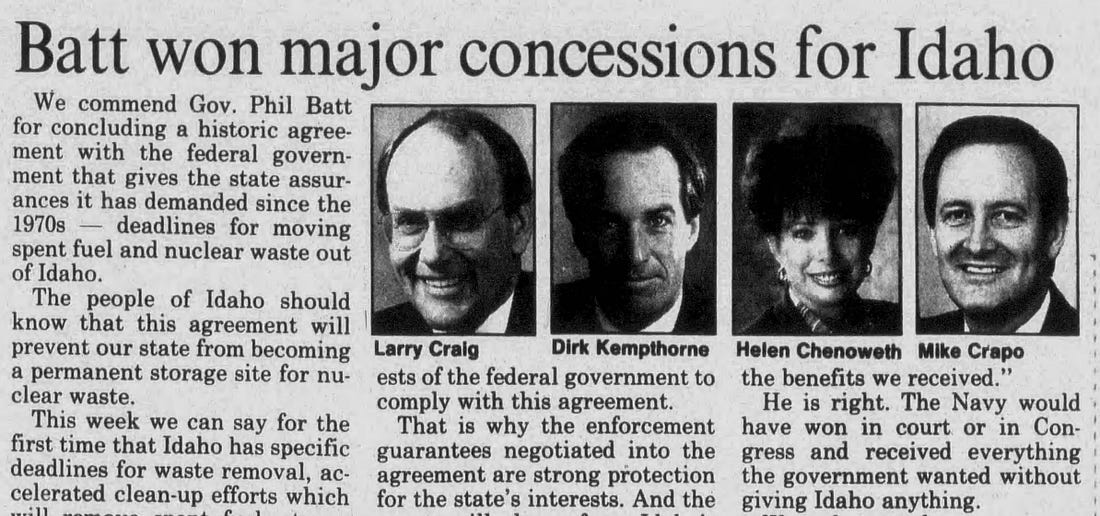 |
In 1995 every major Idaho Republican endorsed then-Governor Phil Batt’s agreement to prevent Idaho from becoming a “permanent site for nuclear waste.” (Idaho Statesman, October 22, 1995)
Now Brad Little’s MOU puts Idaho on the record as ready to not only accept vast amounts of new nuclear waste from across the country but also eager to squander the legal and moral leverage Batt created nearly 40 years ago that could – until Little’s action – have forced DOE to honor decades of commitments to not make Idaho a waste dump.
In the MOU, Idaho also promises to “process all necessary permits and approvals to support the establishment and operation of the NLIC, including utilities such as electricity and water, as allowed by state and federal law.” And to “ensure that state and local regulatory agencies exercise their regulatory authority in a manner that facilitates the establishment and operation of the NLIC, as allowed by state and federal law.”
Since Little appoints the directors of the state agencies he has committed to processing permits, water rights and exercising regulatory authority that last phrase is mere boilerplate. The governor is committing Idaho to doing whatever DOE needs or wants to facilitate its new waste disposal site.
As for the vast economic benefits associated with Idaho, and presumably two other states, agreeing to become waste storage sites the agreement says the MOU “is not a funds obligation document.” The promised economic benefits come with total ambiguity. DOE says to Idaho, as it has since the 1970’s, “trust us,” we’ll work out the details later.
Surely Little and his advisors, including Lt. Governor Scott Bedke and Republican legislative leaders, knew that had they made these commitments in public, with an informed Idaho population knowledgeable about the long-term environmental and legal ramifications, there would have been political hell to pay.
So they have kept their plan on the very low down.
The state’s powerful ruling elites know that a shrunken Idaho press corps and a dispirited political opposition is ill-equipped to shed light on a government operating in the shadows, even when the stakes involve parking more high-level nuclear waste above the Snake River Aquifer, perhaps for a very, very long time.
So far the cynicism about any role for the public in these monumental decisions has been mighty effective, which is why the MOU calls for completion of a “Host Agreement” before September 30.
What you missed in the 2026 Idaho Legislature
The carefully constructed plan quietly bringing Idaho to the brink of nuclear waste importation began to unfold in the late winter in Boise when, largely below the political radar, a state Senate Resolution began to make its way through the overwhelmingly Republican legislature. A resolution is not a law, but rather a statement of policy, a vehicle that normally receives little public attention, and in this case received almost none. Yet the resolution commits the state legislature what Little has now promised the federal government in his recent MOU.
With the tiny Senate Democratic caucus asleep at the wheel or perhaps hoodwinked by Republican Senator David Lent of Idaho Falls, who sponsored the measure, the Senate by unanimous voice vote, passed the resolution on March 4 setting the stage for Little’s recent waste welcoming MOU.
Lent, by the way, is a former INL employee.
The House consideration on March 17, in a minor sense, had some feel of a genuine public policy debate. Boise Democrat Monica Church – granddaughter of former governor Cecil Andrus and former U.S. senator Frank Church – made an impassioned defense of Batt’s agreement and critiqued the folly of Idaho accepting more waste while the waste DOE promised to clean up years ago remains. Church was the only legislator to speak against the resolution.
The debate of the House Republican sponsor of the “bring the waste” measure, Representative Ted Hill of Eagle, resembled a late-night television info commercial. Hill promised that allowing waste storage in exchange for ill-defined economic benefits would mean many Idahoans would get fabulously rich.
“It’s a fantastic opportunity, I drool on this,” Hill said. “I’m not a nuclear engineer … but we could have a billion dollars a year just by storing it.” “I wish I were younger,” Hill gushed, “because there is going to be some billionaires walking around in Idaho soon, whoever leverages into this opportunity.”
You can watch the House debate by linking to the March 17, 2026 recording of that day’s session. The debate begins around the 1 hour, 37 minute mark.
Magical thinking …
This frantic, fantastic scheme of big slogans, unproven technology and unappropriated funding has a Rube Goldberg feel to it, all bells and whistles and devoid of substance.
The whole mess just might – and deserves – to crumble from sheer improbability. But the Idaho Republican Party, from legislature to Congress, has pushed all the state’s chips in on this historic gamble, and without a scintilla of public consideration or any sign of public acceptance.
As my old friend and long-time Idaho journalist Randy Stapilus wrote this week on his Substack:
… if Idaho becomes one of the three “campus” hosts, it will be on the hook for hosting the nation’s nuclear waste. (And we all know how careful the Trump Administration is with handling such sensitive and risky projects.)
They used to say that Idaho is what America was. Today, we might say Idaho isn’t what Idaho was.
Make no mistake Idaho is on the fast track to becoming a massive new nuclear waste storage site. Only a public outcry – as happened in 1995 – will stop this ignorance from changing the state forever.
It’s difficult to be an optimist in today’s world and I’m not all that optimistic, but I do focus on realism and try to populate my writing with solid sourcing and not merely opinion. I write these pieces to offer a perspective based on history and particularly American political history since 1900.
These essays are free, but a financial contribution helps support my writing and research, including a new book in progress.
Subscribe to Marc’s Substack for $8 a month or make a pledge.
Many thanks.
 Subscribe